
3 Car Accident in California: Who Is at Fault?
This article is for informational purposes only and is not to be construed as legal advice. No attorney-client relationship exists based on the review of this this article and none of the information in this article is legal advice.
You may be reading this while your car is still in the shop, your neck is stiff, and two different insurance adjusters have already called. In a 3 car accident, the confusion usually starts before the vehicles stop moving. The front driver says they were pushed. The rear driver says the middle driver stopped short. The middle driver often feels trapped in the worst position of all.
That uncertainty matters because fault in a multi-vehicle crash isn’t always obvious, and in California it often isn’t all-or-nothing. A driver can be partly responsible, mostly responsible, or only minimally responsible. In some cases, the middle car isn’t primarily at fault at all.
Navigating the Aftermath of a 3 Car Accident
A 3 car accident usually leaves people with two problems at once. The first is physical and immediate: pain, shock, transportation, and medical care. The second is legal and financial: who caused the crash, whose insurance applies, and whether someone is trying to pin too much blame on you.
Three-vehicle collisions are harder than ordinary two-car crashes because there are more impact points, more stories, and more opportunities for an insurer to shift responsibility. If you’ve been injured, the practical starting point is understanding that fault may be divided among several drivers rather than assigned to just one.
Many people assume the answer is simple. It often isn’t. The rear driver may have started the chain, but a sudden unsafe lane change, a brake-check allegation, a disabled vehicle in the roadway, or conflicting witness accounts can all change the analysis.
Practical rule: In a 3 car accident, the first version of events isn’t always the final one. Early assumptions often harden into insurance positions unless the evidence says otherwise.
California injury claims also move quickly from the scene to paperwork. Statements to police, vehicle placement, damage patterns, photos, witness names, and medical records can all affect how fault percentages get assigned later. That’s one reason many injured drivers and passengers look for guidance from a California automobile accident attorney early, before the insurance narrative gets set in stone.
The legal issue that gets overlooked most often is proportional fault apportionment. In plain terms, that means one driver may carry most of the blame while two others still share smaller percentages. That matters because your compensation usually depends on reducing any unfair share assigned to you.
Understanding 3 Car Accident Dynamics
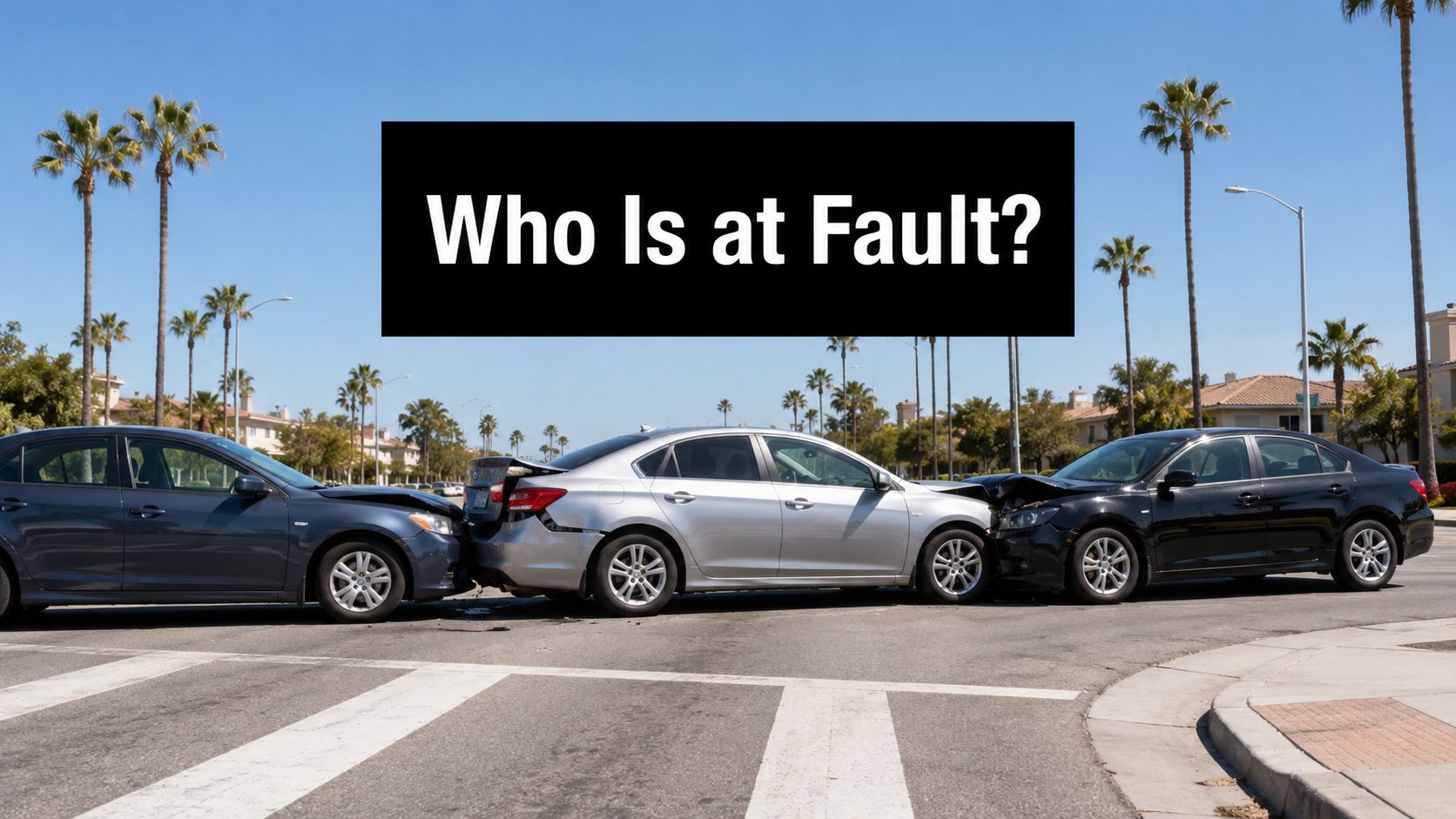
A 3 car accident isn’t one crash. It’s usually a sequence of crashes happening in seconds.

Why the mechanics matter
In a chain collision, one vehicle’s movement changes the path and force on the next vehicle. That seems obvious, but it’s also why fault analysis gets complicated. The vehicle that ends up with front and rear damage may have been negligent, or it may have been struck from behind and propelled forward with no real chance to avoid the second impact.
In a multi-car collision, each vehicle can experience multiple impacts. Because kinetic energy scales with the square of velocity, doubling speed more than doubles collision force.
Common 3 car accident patterns
Some fact patterns appear again and again:
- Rear-end chain reaction: Car C hits Car B, which then hits Car A. This is the most familiar setup, but the middle car may still dispute how much control it had before the second impact.
- Unsafe lane change sequence: One driver moves into another lane without enough space, causing a sideswipe or forced evasive move that pulls a third vehicle into the collision.
- Intersection involvement: One driver enters against a signal or misjudges a turn, striking one vehicle and sending one or both cars into another lane of travel.
- Stationary hazard event: A stopped vehicle, disabled vehicle, or roadside hazard creates a sudden traffic conflict that triggers multiple impacts.
What often triggers these crashes
Speed plays a major role.
That doesn’t mean every speeding case looks dramatic. Sometimes it’s just a driver following too closely at a pace that leaves no stopping distance when traffic compresses. In other cases, speed magnifies the force of an otherwise survivable impact and turns one collision into three.
The damage pattern tells part of the story. The timing between impacts tells the rest.
How California Determines Fault in Multi-Vehicle Crashes
California doesn’t require fault to fall entirely on one person. It uses pure comparative negligence, which means each driver’s responsibility can be assigned as a percentage, and each person’s financial recovery is reduced by their own share of fault.

The starting presumption is not the ending result
That presumption makes sense in many chain-reaction crashes. Drivers are supposed to maintain a safe following distance. But in actual claims, the first assumption often changes after the vehicles are inspected and the sequence is reconstructed.
A middle driver may have little or no realistic chance to avoid hitting the front car if the rear impact launches them forward. A front driver may contribute if they made a sudden unsafe maneuver. A rear driver may remain primarily responsible but not exclusively responsible.
What proportional fault looks like
This is the part most online guides skip. Fault may be split in uneven shares.
For example, a case might settle or be argued as:
| Driver | Fault share | Why |
|---|---|---|
| Rear driver | 60% | Following too closely, late braking |
| Middle driver | 30% | Limited contribution such as stopping pattern or lane position |
| Front driver | 10% | Sudden unsafe movement or other contributing act |
Or the split may look different:
| Driver | Fault share | Why |
|---|---|---|
| Rear driver | 50% | Triggered the chain |
| Middle driver | 40% | Separate driving error before impact |
| Front driver | 10% | Smaller contributing factor |
California fault disputes in multi-car rear-end crashes often turn on damage patterns and paint transfer, and fault can be split among several drivers.
Why the middle driver is often misunderstood
People in the middle vehicle usually hear some version of, “You hit the car in front, so you’re at fault too.” Sometimes that’s true. Sometimes it’s lazy analysis.
A key question is whether the middle driver caused a separate impact through negligent driving, or whether the rear strike forced the vehicle forward before the driver could react. That difference can shift a claim from major exposure to limited exposure.
California’s comparative negligence rule is forgiving in one important sense. Even if you’re assigned a large share of responsibility, recovery isn’t automatically barred. Under California’s pure comparative negligence framework, an injured person can still recover damages reduced by their own percentage of fault, including examples where a claimant found 20% at fault recovers 80%, or a claimant found 70% at fault recovers 30% under the discussion of California comparative negligence law.
Evidence that changes the percentages
Insurers and lawyers usually focus on a short list of proof:
- Vehicle damage location: Front-only, rear-only, crush depth, and offset damage can show sequence.
- Paint transfer and debris fields: These details often help identify which contact happened first.
- Dashcam or surveillance footage: Video can resolve disputes that photos alone can’t.
- Witness accounts: Independent witnesses often matter more than the drivers’ own statements.
- Road position and skid evidence: These details can support or weaken a sudden-stop defense.
Critical Steps to Take After a 3 Car Accident
The first minutes after a crash affect both your health and your claim. In a 3 car accident, there are more drivers, more damaged areas, and more ways for evidence to disappear.
A basic legal duty comes first. California law requires drivers to stop at the scene of an accident, and failure to stop can lead to penalties and hurt later liability arguments.

What to do at the scene
- Get to safety if you can. If the vehicles can move and it’s safe to do so, reduce the risk of a secondary impact. If anyone may be injured, call 911.
- Check yourself before you start talking. Adrenaline hides symptoms. Neck pain, headache, numbness, and dizziness often show up after the first rush wears off.
- Exchange information with every driver, not just one. In a three-car collision, missing one policy number or plate can slow the claim later.
- Photograph all sides of all vehicles. Don’t just capture your own bumper. Get wide shots, lane markings, skid marks, debris, intersection controls, and vehicle resting positions.
- Find witnesses quickly. People leave fast. If someone saw the impact sequence, get their name and contact information before traffic clears.
- Report facts, not conclusions. Tell police what you saw and felt, but don’t guess about speed, distance, or fault if you’re not sure.
Say less than you think you need to. A rushed apology or guess about what happened can be treated as an admission later.
What usually helps and what usually hurts
A short comparison makes this easier:
| Helps your claim | Hurts your claim |
|---|---|
| Photos of every vehicle involved | Only photographing your own car |
| Names of independent witnesses | Assuming the police report will capture everything |
| Prompt medical evaluation | Waiting days while telling insurers you’re “fine” |
| Careful factual statements | Admitting fault to be polite or calm people down |
| Keeping records organized | Relying on memory later |
Video can also help you think through the immediate steps after a crash:
Navigating Multiple Insurance Claims
A 3 car accident can produce three separate narratives and several competing insurance positions. That changes the claims process immediately. You’re not just proving injury. You’re also protecting yourself against blame-shifting between carriers.
Who you may hear from
You should expect contact from:
- Your own insurer: Most policies require prompt notice. Give basic facts and confirm the claim number.
- The other drivers’ insurers: They often want recorded statements early, before the full injury picture is clear.
- Property damage adjusters: These representatives may focus on repair issues and say little about bodily injury exposure.
- Subrogation departments: If your carrier pays first, it may later pursue reimbursement from another insurer.
The practical mistake I see most often is inconsistency. A driver gives one version to their own carrier, a shorter version to another carrier, and a more detailed version to the police. Adjusters compare all of it.
Coverage limits can become a real problem
That matters because multi-vehicle crashes can exhaust available coverage quickly. If multiple people are hurt, claimants may be competing for the same limited policy proceeds. That’s when uninsured or underinsured motorist coverage on your own policy may become important, if it exists.
Practical rules for dealing with adjusters
- Report promptly, but stay concise: Give the date, location, vehicles involved, and that treatment is ongoing.
- Don’t speculate about percentages: Fault allocation belongs at the end of the investigation, not in your first phone call.
- Read medical authorizations carefully: Broad releases can give an insurer access to more history than the claim requires.
- Track every contact: Keep a log of who called, from which company, and what they asked for.
- Push back on artificial urgency: Early settlement pressure often comes before the injury picture is fully documented.
If one insurer says another driver is mostly responsible, that doesn’t mean your own exposure disappears. In multi-car cases, carriers often argue over degrees of fault while still trying to discount your injuries.
Common Injuries and Damages in Multi-Vehicle Collisions
Three-vehicle crashes often create injuries that don’t look serious at the scene but become disruptive over days and weeks. Sudden forward-and-back motion can injure the neck, back, shoulders, jaw, and head. A second impact can worsen the first one, especially when a vehicle is hit from behind and then pushed into another object.

Common injury patterns
Typical complaints in a 3 car accident include:
- Whiplash and soft-tissue strain: Often dismissed early, but these cases can become stubborn and painful.
- Concussion symptoms: Headache, light sensitivity, dizziness, concentration problems, and nausea matter even if imaging is normal.
- Back injuries: Lumbar and thoracic pain may involve disc aggravation, muscle spasm, or nerve symptoms.
- Fractures and joint injuries: Wrists, ribs, knees, and shoulders are common depending on bracing and impact angles.
For some people, conservative care becomes part of the recovery plan. If you’re exploring treatment options, resources on chiropractic care for car accident injuries can help you understand how musculoskeletal symptoms are commonly addressed alongside broader medical evaluation.
The two broad damage categories
A claim usually includes economic damages and non-economic damages.
| Damage type | What it includes |
|---|---|
| Economic damages | Medical bills, future care, lost income, loss of earning capacity, property damage, out-of-pocket costs |
| Non-economic damages | Pain, suffering, emotional distress, inconvenience, and loss of normal daily function |
A low repair estimate doesn’t mean a low injury claim. Vehicle damage and human injury don’t move in lockstep.
The financial stakes are real on a national level. The U.S. Department of Transportation estimates the annual economic cost of all motor vehicle crashes at approximately $340 billion, reflecting the broad impact on individuals and families, according to the National Safety Council’s summary of motor vehicle crash costs and deaths.
In more serious cases involving long-term disability, surgery, or permanent impairment, the legal analysis often moves beyond ordinary injury valuation into issues associated with catastrophic injury claims.
Why You Need an Attorney for a 3 Car Accident Claim
A straightforward rear-end claim can sometimes be handled without much conflict. A 3 car accident usually isn’t that kind of case.
Signs the claim is already getting complicated
You should take the legal side seriously when any of these appear:
- Fault is disputed: One adjuster blames the middle car, another blames the rear car, and the police report isn’t definitive.
- You were in the middle vehicle: That position often attracts blame even when the physics don’t support it.
- There are multiple injuries: More claimants usually means more pressure on available insurance.
- You were a passenger: Passengers are often clearly innocent, but insurers still fight over which policy pays first.
- An early offer arrives fast: Quick money usually means the carrier wants closure before the full claim value is documented.
What a lawyer actually does in these cases
A good attorney doesn’t just “deal with insurance.” In a multi-vehicle crash, counsel should pin down sequence, preserve proof, and challenge inflated fault percentages. That may involve reviewing damage patterns, tracking down camera footage, organizing witness accounts, and presenting a coherent theory of how the impacts happened.
In practice, that means your lawyer’s job is often to reduce the percentage wrongly assigned to you.
Timing matters more than people think
The best time to get legal advice is usually before recorded statements multiply and before evidence disappears. That’s especially true if there are inconsistent stories, serious injuries, or questions about which insurer should pay.
If you need help understanding your rights after a 3 car accident, it’s reasonable to speak with a California personal injury lawyer who can review the facts, identify the likely fault issues, and explain what a fair claim strategy looks like. Para obtener recursos en español y una consulta gratuita, llámenos hoy.
If you were hurt in a multi-vehicle crash and need clear guidance on fault, insurance, and next steps, LA Law Group, APLC offers free initial consultations to review the facts, explain your options, and help you pursue compensation under California law.
Attorney Advertising. This article is general information, not legal advice, and does not create an attorney-client relationship. Prior results do not guarantee a similar outcome.