
Accident in Rental Car: Your 2026 California Guide
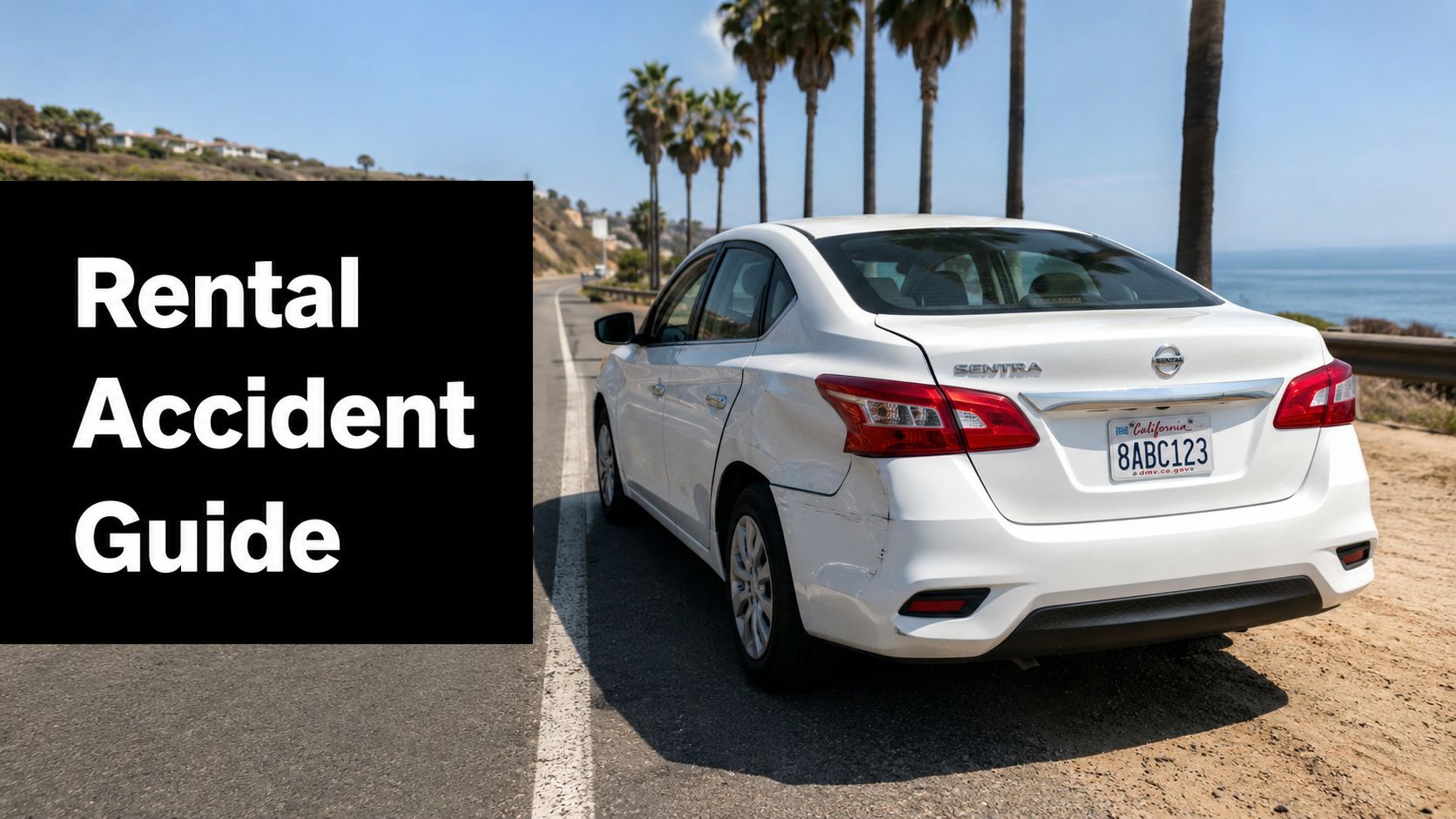
You’re out of town, your suitcase is in the trunk, and you’re thinking about dinner or your next meeting. Then traffic stops, brakes lock, and now you’re standing beside a damaged rental car trying to answer three questions at once: Is anyone hurt, who do I call, and who’s going to pay for this?
An accident in a rental car feels more complicated than a crash in your own vehicle because it usually involves more people, more contracts, and more insurance layers. You may have your own auto carrier, the other driver’s insurer, a rental company, a credit card benefit administrator, and California reporting rules all moving on different timelines. That confusion is where people make expensive mistakes.
This article is for informational purposes and not to be construed as legal advice. No attorney client relationship exists based on the review of this this article and none of the information in this article is legal advice.
What Happens When Your Rental Car Trip Ends in an Accident
A rental car crash usually begins with ordinary facts. You’re driving a Toyota Camry from the airport. You miss a blind turn in an unfamiliar area. Or another driver cuts across your lane. In a few seconds, a simple trip turns into a problem involving injuries, photos, police, a rental counter contract you barely read, and insurance terms like LDW, liability coverage, and subrogation.
Rental car crashes are common for a simple reason. People drive unfamiliar cars in unfamiliar neighborhoods, often while traveling, tired, or distracted by navigation.
Why rental crashes feel different
The first issue is practical. The car isn’t yours, so you can’t just call your insurer and wait. The rental company has its own reporting requirements, vehicle return instructions, and damage procedures.
The second issue is financial. A rental crash can trigger multiple buckets of exposure:
- Injury claims from drivers, passengers, or pedestrians
- Property damage claims for the vehicles involved
- Rental company charges tied to damage to its vehicle
- Coverage disputes over which policy pays first
Practical rule: Treat the rental agreement like part of the accident file. It often controls what the company expects from you in the first hours after the crash.
The goal in the first day
The right approach is simple even if the details aren’t. Protect health first. Preserve evidence second. Report the crash correctly. Then sort out coverage without guessing.
If you’re in California, it also helps to think in state-specific terms from the start. California uses a fault-based system, and the state has its own reporting requirement through Form SR-1 when certain conditions are met. That means roadside decisions matter, but so do the administrative steps you take after you leave the scene.
Many people worry most about the wrong thing. They focus on whether they bought the rental company’s waiver, when the immediate priority is building a clean factual record. The waiver matters. Your personal policy matters. Credit card coverage may matter. But if you fail to document the scene, report properly, or seek medical care when you’re hurt, you make every later step harder.
Your First Moves at the Accident Scene
Start with safety, not paperwork. A calm checklist helps when adrenaline is high and everyone around you is talking at once.
Protect people before property
If anyone may be hurt, call 911. If the vehicles can be moved safely, get out of active traffic. If they can’t, stay where it’s safest and wait for help.

A few roadside habits consistently help:
- Check for injuries first. Minor pain can become obvious only after the initial shock fades.
- Move only if it’s safe. Don’t create a second collision by stepping into traffic.
- Call law enforcement. A report often becomes an anchor for later insurance discussions.
- Keep your statements factual. Tell officers what happened. Don’t guess about speed, blame, or what someone else intended.
- Do not leave the scene. That creates a different legal problem immediately.
Build your evidence file on your phone
Your phone is your fastest documentation tool. Use it before the cars are moved, if you can do so safely.
Photograph these items:
- All vehicles involved and the damage from multiple angles
- License plates and identifying features
- Street signs, signals, lane markings, and skid marks
- The wider roadway view so the layout is clear later
- The rental car interior, especially if warning lights appeared
Then collect the basic exchange information:
- Other driver’s name and contact details
- Driver’s license information
- Insurance carrier and policy details
- Witness names and phone numbers
What not to say
The most common mistake is conversational, not legal. People say “I’m sorry” reflexively. They speculate. They try to be helpful by filling in gaps.
Don’t do that.
Fault isn’t decided on the shoulder of the road. It’s decided later, after reports, statements, vehicle damage, and insurance review.
That doesn’t mean being cold or difficult. It means being accurate. “The light turned yellow and we collided” is better than “I think I may have misjudged it.”
Find the rental agreement
Before you leave the scene, or as soon as things are stable, locate the rental agreement. It may be in the glove compartment, your email, or the rental company app. You’ll likely need the contract number, vehicle details, and the company’s emergency reporting number within the next hour.
If you’re a Spanish-speaking driver helping a family member after an accident in rental car confusion, keep the first priorities simple: seguridad, fotos, intercambio de información, policía, y contrato de renta.
Reporting the Accident to the Right Parties
Once the immediate danger passes, the reporting phase begins. This part feels bureaucratic, but it directly affects coverage and your ability to defend yourself later.

Call the rental company promptly
Your first post-scene call should usually be to the rental company. Most major companies place a claims or roadside number on the key tag, windshield sticker, app, or rental paperwork. Follow their instructions about towing, replacement vehicles, and where the damaged car should go.
Keep the report factual. Give the date, time, location, parties involved, and whether police responded. If they ask for a written incident report, complete it carefully and keep a copy.
Businesses that manage multiple vehicles use structured protocols for a reason. If you want a useful outside explanation of how organizations document crashes, understanding fleet incident reporting gives a practical look at why prompt, consistent reporting matters.
Notify your own insurance carrier
Even if you bought the rental company’s waiver, report the crash to your own insurer. Your policy may provide liability coverage, collision-related protection for a temporary substitute vehicle, or other benefits that become relevant only after the facts develop.
If you also need a practical overview of making a police report and why it matters, this guide on reporting an accident to the police is worth reading before you give a casual summary that leaves out important details.
California Form SR-1 is not optional when it applies
California adds a step many drivers miss. Every involved driver must complete and submit a DMV accident report, Form SR-1, within 10 days if the crash causes any injury or over $1,000 in damage, regardless of fault.
That requirement applies even if police came to the scene. A police report does not replace the DMV filing.
Here’s a simple way to approach it:
| Report | Who gets it | Why it matters |
|---|---|---|
| Police report | Law enforcement | Creates an official incident record |
| Rental company notice | Rental company | Complies with your contract |
| Insurance claim notice | Your insurer | Preserves available coverage |
| Form SR-1 | California DMV | Satisfies a legal reporting duty |
A short explainer can help if you prefer video:
The practical lesson is simple. Report early, report consistently, and keep copies of everything you submit.
Untangling the Rental Car Insurance Web
Here is a common point of confusion. Many assume one policy covers everything, or they assume rental counter products are identical to insurance. Usually, neither is true.
Think of coverage after an accident in rental car cases as a waterfall. You start at the top with the contract protections you bought at the counter, then move through your own auto policy, then any credit card benefit that applies, and finally the at-fault driver’s liability coverage if someone else caused the crash.
Start with the rental company products
If you bought LDW or CDW, you likely bought a contractual waiver, not traditional liability insurance. In plain terms, the company may waive its right to pursue you for damage to the rental vehicle, subject to the terms of the agreement.
That can be useful. It can also create false confidence if you think it covers every consequence of the crash. It typically addresses the rental vehicle itself, not every injury or liability claim arising from the collision.
Then check your personal auto policy and credit card benefits
Many drivers have coverage through their own auto insurer that extends to a rental vehicle. That often matters most for liability if you caused injuries or damage. It may also matter for physical damage, depending on your policy terms.
Credit card coverage is different. Some premium cards offer rental car benefits, but those benefits are often limited and can be secondary. They also tend to have strict notice and documentation rules.
For Spanish-speaking readers, the cleanest summary is this: Primero, el seguro del alquiler (LDW/CDW). Segundo, su seguro de auto personal. Tercero, el seguro de su tarjeta de crédito. Cuarto, el seguro del otro conductor si tuvo la culpa.
The biggest mistake I see is not lack of insurance. It’s lack of clarity about which coverage applies to which loss.
Why California minimums don’t answer the whole problem
California requires minimum liability coverage, but minimums aren’t the same as adequate protection. California’s minimum liability insurance requirements are $30,000 for bodily injury per person, $60,000 per accident, and $15,000 for property damage.
That matters because a moderate crash can involve several separate expenses at once:
- Medical bills for more than one person
- Repairs or total loss issues involving multiple vehicles
- Rental-related charges
- Uninsured or underinsured exposure
If you’re sorting out your own policy language, it also helps to understand uninsured motorist coverage because a rental crash can expose the same gap you’d face in your own car when the other driver has too little insurance or none at all.
What works and what doesn’t
What works is reading each layer separately. Rental contract. Personal auto declarations page. Credit card benefit guide. Claim correspondence.
What doesn’t work is telling each company, “Someone else should handle this.” Coverage disputes often drag out when nobody builds the complete picture early.
Who Pays for What in a California Rental Accident
California follows a fault-based system. That means liability usually tracks the driver who caused the collision, not the owner of the car just because it was involved.

If the other driver caused the crash
When another driver is at fault, their liability insurance should be the starting point for:
- Damage to the rental vehicle
- Your medical expenses
- Other compensable losses tied to the collision
- Transportation-related substitute costs where appropriate
The rental company may pursue the property damage side directly. At the same time, you may have your own bodily injury claim if you were hurt.
If you caused the crash
If you’re at fault, the financial picture shifts quickly. Your applicable liability coverage may need to respond to injuries and property damage suffered by others. For the rental vehicle itself, the answer depends on whether you bought LDW/CDW, whether your own policy extends physical damage coverage, and whether a credit card benefit applies.
Rental companies may also assert additional charges related to the vehicle being unavailable during repair. Drivers are often surprised by that because they think only repair cost matters.
A rental collision is rarely a one-invoice problem. It often becomes a package of separate claims moving on separate tracks.
A practical damage breakdown
Here is the clearest way to separate the issues:
| Type of loss | Typical payer if other driver is at fault | Typical payer if you are at fault |
|---|---|---|
| Other party’s injuries | Their claim against at-fault driver | Your liability coverage |
| Other party’s car damage | Their claim against at-fault driver | Your property damage liability |
| Rental car damage | At-fault driver’s insurer, directly or indirectly | LDW/CDW, your policy, or card benefit depending on terms |
| Your injuries | Claim against at-fault driver | Your own available first-party protections, if any |
For readers trying to understand how vehicle damage claims can balloon from seemingly minor parts, even a basic component can carry labor and parts complications. This overview of T1A Auto handle replacement details is a good reminder that visible damage may be only part of the estimate.
And when one insurer pays then seeks reimbursement from another, you may see a demand or notice tied to subrogation. That process is common in rental claims and often confuses people who think the case was already over.
When You Need a Personal Injury Attorney
Some rental car crashes are manageable without counsel. A scraped bumper, no injuries, clear fault, and cooperative insurers may stay in the claims lane. But once injuries, disputed liability, or layered coverage issues appear, the case changes.
Signs the case has moved beyond routine
You should seriously consider speaking with a personal injury attorney if:
- You were injured and symptoms developed after the crash
- Fault is disputed and each driver tells a different story
- The rental company is demanding payment before the insurance picture is clear
- A carrier is delaying, denying, or redirecting responsibility
- Several policies may apply and nobody is coordinating them correctly
An attorney’s job in these cases isn’t only filing a lawsuit. Often it’s much more practical. Preserve evidence. Analyze policy language. Stop bad statements from hardening into bad claim positions. Push each insurer to state its coverage position clearly.
The rental company isn’t automatically liable
This point matters. Many people assume the rental company must be responsible because it owns the vehicle. Federal law narrows that path.
The federal Graves Amendment generally protects rental companies from being held liable just for owning the vehicle.
That distinction changes case strategy. If the company merely owned the car, that usually isn’t enough. But if the company failed to maintain the vehicle, ignored a safety problem, or rented to someone it should not have trusted with a car, the legal analysis is different.
What legal counsel can actually improve
A good lawyer won’t make facts appear that don’t exist. What counsel can do is prevent avoidable damage to your case.
That includes:
- Organizing medical records so injury claims aren’t dismissed as vague
- Reviewing the rental contract for waiver terms and reporting duties
- Identifying all available insurance layers
- Challenging weak denials based on incomplete investigation
- Evaluating direct-negligence claims when the rental company’s conduct contributed
If you’re hurt, the costliest mistake is waiting until every insurer has taken a position against you before getting legal advice.
For Spanish-speaking families, this matters even more when relatives are translating on the fly after a crash. A misunderstanding about coverage, fault, or paperwork can create a problem that has nothing to do with what really happened on the road.
If you were injured in an accident in a rental car and need California-specific guidance, LA Law Group, APLC offers free initial consultations and a hands-on approach focused on protecting your rights and financial interests. The firm serves clients across California with direct communication, practical case assessment, and support in English and for Spanish-speaking individuals who need clear answers after a crash.
Attorney Advertising. This article is general information, not legal advice, and does not create an attorney-client relationship. Prior results do not guarantee a similar outcome.