
When people search for the best personal injury lawyer Long Beach residents and visitors can trust, they usually need clear deadlines, fault rules, and a practical way to evaluate counsel, not slogans. In California, many injury claims face a roughly two-year filing window under Code of Civil Procedure §335.1, and California’s pure comparative negligence doctrine can still allow a claim even when you share some fault. This guide explains how to assess a personal injury lawyer for Long Beach matters, what stages a claim typically follows, how port and trucking injuries and soft-tissue denial myths fit in, and how LA Law Group can help you understand your options.
Attorney Advertising. “Best” in this title reflects common search language and the evaluation criteria below, not a comparative ranking, award, or guarantee of results. Prior results do not guarantee a similar outcome.
What does “best” mean when you search for a personal injury lawyer in Long Beach?
“Best” in a search query is a shorthand for fit and process, not a trophy, ranking, or award. This page is not a ranking and LA Law Group does not guarantee outcomes. No case results or ranks are cited in this article. This checklist can help when evaluating any California personal injury lawyer (including us):
- Case-type fit: Relevant experience with the type of injury claim involved (auto, premises, rideshare-related, trucking or commercial vehicle, multi-party, or other negligence facts), not a one-size pitch.
- Communication / language: Clear updates in a language you understand (LA Law Group offers English, Spanish, and Farsi).
- Fee clarity: Is the fee agreement in writing, and does it say plainly when an attorney fee is owed and who pays case costs?
- California license: Counsel must be licensed to practice in California for California injury matters.
- Conflicts: Early screening for conflicts of interest with other parties or insurers involved in your facts.
- Investigation: A concrete plan for evidence (scene photos, witnesses, reports, medical chronology, coverage mapping), especially important in multi-party, port-corridor, or commercial truck crashes.
- Trial readiness: Willingness and capacity to litigate if negotiation does not produce a fair resolution, without promising a trial result.
It is worth treating phrases like best personal injury lawyer Long Beach as a prompt for these criteria. It is worth preferring honesty about uncertainty over unsubstantiated rankings, invented settlement figures, or guaranteed wins. Directory listings often dominate local “best lawyer” results. A city-specific evaluation page and clear FAQ help you compare process quality, not listing volume.
Practical rule: After a crash, fall, or commercial-vehicle incident near the Port of Long Beach, downtown Long Beach, Ocean Boulevard, Pine Avenue, or the I-710 / I-405 / SR-91 connectors, it is worth preserving scene evidence in the first 48 hours when it is safe to do so. Harbor trucking density and freeway traffic can make witnesses and camera footage harder to locate.
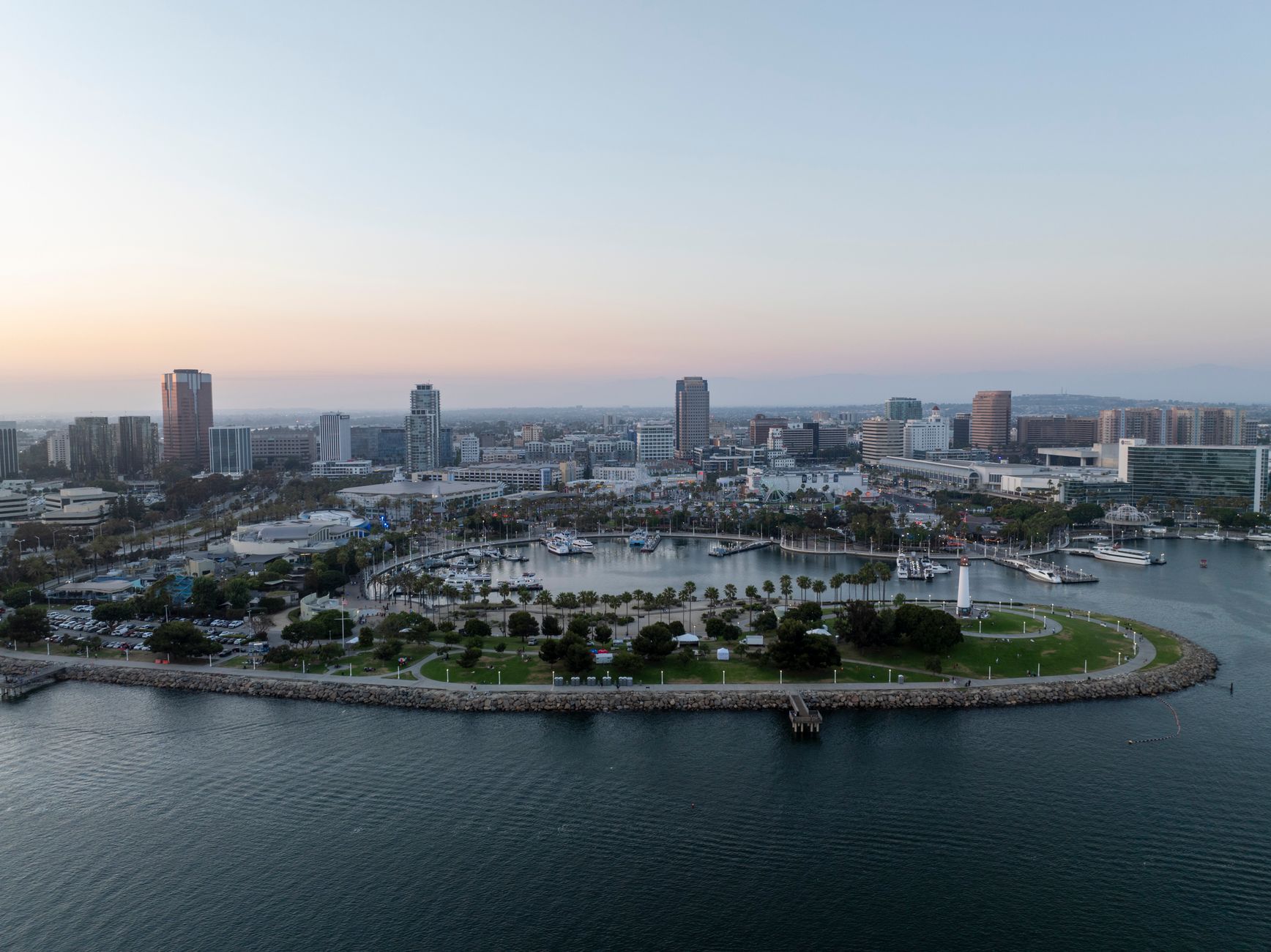
Long Beach sits along the South Bay waterfront, with dense movement around the Port of Long Beach and harbor trucking corridors, downtown Long Beach, Ocean Boulevard, Pine Avenue, and the I-710, I-405, and SR-91 connectors. Port freight, downtown shopping and office traffic, beachfront tourism, and freeway commuting mean collisions and premises incidents can involve passenger drivers, commercial trucks, rideshare drivers, property owners, employers, and multiple insurers. Nearby care is commonly associated with MemorialCare Long Beach Medical Center (a common local association, not a claim about any patient’s route). Knowing who acts and who may pay matters as much as which attorney to call.
Why do Long Beach injury claims feel different from other LA cities?
Long Beach mixes a major port and harbor trucking network with downtown commercial streets, Ocean Boulevard beachfront traffic, residential corridors, and freeway connectors that feed the rest of Los Angeles County. Commuters, port-related trucks, delivery vehicles, rideshare drivers, shoppers, and visitors share those routes. That mix can create multi-party fact patterns: rear-end crashes in stop-and-go downtown or Ocean Boulevard traffic, commercial-vehicle collisions along harbor approaches or I-710, premises disputes near Pine Avenue commercial blocks, or interchange crashes near I-405 / SR-91 with overlapping policies.
None of that requires invented crash rates. Local context matters: arterial congestion, port and trucking activity as context only, downtown and beachfront tourism surges as context only, nearby hospital routes, and evidence that can be harder to obtain later, especially in the first 48 hours.
LA Law Group is based in Chatsworth and serves Long Beach, the South Bay, and California statewide. The firm communicates in English, Spanish, and Farsi. No attorney can guarantee an outcome.
Related reading: our personal injury practice area, how personal injury lawyers get paid, and how to choose a car accident lawyer.
Soft-tissue denial myths in Long Beach (educational)
People often hear fixed stories: “if imaging is normal, the injury is fake,” “pain that starts two days later never counts,” “soft-tissue claims always settle for nuisance money,” or “downtown and freeway cases always wrap in 90 days.” Those are myths.
- Normal imaging does not erase symptoms. Soft-tissue injuries may not show dramatic findings on every scan. Insurers still argue “no objective injury.” That is an adjuster position, not a medical or legal verdict by itself.
- Delayed onset is common and disputed. Neck, back, and shoulder pain can intensify after the adrenaline of a crash fades. Waiting a day or two for care can fuel insurer skepticism, but it does not automatically bar a claim under California law.
- Soft-tissue labels are not a damages floor or ceiling. The phrase “soft tissue” describes tissue type, not a fixed settlement chart. Documented treatment, work limits, and functional impact still matter.
- Settlement speed is not guaranteed. Investigations, medical course, policy limits, and disputed liability control pace, not downtown calendars or freeway myth timelines.
- Filing deadlines are not case duration. CCP §335.1 often gives roughly two years to file many injury suits. That is not a promise of a two-year resolution, and some government-claim deadlines are much shorter.
It is worth asking counsel to explain stages and uncertainty, and preferring firms that refuse to invent a calendar or a soft-tissue “standard offer.”
What should you do after a port or trucking injury in Long Beach?
Crashes involving commercial trucks near the Port of Long Beach, harbor approaches, downtown connectors, Ocean Boulevard, Pine Avenue, or the I-710 / I-405 / SR-91 network can involve multiple companies and insurance layers. A tractor, trailer, shipper, broker, owner-operator, and passenger vehicle may all appear in the fact pattern. Harbor and freeway scenes can change over time. Educational steps (not a plan for your case):
- It is worth getting medical care and documenting injuries even if they seem minor at first. Soft-tissue symptoms can intensify after the first day.
- If it is safe, note truck markings: company name, USDOT or MC number, trailer number, and license plate.
- It is worth photographing the wider scene when safe: skid marks, debris fields, lane configuration, and any nearby cameras along harbor roads or freeway approaches.
- It is worth preserving dashcam clips and witness contacts. Port and connector traffic can make witnesses harder to reach later.
- It is worth avoiding recorded statements to opposing insurers until you understand your rights. Commercial carriers often move early on liability narratives.
- It is worth asking counsel how commercial auto liability, excess or umbrella policies, employer responsibility theories, and your own UM/UIM coverage may apply to your facts, without expecting a guaranteed result.
Shared-fault arguments are common in truck and multi-vehicle matters (lane changes, sudden stops, following distance, visibility near containers or merges). California’s pure comparative negligence rule can reduce damages by a fault percentage without automatically barring a claim. That is a doctrine, not a prediction for your facts.
Related reading: how to choose a car accident lawyer and what to do after an Uber accident for multi-payor thinking that can also appear in commercial settings.
What are the typical stages of a Long Beach personal injury claim?
Every case is unique. The table below is a general educational map, not a required checklist for your matter.
| Stage | What generally happens | Why it matters in Long Beach context |
|---|---|---|
| Immediate aftermath (first 48 hours) | Medical care, safety, basic incident documentation | Port / downtown / Ocean Blvd / I-710 scenes can change over time, and records can be harder to obtain later; photos and witness contacts can be harder to gather later |
| Early investigation | Photos, witness info, police/incident reports, preserving evidence | Harbor corridors, downtown blocks, and freeway connectors may have cameras that overwrite footage |
| Treatment and documentation | Following medical advice; keeping records of bills and limitations | Soft-tissue claims are often disputed; consistent records help tell the medical story |
| Insurance notice and claims | Notifying relevant carriers; it is worth seeking advice before giving recorded statements | Multiple policies (auto, commercial trucking, rideshare period coverage, premises, UM/UIM) may apply |
| Negotiation | Demand package, liability and damages discussion | Comparative fault and soft-tissue skepticism often appear here, especially after truck or stop-and-go crashes |
| Litigation (if needed) | Complaint filing, discovery, motions, possible trial or ADR | CCP §335.1 timing can control whether court remains an option; calendars are not guaranteed |
Who typically acts, and who may pay, after an injury?
| Role | Who often acts | Who may pay (depending on facts) |
|---|---|---|
| Injured person | Seeks care, documents losses, and may consult counsel | N/A (may have health insurance / Med-Pay that seeks reimbursement) |
| At-fault driver / owner | Reports to insurer; may contest liability | Liability auto insurance; excess / umbrella if applicable |
| Commercial trucking company / carrier | May investigate through safety or claims staff | Commercial auto liability; excess / umbrella when facts and policies apply |
| Rideshare platform / driver policies | May respond based on trip stage | Period-based rideshare coverage when facts trigger it |
| Property owner / manager | Investigates premises claims | Commercial general liability or homeowners policies |
| Insurers | Adjusters evaluate liability and damages | Policy limits and coverage defenses control available funds |
| Attorneys | Investigate, negotiate, litigate if needed | No attorney fee unless we win your case. You are responsible for case costs regardless of the outcome. |
This table is illustrative only. Coverage depends on policy language, fault allocation, and available limits.
Hypothetical: disputed soft-tissue claim after an I-710 corridor crash (illustrative only)
Illustrative hypothetical, not a case result: This example uses invented numbers. It does not describe a real client and does not predict any outcome. A Long Beach commuter is rear-ended near an I-710 connector approach used by harbor-bound trucks and passenger traffic. They seek care within three days for neck and lower-back pain after initially feeling “just shaken up.” Documented medical bills total about $8,400 in the first three months, with ongoing soft-tissue care and no surgery. An adjuster argues the driver “waited too long,” that imaging was “essentially normal,” and that soft-tissue injuries do not justify a serious claim. For arithmetic only, assume a fact-finder assigned 20% fault to the injured driver and 80% to the rear-ending vehicle, and that total proven damages equaled the documented medical bills of $8,400. Under California’s pure comparative negligence rules, damages are reduced by the share of fault assigned to the injured person: 20% of $8,400 is $1,680, which leaves $6,720, before considering policy limits, liens, or other case-specific adjustments. Shared fault, delayed onset, or soft-tissue labels alone would not automatically bar a claim. Timing would still depend on medical course, liability proof, coverage layers (including any commercial policy if a truck was involved), and insurer response. CCP §335.1 and any insurance notice rules would still need attention. This scenario is educational only; real outcomes turn on specific evidence and law.
What damages may be discussed in a California personal injury matter?
Depending on proof, discussions may include:
- Economic losses: medical expenses, future care, lost wages, reduced earning capacity, property damage.
- Non-economic losses: pain, suffering, emotional distress, loss of enjoyment of life (subject to statutory limits in certain medical malpractice contexts, not this overview’s focus).
- Other issues: liens, Med-Pay, health-insurance reimbursement, and UM/UIM coverage.
No article lists every category for your facts. A consultation can map claim theories without guaranteeing results.
How do California deadlines and fault rules shape strategy?
Two doctrines come up constantly in Long Beach injury discussions:
Code of Civil Procedure §335.1 (about two years)
Many personal injury lawsuits in California must be filed within approximately two years of the date of injury. Exceptions, tolling theories, and shorter government-claim deadlines can change the calendar. Time can affect both the evidence available and, in some situations, the right to sue. More detail is in our statute of limitations guide.
Pure comparative negligence
California follows pure comparative negligence: your damages can be reduced by your percentage of fault, but you are not automatically barred from making a claim merely because you share blame. Insurers often argue shared fault early, especially in stop-and-go downtown or Ocean Boulevard traffic, merges near harbor trucking corridors, pedestrian crossings near Pine Avenue, or disputed lane-change cases near I-710 / I-405 / SR-91. Understanding the doctrine helps you evaluate whether an adjuster’s first offer fairly accounts for liability disputes. Related guide: what pure comparative negligence means.
How fees and case costs work at LA Law Group
No attorney fee unless we win your case. You are responsible for case costs regardless of the outcome.
All fee and cost terms are set out in a written fee agreement before work begins. Aryan Amid, Esq., the firm’s founding attorney, and the team can walk through that agreement line by line.
Your initial consultation is free.
What questions should you ask in an initial consultation?
It is worth bringing a short timeline, photos if safe, insurance info (including commercial truck identifiers or rideshare details if relevant), and a provider list. Helpful questions include:
- Who handles day-to-day communication?
- How do you investigate Port of Long Beach crashes, downtown or Ocean Boulevard incidents, I-710 / I-405 / SR-91 collisions, or commercial trucking injuries?
- How do you approach comparative fault and soft-tissue denial myths?
- What should I believe, and ignore, about “how long Long Beach cases take”?
- How are fee and case-cost terms documented in the written agreement?
- Can we communicate in Spanish or Farsi if needed?
Call (866) 625-2529. More information is on our personal injury practice page.
Key takeaways
- Searching for the “best personal injury lawyer Long Beach” is a starting point for evaluation, not a ranking of any firm.
- Many California injury suits face a roughly two-year clock under CCP §335.1. Government claims can be shorter.
- Pure comparative negligence can reduce damages, but does not automatically bar a claim, when fault is shared.
- Long Beach claims often involve the Port of Long Beach, harbor trucking corridors, downtown, Ocean Boulevard, Pine Avenue, I-710 / I-405 / SR-91, and multi-payor patterns. The first 48 hours matter for evidence.
- Soft-tissue denial myths (normal imaging equals no injury, delayed onset never counts, fixed settlement dates, invented dollar floors) are unreliable. It is worth asking about stages instead.
- Port and trucking injuries may involve commercial fleets, owner-operators, and stacked policies. It is worth preserving truck identifiers and scene data early.
- LA Law Group (Chatsworth base) serves Long Beach, the South Bay, and California clients statewide, with English / Spanish / Farsi communication, without outcome guarantees.
- No attorney fee unless we win your case. You are responsible for case costs regardless of the outcome.
Checklist: preparing to speak with counsel (general information)
- It is worth seeking appropriate medical care and keeping records (especially within the first 48 hours when possible)
- It is worth preserving photos, dashcam clips, and witness contacts when safe and lawful
- It is worth noting the date, time, and location (e.g., Port of Long Beach, downtown, Ocean Blvd, Pine Ave, I-710, I-405, or SR-91)
- For trucking / port incidents: it is worth saving company names, USDOT or MC numbers, trailer IDs, and any carrier paperwork you receive
- For rideshare: it is worth saving trip receipt, screenshots, and driver/vehicle details
- It is worth gathering auto / health / Med-Pay / umbrella / UM/UIM policy information
- It is worth avoiding recorded statements to opposing insurers until you understand your rights
- It is worth calendaring known deadlines and asking counsel about CCP §335.1 and any government-claim rules
- It is worth listing the languages you prefer for communication
- It is worth writing down your questions about how fee and case-cost terms are documented.
Frequently asked questions
What does “best” mean in “best personal injury lawyer Long Beach”?
This article is an evaluation frame, not a ranking or guarantee. It is worth looking for case-type fit, language access, California licensing, conflicts, investigation, and trial readiness. LA Law Group does not guarantee outcomes.
What should I do in the first 48 hours after a crash near the Port of Long Beach or downtown?
It is worth prioritizing safety and medical care, documenting the scene if it is safe, exchanging information, and preserving photos, witness contacts, and any report numbers. Busy harbor, downtown, Ocean Boulevard, and freeway corridors can change over time, and records can be harder to obtain later. It is worth avoiding recorded statements to opposing insurers until you understand your rights.
What should I do after a port or trucking injury in Long Beach?
It is worth prioritizing medical care, documenting the scene if safe, and preserving truck numbers, USDOT or MC identifiers when visible, dashcam clips, and any employer or carrier names. Harbor and freeway corridors can involve commercial fleets and multiple policies. It is worth avoiding recorded statements to opposing insurers until you understand your rights.
Are soft-tissue injuries taken seriously in Long Beach claims?
Insurers often dispute soft-tissue claims, especially when imaging is limited or symptoms appear days later. That skepticism is common; it is not proof that your pain is fake. Consistent medical records still matter. Pure comparative negligence and CCP §335.1 still apply. No article can predict your outcome.
Can you communicate in Spanish or Farsi, and how do you serve Long Beach clients?
LA Law Group serves Long Beach clients from our Chatsworth office at 21540 Prairie St Unit A, Chatsworth, CA 91311. We speak English, Spanish, and Farsi. Call (866) 625-2529.
How long do I have to file a personal injury lawsuit in California?
Many personal injury lawsuits in California must be filed within approximately two years of the date of injury. Exceptions, tolling theories, and shorter government-claim deadlines can change the calendar.
Ready to discuss your options?
If you were hurt in or around Long Beach, or anywhere in California, and want to understand deadlines, fault rules, port and trucking coverage layers, soft-tissue documentation questions, and next steps, contact LA Law Group. Your initial consultation is free. Call (866) 625-2529. More information is on our personal injury page.
This article is for general information only. It is not legal advice and does not create an attorney-client relationship. Reading it does not make LA Law Group your lawyers. Results depend on facts and California law. Prior results do not guarantee a similar outcome. Attorney Advertising.
Frequently asked
What does 'best' mean in 'best personal injury lawyer Long Beach'?
This article is an evaluation frame, not a ranking or guarantee. It is worth looking for case-type fit, language access, California licensing, conflicts, investigation, and trial readiness. LA Law Group does not guarantee outcomes.
What should I do in the first 48 hours after a crash near the Port of Long Beach or downtown?
It is worth prioritizing safety and medical care, documenting the scene if it is safe, exchanging information, and preserving photos, witness contacts, and any report numbers. Harbor trucking corridors, downtown Long Beach, Ocean Boulevard, Pine Avenue, and I-710 / I-405 / SR-91 connectors can change over time, and records can be harder to obtain later. It is worth avoiding recorded statements to opposing insurers until you understand your rights.
What should I do after a port or trucking injury in Long Beach?
It is worth prioritizing medical care, documenting the scene if safe, and preserving truck numbers, USDOT or MC identifiers when visible, dashcam clips, and any employer or carrier names. Harbor and freeway corridors near the Port of Long Beach can involve commercial fleets, owner-operators, and multiple policies. A lawyer can help map coverage layers without promising a result.
Are soft-tissue injuries taken seriously in Long Beach claims?
Insurers often dispute soft-tissue claims, especially when imaging is limited or symptoms appear days later. That skepticism is common; it is not proof that your pain is fake. Consistent medical records, activity limitations, and a clear timeline still matter. Pure comparative negligence and CCP §335.1 still apply. No article can predict your outcome.
Can you communicate in Spanish or Farsi, and how do you serve Long Beach clients?
LA Law Group serves Long Beach clients from our Chatsworth office at 21540 Prairie St Unit A, Chatsworth, CA 91311. We speak English, Spanish, and Farsi. Call (866) 625-2529.
How long do I have to file a personal injury lawsuit in California?
Many personal injury lawsuits in California must be filed within approximately two years of the date of injury. Exceptions, tolling theories, and shorter government-claim deadlines can change the calendar.
Attorney Advertising. This article is general information, not legal advice, and does not create an attorney-client relationship. Prior results do not guarantee a similar outcome.