
California Car Seat Law: Your Complete 2026 Guide
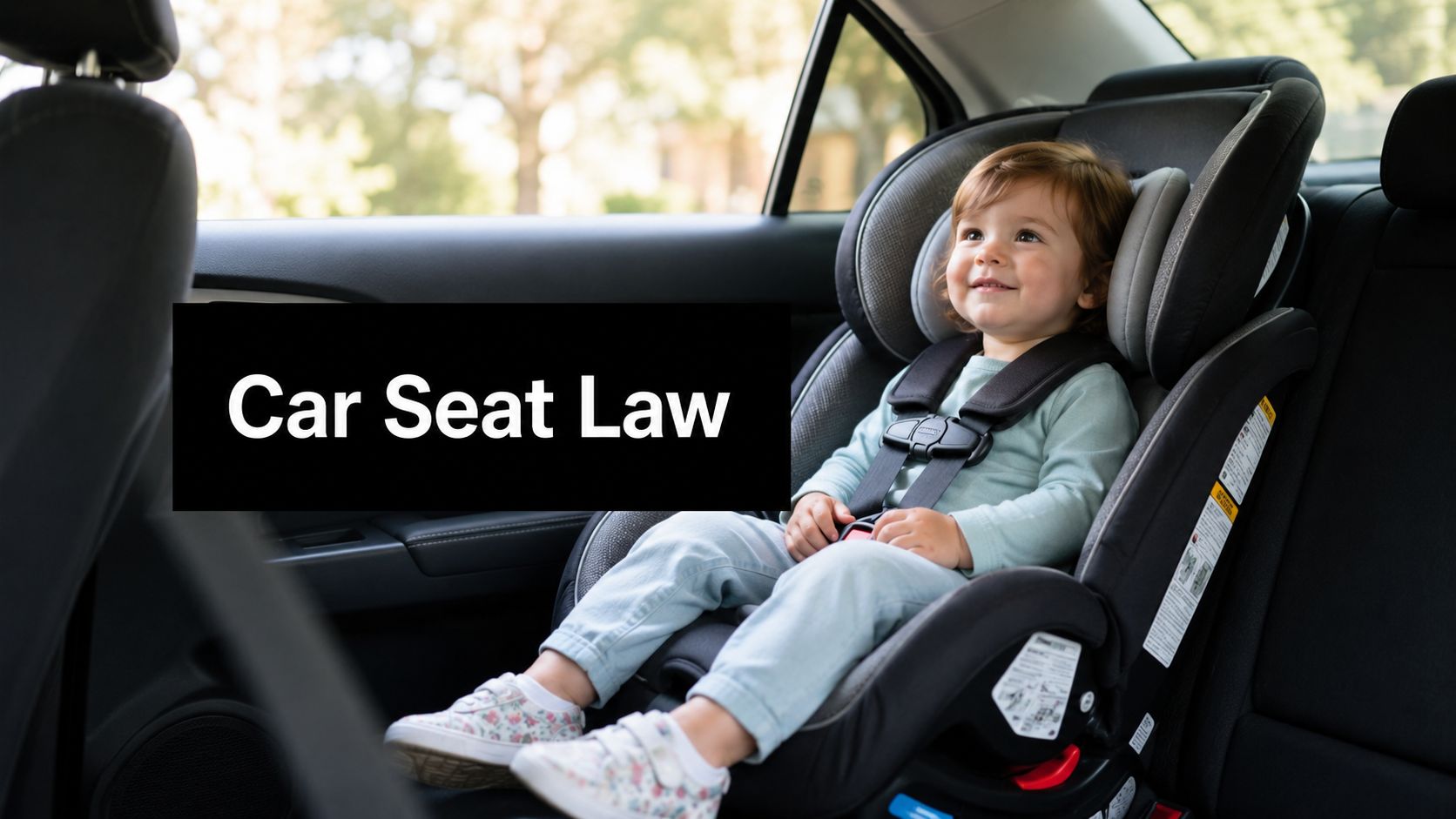
You buckle your child in, hand back a snack, start the engine, and head out for school drop-off, daycare pickup, or a quick run across town. That routine feels ordinary. The legal and safety rules behind it often don’t.
This article is for informational purposes and not to be construed as legal advice. No attorney client relationship exists based on the review of this this article and none of the information in this article is legal advice.
Parents usually aren’t confused because they don’t care. They’re confused because California’s rules change as a child grows, car seat labels use one set of measurements, and state law uses another. Add in an upcoming law change for older kids, and it’s easy to second-guess whether your child is in the right seat today and whether that will still be true next year.
Keeping Your Child Safe on California Roads
Most families don’t struggle with the idea of car seat safety. They struggle with the details. Is your child still supposed to be rear-facing? Does turning 8 automatically mean a seat belt is enough? What if your child is tall for their age but still slouches when the shoulder belt sits wrong?
Those questions matter because the California car seat law isn’t only about avoiding a ticket. It’s about how a child’s body handles crash forces. Young children have proportionally larger heads, developing spines, and smaller hips, which means an adult belt can sit in the wrong place even when a child seems “big enough.”
Why parents get tripped up
A common mistake is assuming age alone controls everything. It doesn’t. California law uses age in some places, but height, weight, seat type, and belt fit also matter. On top of that, your car seat’s manufacturer instructions still matter because the law works alongside those limits, not instead of them.
Another source of confusion is the jump from current rules to the upcoming changes taking effect in 2027. A parent might hear, “My child is 8, so we’re done with boosters,” and think that settles it. It doesn’t, especially with the new fit-test standard coming soon.
Practical rule: Don’t treat a birthday as an automatic graduation date for the next restraint stage. Check the law, your child’s size, and the way the restraint actually fits in your specific vehicle.
What helps most
If you want a clear way to think about this topic, use this order:
- Start with your child’s age
- Check height and weight
- Confirm the seat’s own limits
- Look at where the child sits in the vehicle
- Make sure the harness or belt fits the body correctly
That sequence cuts through most of the confusion. Once you know the right restraint category, the next question becomes whether you’re installing and using it correctly.
California Car Seat Requirements by Age and Size
Your child turns 8, looks taller than last month, and suddenly the big question feels urgent: can you retire the booster, or is that too soon? California law gives parents a framework, but the safest answer still depends on how age, height, weight, and belt fit work together in practice.
Start with the current legal floor. In California, children under 2 must ride rear-facing unless they are at least 40 pounds or 40 inches tall. Children under 8 must ride in a car seat or booster seat in the back seat. A child who is 8 years old or at least 4 feet 9 inches tall may use the vehicle’s seat belt.

The current stages in plain English
A good way to read these rules is to treat them like school grades. Your child does not move up because of one birthday alone. They move up when they meet the legal rule, fit the next restraint correctly, and fall within the car seat maker’s limits.
| Stage | Who it generally applies to | Key takeaway |
|---|---|---|
| Rear-facing seat | Children under 2, unless they meet the listed weight or height exception | Rear-facing is the legal starting point |
| Forward-facing seat | Children who’ve outgrown rear-facing and still need a harnessed restraint | Move up only after rear-facing limits are reached |
| Booster seat | Children under 8 who are no longer in a harnessed seat | Booster use belongs in the back seat |
| Seat belt | Children who are 8 or who are at least 4 feet 9 inches tall | Belt use is allowed, but fit still matters |
What each stage means for your family
Rear-facing seats protect the head, neck, and spine by spreading crash forces across the child’s back. That matters most for infants and toddlers, whose bodies are still developing. If your child is under 2, rear-facing is the rule unless the child has already reached 40 pounds or 40 inches tall.
Forward-facing seats usually come next, but only after your child has outgrown the rear-facing limits for the seat you own. This is one of the places parents get tripped up. Two children the same age may need different seats because one has outgrown a seat by height while the other still fits safely in it.
Booster seats create the most confusion. Under the current law, a child under 8 still needs a car seat or booster in the back seat. A booster is not just a smaller child seat. It raises your child so the adult belt sits on the strong parts of the body, the shoulder and hips, instead of the neck or stomach.
That point becomes even more important because California’s 2027 booster seat changes will put more attention on belt fit, not just birthdays. If you want a parent-friendly explanation of booster timing and belt fit concerns, Hiccapop’s booster seat insights offer a useful practical overview.
Seat belts alone are allowed once a child is 8 or reaches 4 feet 9 inches. Allowed does not always mean ideal. Some children meet the legal threshold but still do not sit in a way that lets the lap and shoulder belt stay in the right position for the whole ride.
A legal minimum and the safest choice are not always the same thing.
A quick way to check yourself
Before you change seats, run through these five questions:
- Age: Does California law still place your child in a rear-facing, car seat, or booster category?
- Height and weight: Has your child reached the threshold that matters for this stage?
- Seat limits: Does your specific seat allow the next step yet?
- Body fit: Will the harness or belt rest on the right parts of your child’s body?
- Real-world posture: Can your child stay seated correctly for the whole trip, even when tired or asleep?
That last point matters more than many parents realize. A child who slouches, tucks the shoulder belt behind the back, or slides forward in the seat is not getting the protection the law is trying to achieve.
If you are unsure, the safer call is usually to stay in the current stage until your child clearly fits the next one by both law and body size. That cautious approach lines up with how California’s current rules work today and helps you prepare for the more fit-focused booster standard arriving in 2027.
Proper Car Seat Installation and Placement Rules
A car seat is only as good as its installation. You can buy the right model, follow the age rule, and still lose protection if the seat shifts too much or the harness sits in the wrong place.

Placement comes first
The back seat matters. For children who are still legally required to use a car seat or booster, placement is not a small detail. Parents often focus on the seat itself and forget that where the child rides is part of safe use.
If you’re driving an SUV, sedan, or minivan, check the vehicle manual before you install anything. Carmakers often give model-specific instructions about LATCH locations, seat belt routing, tether anchors, and positions where certain child restraints shouldn’t be installed.
Installation mistakes that show up all the time
Parents most often run into trouble with a few recurring issues:
- Loose base or shell: If the seat slides around easily at the belt path, it isn’t secure enough.
- Wrong recline angle: Rear-facing seats need the angle specified by the manufacturer so the child’s body stays properly supported.
- Harness straps in the wrong position: Strap height changes depending on whether a child rides rear-facing or forward-facing, so check your manual.
- Bulky coats under the harness: Puffy layers create slack you may not notice until a crash.
- Using both systems when the seat doesn’t allow it: Some seats permit either LATCH or the seat belt, not both at once.
A simple at-home routine
Try this each time you reinstall or adjust a seat:
- Read both manuals. The car seat manual and the vehicle manual need to work together.
- Choose one installation method. Use the seat belt or LATCH if your seat instructions say to do so.
- Tighten at the belt path. Test where the seat is anchored, not at the top.
- Check the harness on the child. The straps should lie flat, and the chest clip should be positioned correctly according to the seat instructions.
- Recheck after growth spurts. Children outgrow settings before parents realize it.
If you can pinch excess webbing at the harness after buckling, the fit usually needs more adjustment.
You don’t need to be mechanically gifted to install a seat well. You do need patience, the manuals, and a willingness to redo it if something looks off.
The Upcoming 2027 Booster Seat Law Explained
Your 9-year-old may look big enough for the seat belt alone. Then you start the car, and within minutes the shoulder belt is rubbing the neck, the lap belt has crept onto the stomach, and your child has slid forward just to get comfortable. That is the problem California’s next booster seat update is meant to address.
California is scheduled to make an important change on January 1, 2027.
Why this change matters
This update shifts the focus away from age by itself and toward body fit in a specific vehicle seat. That is a smarter safety standard because seat belts are built for adult proportions, and children do not grow in a straight line. One child may be tall but still too slight through the hips. Another may seem mature enough for the seat belt but still cannot sit upright long enough to keep the belt where it belongs.
A booster works like a bridge between a child’s body and an adult seat belt. It raises and positions the child so the lap belt can sit on the strong hip bones and the shoulder belt can cross the center of the chest. Without that fit, the belt can ride into soft areas of the body during a crash.
The 5-Step Fit Test in plain language
The coming law matters because many parents have never been shown the actual fit test. Passing it means passing every step, in that vehicle seat, for the whole ride.
- Back against the vehicle seat: Your child should sit all the way back, without slouching.
- Knees bend naturally at the edge: If the legs stick straight out and your child has to scoot forward to bend the knees, the fit is off.
- Shoulder belt crosses the chest and shoulder: It should not cut across the neck or slip off the shoulder.
- Lap belt stays low on the hips or upper thighs: It should not ride up onto the belly.
- Your child can stay in that position the entire trip: Good fit has to last beyond the first minute after buckling.
Here is the point parents often miss. A child can buckle independently and still fail the fit test. Buckling is only the start. Belt position is what protects the spine, abdomen, and head in a collision.
A practical way to check your child
Try the test in the exact spot where your child usually rides. Vehicle seats differ, and a child may fit in one row or one car but not another.
For example, a child may sit in the back seat and seem ready to move past the booster. But if the knees do not bend at the edge, the child will usually slide forward. Once that happens, the lap belt often moves onto the stomach and the shoulder belt shifts toward the neck. That child still needs a booster, even if the child is older and even if friends have already stopped using one.
That forward-looking part of the law is what makes this update so useful. It gives families a clearer standard for the years when children outgrow one stage of restraint but are not yet getting true protection from the seat belt alone. Parents thinking ahead to older kids and safety habits may also find this article on seat belt safety in reducing teen driver injuries helpful.
Navigating Special Scenarios and Exceptions
A lot of parents feel confident about the basic rules until real life steps in. The school pickup runs late. A rideshare is the only way home. A child has a medical condition that makes a standard car seat difficult or unsafe. Those are the moments when families are most likely to make a rushed decision.

The safest approach is to treat special situations like bad weather. You plan for them before they happen, because once you are standing at the curb or dealing with medical equipment in a parking lot, your options narrow fast.
When you use Uber or Lyft
Start with rideshares, because this catches many families off guard. The driver may be careful and well-meaning, but that does not mean the vehicle will have the right restraint for your child, or any restraint at all.
For practical purposes, assume you must bring the car seat or booster your child needs. Also assume you are the person who must confirm it is being used correctly before the trip begins. A short ride across town does not lower the risk in a crash. In fact, many collisions happen close to home, during the exact kind of trip people are tempted to treat casually.
If a rideshare trip follows a collision, seat condition matters too. Families often have questions about whether a restraint can still be used after impact. Our guide on whether car seats should be replaced after an accident explains what to check.
Medical exceptions require specific written support
Medical issues create a different kind of problem. Some children have feeding tubes, casts, airway concerns, muscle tone disorders, or other conditions that make a standard seating position unsafe or unrealistic. California law can allow exceptions in limited circumstances, including some front-seat situations, but parents should expect those exceptions to be documented clearly.
A quick verbal suggestion from a doctor usually is not enough. What helps is a written statement that explains the child’s condition, why the standard restraint setup does not work safely, and what accommodation is needed instead. That paperwork should travel with the child, just like medication instructions or an allergy plan.
A practical checklist for unusual situations
If your family is dealing with a special transportation issue, use this approach:
- Get written medical guidance: Ask the treating physician to describe the restriction and the safer alternative in plain terms.
- Match the note to the specific problem: The documentation should explain why a rear seat, standard harness, or usual seat angle does not work for this child.
- Keep the paperwork in the vehicle: If a question comes up during a stop or after a crash, you do not want the explanation sitting in a file at home.
- Review the plan as your child grows: A seat setup that made sense a year ago may no longer fit the child’s size or medical needs.
Medical exceptions are usually handled case by case, with careful documentation and a clear safety reason.
That same mindset helps with other gray-area situations too. Grandparents, babysitters, and family friends should know the child’s current seat, weight range, and any medical instructions before they drive. One consistent plan protects the child better than a patchwork of guesses from one vehicle to the next.
Penalties Enforcement and Steps After a Crash
Parents often think of car seat rules as a ticket issue. That’s too narrow. Compliance affects safety first, but it can also affect what happens after a collision, including how insurers and opposing parties evaluate the situation.
The legal consequences go beyond the roadside stop
The upcoming 2027 booster rule carries meaningful penalties, including fines described earlier. A violation can also become part of a larger dispute after a crash. If a child wasn’t properly restrained, another party may try to argue that the injuries were worse because the restraint was wrong, misused, or missing.
That doesn’t mean a family loses all rights after a crash. It does mean details matter. Police reports, photographs, seat condition, and medical records can all become important.
What to do right after a collision
If your child was in a crash while using a car seat or booster, focus on practical steps:
- Get medical evaluation: Even when a child seems fine, symptoms can appear later.
- Take photos: Document the vehicle interior, the restraint, buckle position, and any visible damage.
- Preserve the seat: Don’t throw it away immediately if there’s any chance of an injury claim.
- Write down what happened: Note where the child was seated, how the harness or belt was positioned, and who installed the seat.
- Check replacement guidance: Families often need to replace child restraints after a collision. For a focused discussion of that issue, this guide on car seats after accidents is worth reviewing.
Why this matters for injury claims
A properly used child restraint can become an important fact in a personal injury case. It shows the adult driver took reasonable safety steps. An improperly used restraint can create avoidable arguments for the other side.
That’s why following the California car seat law is about more than compliance. It protects your child physically, and it may also protect your family’s position if someone else causes a crash.
Save the manuals, registration information, and purchase records for your child restraint if you can. Small details can become useful later.
Protecting Your Child and Your Legal Rights
Parents don’t need a perfect memory for every rule. They do need a dependable process. Check your child’s current stage, confirm the seat’s limits, install it carefully, and don’t assume an age milestone automatically means the next restraint is safe.
The upcoming 2027 change matters because it shifts the conversation from age to fit. That’s a smart way to think about child passenger safety in general. A restraint works best when it fits the child’s body and the vehicle correctly, not when it satisfies a guess about what “seems old enough.”
A practical family checklist
Keep these habits in place:
- Review seat fit often: Growth happens faster than most parents expect.
- Check every vehicle: A belt that fits in one car may fit differently in another.
- Plan ahead for 2027: Test older children using the five-step approach before the law takes effect.
- Keep your coverage current: If you’re reviewing family transportation risks more broadly, this guide on how to get California auto insurance may help you think through protection issues beyond child restraints.
If a child safety seat appears defective, breaks unexpectedly, or fails in a collision, that can raise a different set of legal issues from an ordinary traffic case. In those situations, information about defective child safety seats and restraint system injury claims can help families understand the next step.
Staying informed helps prevent harm. If the worst happens anyway, protecting your child also means protecting your legal rights.
If your family is dealing with the aftermath of a crash, LA Law Group, APLC can help you evaluate what happened, preserve important evidence, and understand your options. The firm represents Californians in personal injury matters and offers a direct, practical approach when families need answers after an accident involving a child passenger.
Attorney Advertising. This article is general information, not legal advice, and does not create an attorney-client relationship. Prior results do not guarantee a similar outcome.