
Car Accident Lawyer at Fault: Can You Still Recover?
Yes. California uses pure comparative fault: a jury or insurer can assign you a percentage of blame, and your recovery is reduced by that percentage rather than erased. If a driver were found 20% responsible on a $100,000 claim, for example, $80,000 would remain before liens and fees.
A car accident lawyer at fault inquiry usually turns on three practical questions: what percentage is likely to stick, how large the proven damages are, and what coverage or assets can pay. Blame can come from ordinary choices such as following too closely, rolling a stop, drifting during a lane change, or looking down at a phone. The apology at the curb and the adjuster’s early letter may sound final, but the civil case still depends on evidence tying conduct to collision and injury.
Confusion is normal because some states bar recovery past a cutoff. California does not work that way. The harder math is whether the remaining share justifies the fight: strong proof can make a modest-fault claim viable, while thin evidence can shrink even a serious injury case.
Whether a Lawyer Will Take a Case When You Were Partly at Fault
A lawyer will often accept a California case in which the client shares some blame, because fault is split by percentage rather than treated as all or nothing.
What negligence actually requires
Under California driver-safety guidance, a driver is negligent when the driver fails to use the care expected to avoid an accident. Action can be warranted even when the conduct is less than grossly negligent, including misjudgment or inattention. A rolling stop, a glance at a phone, or a merge that was a half-second early can be enough. Nobody has to prove you meant to crash.
After a property-damage-only collision, Vehicle Code section 20002 still requires a stop at the nearest safe location, identification of the driver and owner, identifying information when requested, and either notice to the property owner or a written notice plus a prompt police report. Moving the car to a safe spot doesn’t itself decide fault. A citation, an insurer’s first letter, or something you said at the curb also doesn’t close the civil case. The record still has to show duty, breach, causation, and a compensable injury.
Recovery and representation by fault scenario
| Your Situation | Can You Recover? | What a Lawyer Weighs |
|---|---|---|
| Injured, 0% at fault | Yes, full claim against the responsible party | Strength of liability evidence and injury severity |
| Injured, 20% at fault | Yes, reduced by 20% | Whether the reduced value still covers fees and case costs |
| Injured, 50% at fault | Yes, reduced by 50% | Dispute over the percentage and quality of the evidence |
| Injured, 80% at fault, another driver also negligent | Yes, but only 20% of total damages | Whether the remaining share justifies litigation |
| Injured, 100% at fault, no other party responsible | No claim against another party | Usually declined; own coverage such as med-pay may still apply |
| Passenger hurt by a driver’s negligence | Yes, generally a full claim | Identifying every insurer and the coverage limits |
| Property damage only, client partly at fault | Limited, small dollar value | Often declined because fees can exceed the recovery |
The acceptance decision usually turns on whether the expected net recovery covers case costs and fees, not on whether you are blameless. A serious injury with a 50% dispute can still be worth the file. A dented bumper with partial fault is the scenario firms decline most often, because the fee can swallow the check.
Estimate your likely percentage range before the first consultation, and bring the police report, photos, and insurer correspondence.
This article is for informational purposes only, is not legal advice, and reading it creates no attorney-client relationship.
How California Comparative Fault Reduces Your Recovery
California is a pure comparative-fault state, so a plaintiff who is 30% responsible can still recover 70% of total damages, with no 50% or 51% cutoff.
Out-of-state pages can read differently. Oregon, for example, uses a modified rule that bars recovery once your fault is greater than the combined fault of the other parties. A guide built for that system will tell a mostly-at-fault driver the claim is over. California doesn’t draw that line.
The calculation, in order
The California jury framework requires the fact finder to set total damages, assign each responsible party a percentage, and reduce the plaintiff’s recovery by the plaintiff’s own percentage. A separate causation instruction says a defendant can remain responsible when that negligence was a substantial factor, even if another person, condition, or event was also a substantial factor. Being at fault isn’t the same as being solely at fault.
Work the numbers in this order:
- Total the economic damages, including medical bills, lost wages, and future care.
- Add non-economic damages such as pain and suffering.
- Assign each responsible party a percentage.
- Reduce the award by the client’s percentage.
- Collect from each defendant according to that defendant’s share.
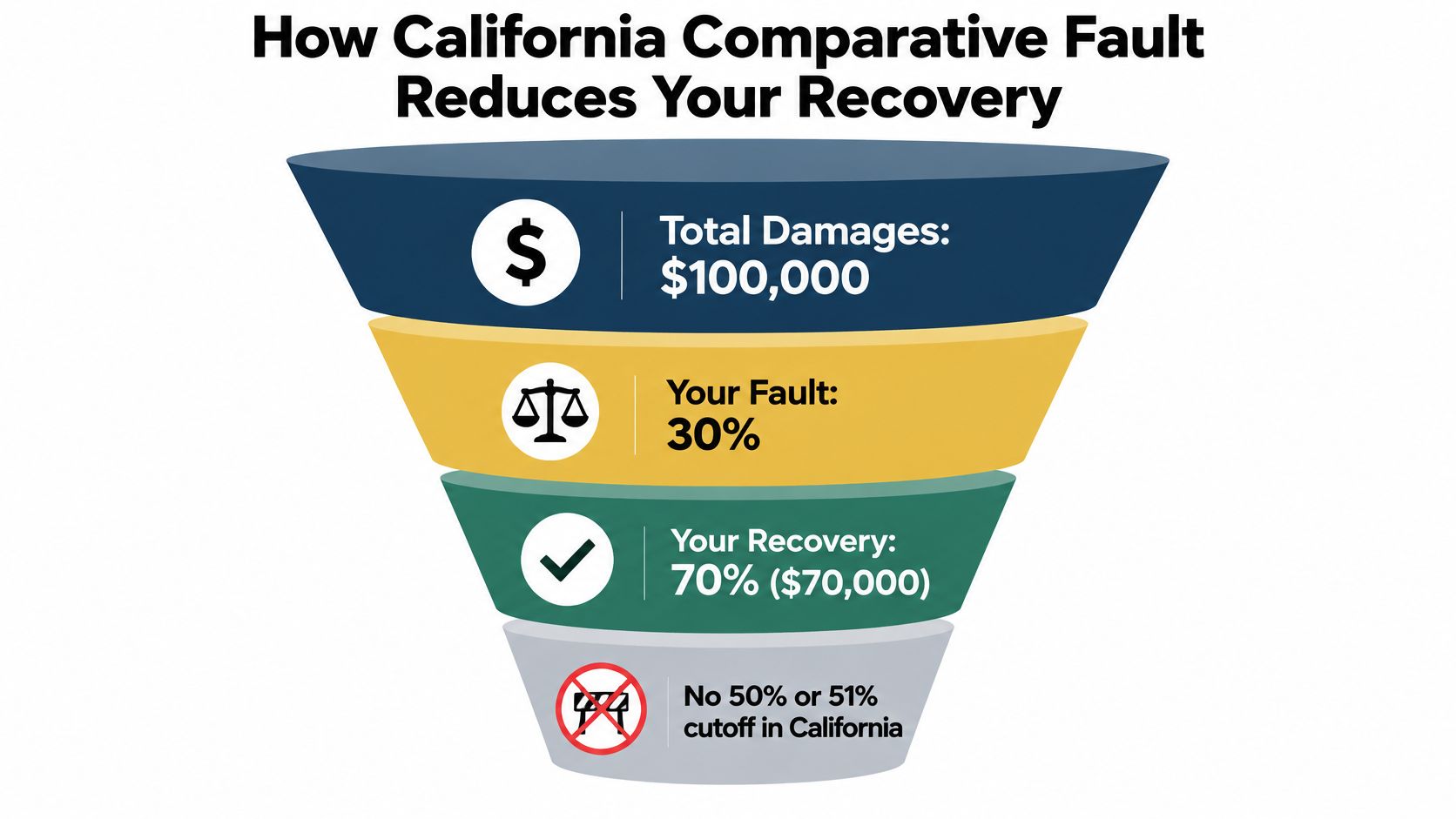
The graphic uses a round $100,000 so the 30% cut is easy to see. The same math on a larger award looks like this. Each 10-point step on $200,000 costs $20,000.
Recovery on $200,000 in damages by client fault share
| Client’s Fault Share | Recovery From $200,000 in Damages | Amount Lost to Own Fault |
|---|---|---|
| 0% | $200,000 | $0 |
| 10% | $180,000 | $20,000 |
| 25% | $150,000 | $50,000 |
| 50% | $100,000 | $100,000 |
| 60% | $80,000 | $120,000 |
A road defect doesn’t erase the driver’s share. If the driver’s negligence was a substantial factor, that driver can still be liable alongside the condition. At an intersection, an approaching driver generally must yield to a vehicle that already entered from a different highway. Photos of positions and sight lines, the collision report, and any video are what make that rule usable.
Insurers negotiate percentages long before a verdict. Don’t put a guessed percentage in an email or a recorded call before the evidence is complete. The final split depends on the facts and the instructions the fact finder really uses.
Conflict of Interest Rules That Decide Who a Lawyer Can Represent
Lawyers owe loyalty to one side. The first conflict question is who else could be a defendant.
Under the California Rules of Professional Conduct, a firm may not take a matter in which a current client’s interests are directly adverse without informed written consent. Consent doesn’t fix every clash, and many firms won’t ask for it when the stories collide.
Three patterns that come up constantly
Two drivers, one light. Each driver says the other ran the signal. One firm can’t represent both. The stories are directly adverse, and anything one client says can hurt the other.
A passenger in that same crash. The passenger usually didn’t cause the collision and can pursue both drivers. The firm for that passenger may name both. That firm still can’t also represent either driver.
A prior conversation. If the firm already consulted the other driver, or already spoke with the other insurer in a way that created a duty, it may have to decline even if your injuries are serious.
A decline for conflict says nothing about the merits. Ask for a referral to unconflicted counsel, and keep the evidence file ready so the next lawyer isn’t starting from zero.
What to disclose at intake
- Every person in the cars: Name each driver and each passenger, including anyone who left before police arrived.
- The vehicle owner: The driver and the registered owner are often different people, and both policies may matter.
- Work status: Say whether the driver was on the job, because an employer can be a separate defendant.
- The household policyholder: A parent, spouse, or roommate on the title or the policy can change which coverage applies.
- The other insurer’s name: If you already called that company, say so. That call is sometimes the conflict.
Bring those names to the first meeting. A firm can spot a conflict in minutes when the cast of characters is complete, and it can miss one when a passenger or an employer stays off the intake sheet.
Defense Tactics Insurers Use to Shift Fault Onto You
Insurers rarely dispute that a collision happened. They dispute who caused it, and how much of it was you.
In the National Motor Vehicle Crash Causation Survey, the final event in the causal chain was assigned to a driver in about 94% of investigated crashes, with a margin of error of ±2.2%. Among driver-related critical reasons, recognition errors such as inattention, distraction, and inadequate surveillance accounted for about 41%. Decision errors accounted for about 33%. Performance errors, including overcorrection and poor directional control, accounted for about 11%.
Defense teams use those buckets as a checklist. Phone records are aimed at a recognition error. Event-data speed is aimed at a decision error, such as an unsafe speed or following too closely. Sight lines and “you should have seen them” arguments are aimed at inadequate surveillance. The label sounds scientific. It is still an argument, and it can be answered with better proof.
NHTSA cautions that a critical reason is the last event in a chain, not automatically the sole cause. You can still show that roadway design, weather, a vehicle defect, or the other driver contributed. That is why early preservation matters. Delay can wipe the event data and the footage the defense is hoping won’t exist.
Defense tactics and the evidence that answers them
| Defense Tactic | What They Look For | How to Counter It |
|---|---|---|
| Speeding or distraction claim | Phone records and event-data speed | Traffic-camera footage and phone logs showing no use at impact |
| Lane change or right-of-way dispute | Vehicle damage pattern and sight lines | Scene photos, skid marks and measured vehicle positions |
| Recorded statement or social media | Admissions of speed, apologies or fault | No recorded statement without counsel; restrict new posts without deleting old ones |
| Pre-existing injury | Prior medical records of the same body part | Treating doctor’s causation opinion and imaging comparison |
| Gap in treatment | Missed appointments or delayed care | Documented treatment chronology explaining each interval |
| Another cause of the crash | Road design, weather or vehicle defect | Expert reconstruction and roadway or maintenance records |
A critical reason is a last event, not a verdict. Road design, weather, and the other driver’s conduct still belong in the file.
How you talk to the adjuster shapes every row in that table. A practical walk-through of how to deal with insurance adjusters covers the calls, the forms, and the statements that get reused later as admissions.
Collecting Damages When the At-Fault Driver Has Little Coverage
Proving the other driver was negligent doesn’t guarantee you can collect. Liability answers who caused the crash. Collection answers which policy can really pay, and those are two different problems.
What the minimum actually covers
California’s required limits rose as policies renew on and after January 1, 2025. The California Department of Insurance explains that the per-accident bodily-injury figure is a shared total, not a separate stack for each injured person. A driver and two passengers can be splitting one pot.
California minimum auto liability limits before and after January 1 2025
| Coverage | Before January 1 2025 | From January 1 2025 |
|---|---|---|
| Bodily injury, per injured person | $15,000 | $30,000 |
| Bodily injury, per accident (shared by all injured) | $30,000 | $60,000 |
| Property damage, per accident | $5,000 | $15,000 |
Those figures are a floor, not a measure of your damages. Hospitalization, surgery, lost income, or a long disability can pass $30,000 for one person quickly. Some drivers also carry no policy at all. The California Automobile Assigned Risk Plan reported that 77% of the applications it assigned to insurers in 2025 came from people who were uninsured when they applied. An early offer at the minimum limit is not the value of the claim.
Which policy to check, and in what order
- List every policy that might apply. That includes the at-fault driver, the vehicle owner, household members, and an employer if the driver was working.
- Read your own uninsured and underinsured motorist coverage. An uninsured motorist claim is often the most practical path when the other limit is $30,000 or the other driver has no policy at all.
- Check med-pay and health-plan liens. Those payments can fill a gap, and they can also claim a share of a later settlement.
- Confirm permissive use if the driver borrowed the car. Permission, or the lack of it, can open or close the owner’s policy.
- Don’t sign a release before the medical picture is known. A release aimed at the minimum policy can wipe a larger claim you haven’t priced yet.
Hit-and-run crashes often leave your own uninsured coverage as the main route to payment. Preserve the fault evidence anyway. Your own insurer will still test liability before it pays.
The short video below works through these same coverage questions.
Special Cases Where Shared Fault Changes the Claim
Shared fault gets harder to assign once a claim stops being one driver against another. Two situations come up often in California cases: a passenger who never touched the wheel, and a car that helped drive itself.
Rideshare passengers
A passenger in an Uber or Lyft almost never caused the crash, so comparative fault against that passenger is rarely the fight. The fight is over which policy answers. Rideshare coverage shifts with the app’s status at the moment of impact: off, waiting for a request, en route to a pickup, or carrying a rider. Save the trip screen and app status early, because trip histories thin out fast. A crash involving three or more vehicles adds another driver and another insurer to that question, and a passenger can often pursue more than one of them.
Driver-assistance systems
Automatic emergency braking, lane-centering, and similar Level 2 features raise a harder question. The car helped drive, so who owns the mistake? NHTSA’s automated-vehicle safety guidance answers part of it: drivers must stay engaged and attentive with current consumer technology, and the agency flags liability and insurance questions around automated driving that remain unresolved. Its amended crash-reporting order, effective June 16, 2025, also requires covered entities to report certain crashes when an automated driving system was active within 30 seconds before the incident.
That reporting builds a technology-specific record your lawyer can request. It does not decide who caused your crash.
Questions worth asking before anyone assigns a percentage:
- Engaged or equipped: Was the system switched on, or merely installed in the car?
- Warnings: Did the driver ignore alerts, and does that raise the driver’s comparative share?
- Event data: What did the car record, and which company holds that file?
- Manufacturer conduct: Does the software’s behavior need a look, separate from the driver’s?
Current systems leave substantial responsibility with the human driver. Better braking software can reduce how often crashes happen, yet the legal question stays the same: what the driver did, what the system did, and which records prove it.
Confirm Deadlines and Evidence Before You Act
Percentages and policies don’t matter if a deadline passes or the proof is gone. Work this list in order.
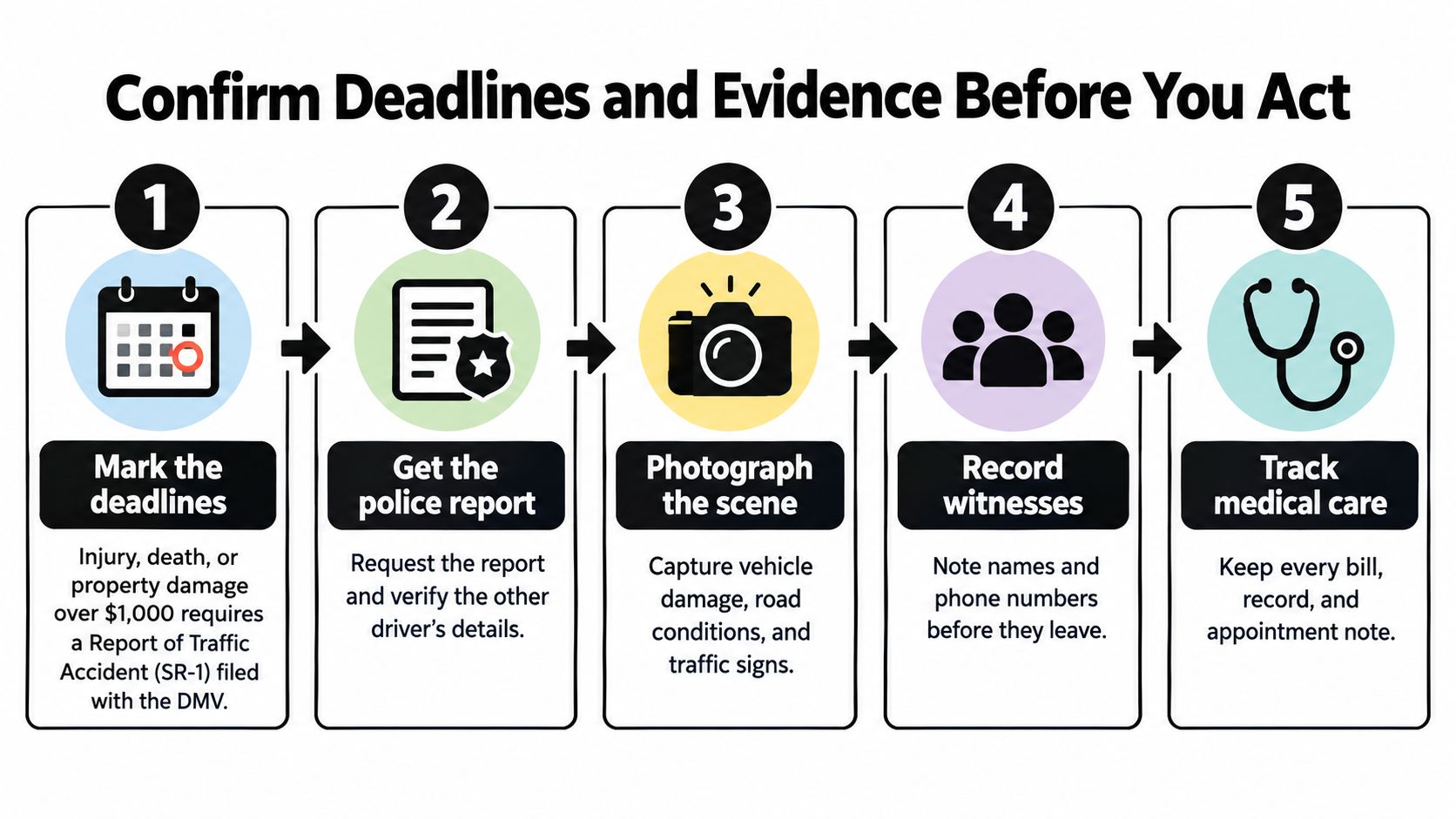
- Mark the DMV deadline. If the crash caused injury, death, or property damage over $1,000, the driver must file a Report of Traffic Accident Occurring in California, the SR-1, with the DMV within 10 days. The DMV collision-reporting rules apply regardless of who caused the crash, including crashes on private property. A report to police, an insurer, or the California Highway Patrol doesn’t replace the SR-1. The filing doesn’t decide fault.
- Mark the lawsuit deadline separately. A personal-injury suit generally must be filed within two years of the injury under Code of Civil Procedure section 335.1, according to California Courts self-help guidance. Missing it can keep a court from hearing the claim, though special rules can change the count. The 10-day SR-1 doesn’t extend the two years.
- Keep the core file. Photos, the police report number, witness names, medical records, and repair estimates.
- Request video and vehicle data before cameras overwrite and event recorders cycle.
- Don’t speculate in writing. Skip recorded statements, and don’t put a fault percentage in an email.
- Gather the coverage names for the other driver, your uninsured or underinsured coverage, and any household policy.
- Book a consultation while the file is still fresh. LA Law Group, APLC offers a free initial consultation, direct attorney access, and a personal-injury practice, with offices in Los Angeles, Santa Monica, Chatsworth, and Fremont.
This article is for informational purposes only and is not to be construed as legal advice. No attorney-client relationship exists based on reading it, and none of the information in it is legal advice.
LA Law Group, APLC helps injured people sort comparative fault, coverage limits, and filing deadlines before a percentage or a release locks the claim in place. If you were hurt in a California crash and you’re unsure whether a shared-fault case is still worth pursuing, start with a free initial consultation. Visit LA Law Group, APLC to talk through the facts of your crash.
Attorney Advertising. This article is general information, not legal advice, and does not create an attorney-client relationship. Prior results do not guarantee a similar outcome.