
Elevator Accident Lawyer: A California Victim's Guide
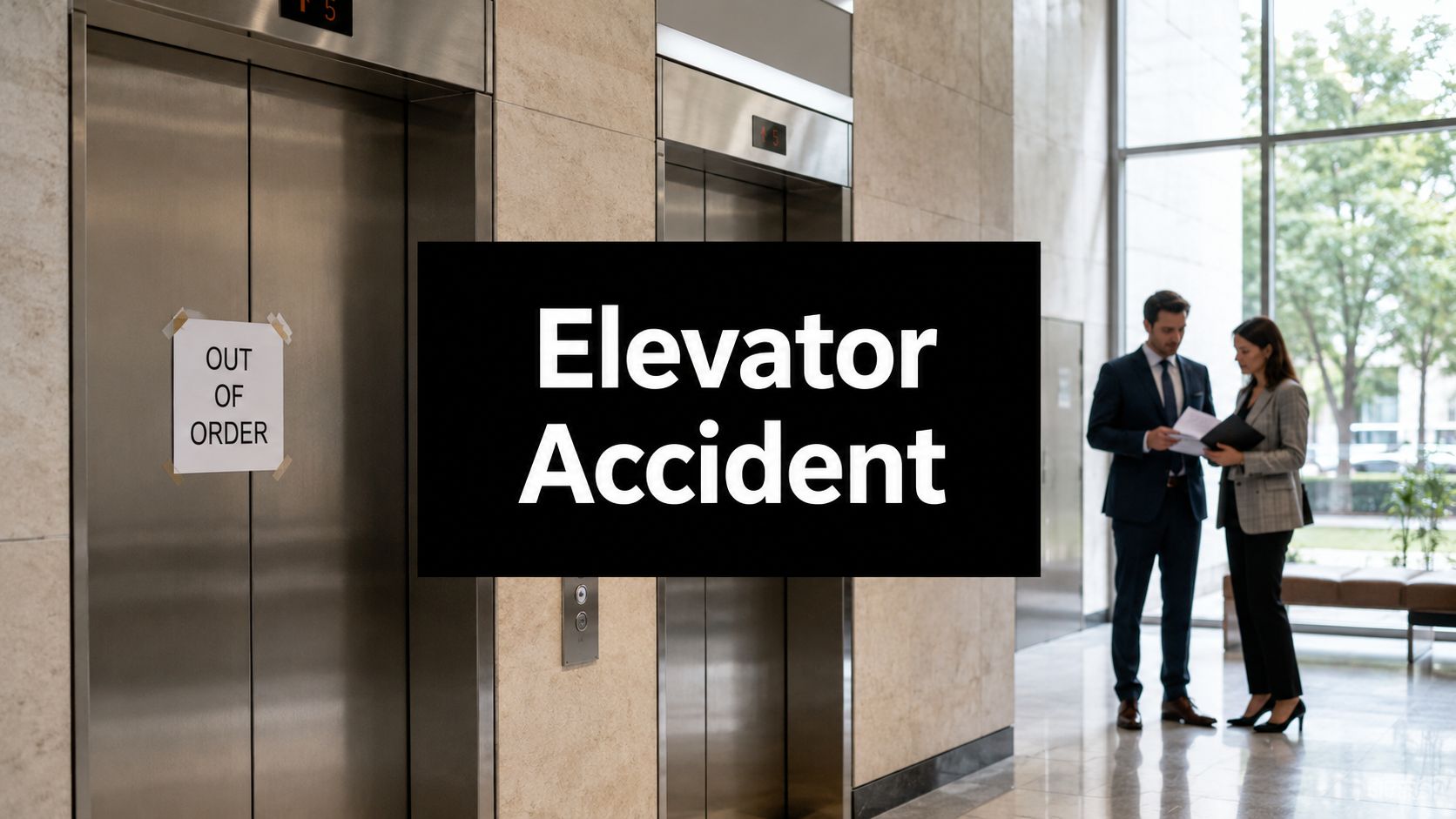
The elevator jerks. The lights flicker. The doors open halfway, then clamp shut. Or worse, they open and there’s no cab where you expected solid flooring to be. In a few seconds, an ordinary trip to an office, apartment, hospital, airport, or courthouse turns into pain, confusion, and a dozen urgent questions.
If that’s where you are right now, you’re not overreacting. Elevator accidents are violent, disorienting events. People often walk away thinking they were “lucky,” only to feel neck pain, dizziness, back spasms, or anxiety hours later. Others know immediately that something is badly wrong but have no idea who’s responsible, what they should say to building staff, or how fast they need to act.
This article is for informational purposes and not to be construed as legal advice. No attorney client relationship exists based on the review of this this article and none of the information in this article is legal advice.
An Elevator Accident Can Change Everything
A lot of victims replay the same moment again and again. They stepped in expecting a routine ride. Then came the sudden drop, the grinding stop, the misleveled floor, or the doors that closed on an arm, shoulder, or leg. After that, the day usually dissolves into ambulance paperwork, confused conversations with building staff, and messages from family asking what happened.
That sense of shock is normal. Elevator cases feel simple from the outside, but they rarely are. Those numbers matter because they show this isn’t a rare legal oddity. It’s a recurring safety problem with potentially life-altering consequences.
For some people, the injury is obvious. Broken bones, head trauma, deep bruising, or a crushed hand. For others, the worst harm shows up later. A jolt can aggravate spinal issues, trigger headaches, or create symptoms that belong in the category of catastrophic and severe injuries caused by accidents, even when the scene didn’t look dramatic to bystanders.
Why confusion hurts cases
The first danger after an elevator malfunction is the injury itself. The second is delay.
People often assume the building will “take care of it,” or they trust a brief incident note prepared by a manager who wasn’t there. Others say too much too early. They speculate about what caused the problem, apologize reflexively, or accept a casual assurance that maintenance will “look into it.”
Practical rule: In the first day, your job is to protect your health and preserve the facts. Not to diagnose the elevator, not to debate blame, and not to trust that the property owner will preserve the evidence for you.
California law gives injured people paths to recover compensation, but those paths depend on details that are easy to miss. Was the building privately owned or public? Were you a tenant, guest, delivery driver, employee, mechanic, or contractor? Did the doors malfunction, did the elevator mislevel, or did the cab stop abruptly between floors? Those details affect liability, deadlines, and the kind of claim you may need to file.
Your First Moves After an Elevator Malfunction
The first hour matters. So does the first day. What you do right after an elevator accident can shape both your medical recovery and your legal claim.
Start with your body, not the claim form.

Get medical care even if you think you can wait
If you hit your head, felt a drop, were pinned by doors, twisted during a sudden stop, or fell while entering or exiting, get evaluated promptly. Adrenaline can hide symptoms. A medical record also creates a clean timeline between the malfunction and your injuries.
That doesn’t mean you need to dramatize what happened. It means you should be accurate. Tell the doctor where the pain is, what movement makes it worse, whether you struck your head, and whether you felt numbness, dizziness, or nausea. If a symptom starts later that same day or the next morning, report that too.
Report the incident, but keep your statement tight
Tell building management, security, or the property owner that an elevator incident occurred and that you were injured. Ask for an incident report. If they won’t provide one immediately, note who you spoke with, their title, the time, and what they said.
Keep your statement factual:
- Describe the event: “The elevator dropped suddenly,” “the doors closed on my arm,” or “the doors opened and the cab was not level with the floor.”
- Identify the location: Building name, address, elevator number if visible, and floor.
- State the injury plainly: Pain areas, visible bleeding, difficulty walking, or dizziness.
- Avoid guessing: Don’t say the cable snapped, the mechanic was careless, or the building “never maintains anything” unless you know those facts.
- Don’t minimize: “I’m probably fine” becomes a problem later if your condition worsens.
A short written record often helps more than a long emotional account. The same discipline that matters after a wet-floor fall also matters here. The basic evidence-preservation habits in what to do after a slip and fall apply surprisingly well to elevator cases.
Document what the building may not preserve
Use your phone if you can do so safely. Focus on the elevator, not just your injuries.
Photograph or record:
- The elevator area: Hallway, call buttons, floor level, posted inspection certificates, warning signs, and any visible damage.
- Inside the cab: Control panel, floor display, door tracks, uneven alignment, debris, or blood if present.
- Your injuries: Bruising, swelling, cuts, torn clothing, damaged shoes, or assistive devices.
- Context clues: Security desk location, camera placement, and whether anyone blocked off the elevator afterward.
Witnesses matter too. Get names and contact information from anyone who saw the event, heard the sounds, helped you afterward, or had trouble with that elevator earlier.
Don’t assume surveillance footage will still be there next week. Many systems overwrite automatically, and private buildings rarely preserve video unless someone asks promptly.
A short explainer can help you think through the immediate aftermath and what evidence tends to matter:
What not to say
The most common early mistake is trying to be agreeable.
Don’t apologize. Don’t say you were distracted. Don’t accept a manager’s version of events if you don’t know it’s true. And don’t give a recorded statement to an insurer before you understand the scope of your injuries and the identity of the responsible parties.
If you’re too hurt or too shaken to gather everything on scene, that’s okay. Medical care comes first. But if a family member or friend can return quickly to photograph the elevator area and ask management to preserve footage and maintenance records, that can make a real difference.
Identifying Who Is Liable for Your Injuries in California
People usually ask one simple question after an elevator accident: who do I sue? In practice, that’s the wrong starting point. The better question is: who controlled safety, maintenance, operation, and warnings for this elevator at the time of the incident?
That answer may involve one party or several.

Liability usually starts with control
Think of an elevator like a shared responsibility chain. One company may own the building. Another manages it day to day. A third company services the elevator. A manufacturer may have designed or supplied a defective component. Each role creates a different legal question.
A clear overview of premises liability law helps here, but elevator cases often go a layer deeper because the equipment itself is specialized and heavily dependent on inspection, repair, and service records.
Here’s how liability often breaks down:
| Potential party | Why they may matter |
|---|---|
| Property owner | May be responsible for keeping common areas reasonably safe |
| Building management | May handle complaints, shutdown decisions, and safety responses |
| Maintenance company | May be responsible for inspection, repair, and service failures |
| Manufacturer | May be involved if a defective component caused the incident |
The evidence usually tells the story. Maintenance logs, inspection records, service call histories, prior complaints, surveillance footage, and witness statements can reveal whether the problem was known, ignored, poorly repaired, or built into the equipment itself.
The visitor versus worker distinction changes the whole case
This is one of the most overlooked issues in California elevator claims.
That distinction matters because two people injured in the same building may have completely different legal routes.
If you were a tenant, guest, customer, patient, resident, or delivery visitor, your case will often focus on negligence and premises liability. The key questions are whether the responsible party knew or should have known about the hazard and whether they failed to act reasonably.
If you were an employee or elevator mechanic working at the time, your claim may involve workers’ compensation issues, Labor Code protections, or separate third-party liability questions. A worker may have rights against an employer, but also potentially against a property owner, outside maintenance contractor, or product manufacturer depending on the facts.
A bad case strategy often starts with a category mistake. A visitor’s claim handled like a workplace matter can miss negligence evidence. A worker’s claim handled like an ordinary premises case can ignore statutory protections and deadlines.
What actually helps prove fault
In elevator litigation, broad accusations don’t help much. Specific records do.
Useful evidence may include:
- Service histories: Whether the elevator had repeated shutdowns, door issues, leveling problems, or prior complaints.
- Inspection certificates and logs: Whether inspections were current and whether deficiencies were noted.
- Repair records: Whether a contractor was called, what was repaired, and whether the same malfunction returned.
- Witness accounts: Whether other tenants, staff, or visitors similar problems.
- Scene conditions: Signage, barriers, alarms, and whether the elevator should have been taken out of service.
When an elevator accident lawyer evaluates a case, one of the first jobs is identifying all potentially responsible parties before evidence disappears or fingers start pointing in every direction.
The California Statute of Limitations Is Not Always Two Years
One of the most damaging assumptions in California injury law is “I have two years, so I can deal with this later.” Sometimes that’s true. Sometimes it’s the mistake that destroys the case.
For many private-property elevator accidents, California generally allows 2 years from the date of injury. But that general rule does not cover every elevator claim.

Public property changes the deadline fast
In California, victims have a strict 6-month deadline to file a Government Claims Act claim for accidents on public property, like airports or courthouses, under Gov. Code § 911.2, while cases on private property generally allow 2 years from the injury date under Code Civ.
That means the location of the elevator matters as much as the injury itself.
Examples that can trigger government-claim issues include elevators in:
- Courthouses
- Public universities
- Transit facilities
- Airports
- Government office buildings
If a public entity is involved, the claim process doesn’t begin with a standard lawsuit. It begins with a formal government claim. Miss that early deadline and you may lose the right to pursue compensation at all.
Why victims miss this deadline
Individuals typically don’t think in terms of property ownership while they’re recovering. They remember the injury, not whether the building was run by a city, county, state agency, transportation authority, or another public entity.
Sometimes the mistake comes from appearance. A building can look like a private office tower but house public functions. An airport retail area can involve layers of public and private responsibility. A hospital or university setting can create the same confusion.
The safest approach is simple. If you were hurt in any building that might have a public connection, find that out immediately. Waiting to “see how you feel” can cost you the claim.
A quick comparison
| Claim setting | Time issue to investigate immediately |
|---|---|
| Private building | General personal injury deadline may apply |
| Public building or public conveyance | Government claim deadline may apply much sooner |
The legal deadline is not a technicality. It’s a gatekeeper. In elevator cases, I often find that the hardest legal problem isn’t proving someone failed to keep the elevator safe. It’s fixing the damage done when a victim got the right medical treatment but the wrong legal assumption about time.
How to Hire the Right Elevator Accident Lawyer
Not every personal injury lawyer is the right fit for an elevator case. That doesn’t mean the lawyer has to market themselves only as an elevator specialist. It means they need to understand premises liability, equipment-related injury investigation, third-party responsibility, and California deadline traps well enough to move quickly and ask the right questions.
That misses too much. Elevators generate maintenance logs, service contracts, shutdown histories, repair tickets, surveillance issues, and technical questions about door systems, leveling, and emergency response. Those details can drive liability.
What to ask in the first consultation
A consultation should help you evaluate the lawyer, not just the other way around.
Ask questions that reveal how they think:
- Have you handled premises liability cases involving mechanical systems? You want to hear how they investigate, not just “yes.”
- How will you identify all responsible parties? A strong answer should mention owners, managers, maintenance contractors, and manufacturers where appropriate.
- What evidence will you try to preserve first? Good answers often include video, incident reports, repair logs, witness names, and maintenance records.
- Who will communicate with me?
- How do you handle a case if a public entity may be involved? This question is especially important in California.
- What problems do you see in my case right now? A careful lawyer won’t promise a win. They’ll identify risks.
Watch for practical competence, not sales language
You don’t need a dramatic pitch. You need someone who can separate a strong case from a weak one and tell you why.
A useful consultation usually includes:
| Good sign | Why it matters |
|---|---|
| Specific questions about location and role | Shows the lawyer understands the worker versus visitor distinction |
| Interest in records and preservation | Indicates an investigation mindset |
| Clear explanation of deadlines | Reduces the risk of fatal timing mistakes |
| Realistic discussion of proof problems | Suggests credibility and preparation |
A weak consultation often sounds vague. The lawyer talks mostly about settlements in general, says every case is “big,” or rushes past the ownership and employment questions that often decide how an elevator claim should be filed.
You’re not just hiring someone to file paperwork. You’re hiring someone to spot the issue you don’t know exists yet.
Understand the fee structure before you sign
Most injury victims are already worried about medical bills, missed work, and transportation to treatment. Many injury lawyers work on a contingency basis.
It is worth asking for the fee terms in plain language. It is also worth asking what happens with litigation costs, record fees, expert expenses, and how costs are handled if the case resolves early versus later.
A short hiring checklist
Before you hire an elevator accident lawyer, make sure you can answer yes to most of these:
- They explained your likely claim path clearly.
- They asked whether the property might be publicly owned.
- They asked whether you were a worker, visitor, resident, or contractor.
- They discussed evidence preservation early.
- They gave you a clear fee agreement.
- You know who will return your calls and emails.
It’s usually the one who listens carefully, spots the hidden issue quickly, and gives you a concrete plan instead of a slogan.
Your Next Steps and What to Expect from Your Claim
Once you hire counsel, the legal burden should start shifting off your shoulders. Your lawyer’s role is to investigate the malfunction, identify the right defendants, gather records, assess your injuries, and deal with insurance carriers and defense lawyers while you focus on treatment.
That process usually includes collecting medical records, obtaining incident reports, requesting surveillance footage, securing maintenance and repair records, and documenting how the injury affected your work, mobility, and daily life. Your claim may include medical expenses, lost income, pain and suffering, and other losses recognized under California law.

Most cases resolve before trial
Many injured people assume they’re signing up for a long courtroom fight. That can happen, but it isn’t the only path.
That matters for two reasons. First, settlement is common when the evidence is developed early and presented well. Second, the cases that settle best are often the ones prepared seriously enough that the other side knows trial is a real option.
What you should do while the claim moves forward
Your part still matters.
- Keep treating consistently: Gaps in care can create avoidable arguments.
- Save documents: Bills, discharge papers, prescriptions, work notes, and receipts.
- Be careful with statements: Don’t post details online and don’t discuss fault casually.
- Update your lawyer: New symptoms, job issues, and contact from insurers all matter.
An elevator accident lawyer can only build with the facts available. Timely records, honest reporting, and consistent treatment make the claim stronger and more credible.
If you were injured in an elevator malfunction in California, the next sensible move is a personalized case evaluation. A lawyer can tell you whether you’re looking at a private premises claim, a government claim issue, a workplace injury problem, or some combination of them.
If you need direct guidance after an elevator accident, contact LA Law Group, APLC for a free, no-obligation case evaluation. The firm helps injured Californians assess liability, protect evidence, and act before critical deadlines expire.
Attorney Advertising. This article is general information, not legal advice, and does not create an attorney-client relationship. Prior results do not guarantee a similar outcome.