
Injury at Work Rights: Your 2026 California Guide
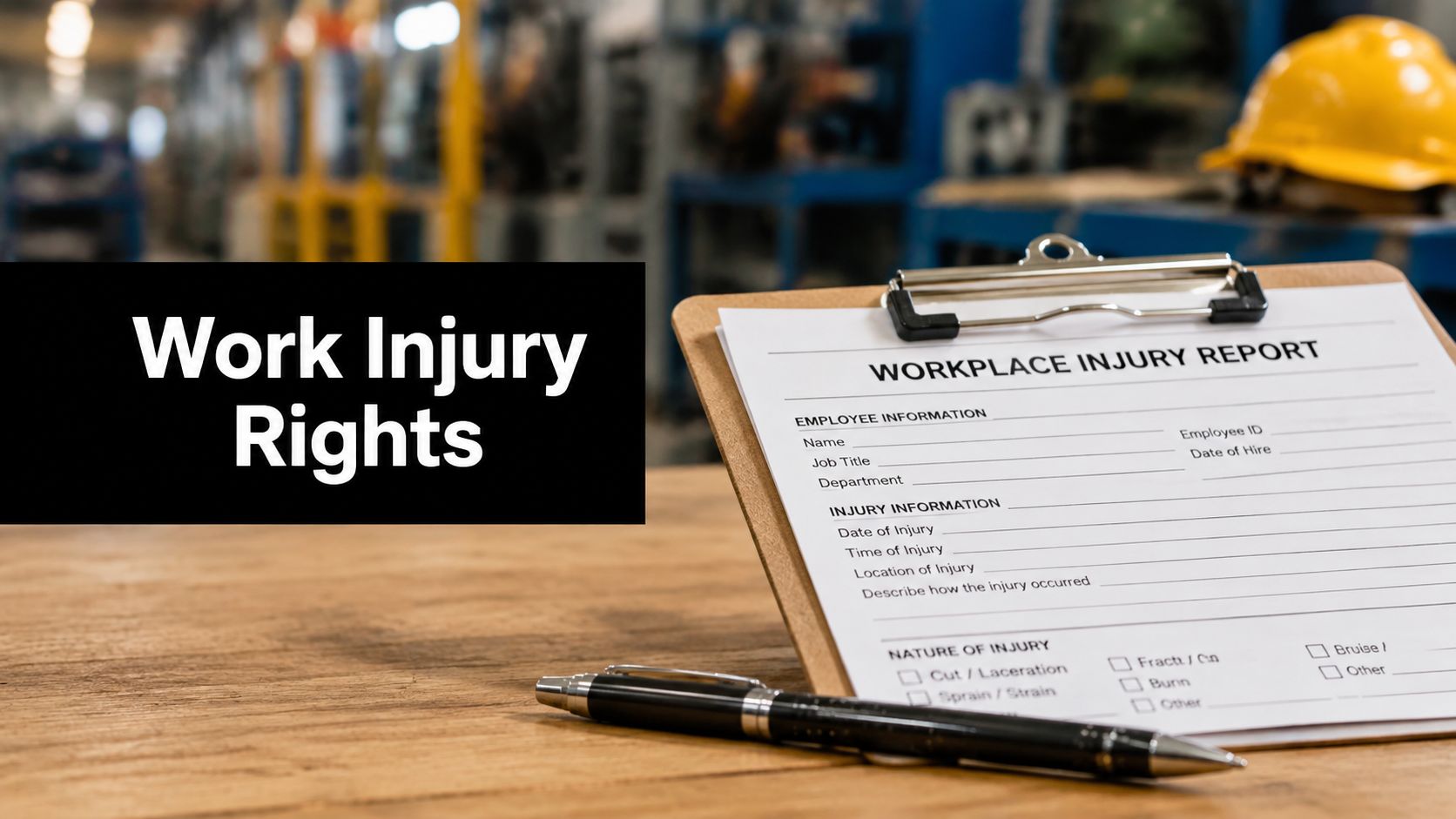
You may be reading this from a hospital chair, a car parked outside urgent care, or your kitchen table with one shoe off and a stack of forms you do not understand yet. A supervisor may have told you to “fill something out,” the pain may be getting worse, and you are probably asking the same question most injured workers ask first, what are my rights now?
In California, injury at work rights begin with a simple idea, the system is supposed to help you get medical care and wage support without making you prove your employer meant to hurt you. That matters because a workplace injury can disrupt everything at once, your body, your pay, and your routine. Federal workplace data shows injuries and illnesses remain a real issue for employees across the country, which is why quick action after an accident still matters. OSHA’s common statistics page tracks these incidents over time OSHA common workplace statistics.
For injured workers in California, the practical question is not abstract. It is whether you know what to say, who to notify, and what to ask for before a small delay turns into a larger dispute over your claim.
This article is for informational purposes only and should not be construed as legal advice. No attorney-client relationship exists based on your review of this article, and none of the information here is legal advice.
What Happens After a Workplace Injury
A workplace injury often starts with confusion. You may be in pain, unsure whether you should keep working, or worried that reporting the incident will create problems with your supervisor. California workers’ compensation is a no-fault system, so the first question is usually whether the injury happened during work, not whether you can prove someone intended harm.
That matters because you do not need to have every detail sorted out before you protect your health and your claim. A workplace injury is like a file that starts the moment the accident happens. The earlier you begin that record, the harder it is for details to blur, witnesses to disappear, or an insurer to question what took place. Washington’s worker guidance explains that basic no-fault structure clearly, and California workers are given the same practical direction, report the injury quickly and get medical attention right away Washington workers’ compensation rights overview.
A first report should be treated as the starting point for your case. If you wait, the facts can become harder to pin down, and the employer or insurer gets more room to dispute what happened.
Why the numbers matter
Workplace injuries are not a rare problem for California employees. Federal workplace data shows that injuries and illnesses still happen across private industry, including cases that lead to time away from work OSHA common workplace statistics. That tells you two things at once. Safety efforts matter, and injured workers still need a plan when an accident happens.
A serious injury is not limited to a broken bone or a dramatic accident. It can also mean missed shifts, lost wages, follow-up appointments, physical therapy, and pressure from an employer or insurer to return before you are ready. That is why the law gives injured workers a path to medical care and wage-related benefits instead of leaving them to absorb the loss alone.
A clear starting point
Your first move is not to argue about fault. Your first move is to protect your health, create a record, and make sure the employer knows the injury happened. Once that starts, the rest of the process is easier to manage, even if it still feels stressful.
Your Immediate Rights The Moment You Are Hurt
If you are hurt at work, start with the basics. Report the injury, get medical care, and write everything down. Those steps protect your health and your claim, even when the injury seems minor at first or you are not sure yet how serious it is.

Your report does not need to be perfect
California workers should notify a supervisor as soon as possible, including for conditions that build up over time once they know or believe the work caused them injury. You do not need legal wording. You need a clear statement of what happened, when it happened, and what body part or condition is involved.
A written report is better than a verbal conversation because it creates a record that can be reviewed later by the employer, the insurer, or anyone handling the claim. Put the date, time, location, task you were doing, and the names of anyone who saw what happened in the report. Keep your wording plain and factual.
Medical care comes first
You have the right to reasonable care for a work injury, and a supervisor should not talk you out of treatment if you are in pain, dizzy, or unsure about your condition. If the employer hesitates, say you want the incident documented and you want to see a doctor or clinic right away. If the condition is urgent, emergency care comes first.
A delay can work against you. It can make it harder to connect the injury to your job and can also slow treatment.
Document every contact
Write down the names of the people you spoke to, what they said, and when they said it. Save texts, emails, appointment notes, and discharge paperwork. If your supervisor says the injury was not serious, or asks you not to file a report, keep that too. Small details often become the facts that matter later.
If you are keeping notes in Spanish for your own records, make them as clear as possible and save the original wording. That helps a bilingual attorney, claims adjuster, or medical provider understand exactly what was said.
How to Report Your Injury and Start a Claim in California
A work injury can leave you focused on pain first and paperwork second. California’s reporting process is meant to be direct, but each step still has legal weight, so the safest approach is to tell the employer right away, ask for the claim form, complete your part, and return it without delay. If you are working with LA Law Group, APLC, this is also where bilingual support can help keep the process clear when English is not the language you use best.

The DWC-1 form is the key document
The DWC-1 claim form is the official starting point for a California workers’ compensation claim. Once you receive it, fill out your section carefully and keep a copy before you hand it back. If any part of the form asks what happened, stick to plain facts and leave out guesses.
Write the task you were doing, the body part or condition involved, and whether the injury happened all at once or developed over time. If you do not yet know the full diagnosis, you can still report the condition as work-related based on what you felt, what you saw, or what a medical provider told you.
Deadlines matter more than most workers realize
California expects injured workers to act promptly, and the notice should go out as soon as possible. Waiting can make the claim harder to support because the employer, insurer, and medical records all become less connected over time. The California Division of Workers’ Compensation guidance explains the basic reporting duty and why early notice matters.
Do not wait for a perfect diagnosis before filing. Early reporting helps preserve the link between the injury, the job duty, and the medical record, which is often the point insurers examine first when they question a claim.
What to keep in your file
Keep your own copy of the report, the claim form, and any follow-up emails. Save pay stubs, work schedules, and appointment summaries in one folder so you can show what happened and when. If your employer gives you a case number or sends you to a specific doctor, write that down right away.
Good records reduce disputes. A clean paper trail makes it harder for anyone to say they never heard about the injury or that the facts changed later.
Understanding Your Workers Compensation Benefits
Once a claim moves forward, most injured workers want the same answer, what does this pay for? California workers’ compensation generally revolves around four basic benefit categories, medical treatment, temporary disability, permanent disability, and supplemental job displacement benefits. Those labels sound technical, but the ideas are manageable once you separate them.

Medical care is about getting better, not just getting by
Medical treatment is meant to address the injury itself. That can include doctor visits, tests, therapy, medication, or other care that is reasonable and necessary for the work injury. The point is to cure or relieve the condition, not to leave you stuck managing pain on your own.
Wage replacement depends on the injury’s effect on your work
Temporary disability is the benefit that matters when you can’t work while you recover. Think of it as short-term income support during the healing period. Permanent disability is different, because it deals with lasting impairment after you’ve reached a more stable medical condition.
Retraining can matter if your old job no longer fits
Some workers can’t return to the same job after a serious injury. In that situation, supplemental job displacement benefits can provide retraining support. That benefit is especially important for workers whose old duties involved lifting, climbing, long standing, or other physical tasks that the injury now makes hard or impossible.
Benefit calculations can hinge on old pay records
The wage base matters more than many workers expect. The U.S. Department of Labor explains that workers can inspect records that affect benefits, and wage-loss benefits in many systems are based on the worker’s average weekly wage, calculated from gross earnings, including overtime, not just take-home pay U.S. Department of Labor workplace injury compensation guidance. That’s why pay stubs, schedules, and W-2s can make a real difference.
Keep every pay record you can find, especially if your job included overtime, shift differentials, or irregular hours. Those details can change the wage picture the insurer uses.
One practical example helps. If you regularly worked extra hours before the injury, those earnings may belong in the wage calculation. If you only save your net paycheck totals, you may miss the evidence that shows the full gross amount. That’s why workers who understand the paperwork often end up in a better position than those who rely on the insurer to assemble the file correctly.
When a Third Party Is at Fault
Workers’ compensation usually limits claims against the employer, but that doesn’t mean every other responsible person disappears from the picture. If someone outside your employer caused the injury, you may have a separate claim against that third party. The key is to spot who created the danger.
A delivery driver who gets hit by another motorist while making a work run may have a workers’ compensation claim and a separate claim against the driver who caused the crash. A construction worker injured by a defective tool made by another company may have one claim through workers’ comp and another against the manufacturer. An office worker who falls because a different company manages a badly maintained building may also have more than one path to recovery.
The tricky part is that not every injury away from a standard office is automatically covered or excluded. Guidance on work injuries notes the going and coming rule, which often excludes ordinary commuting, but coverage can still exist for travel between job sites or some work-from-home situations if the employee was acting in the course of employment work injury coverage guidance. That fact-specific analysis matters because location alone does not decide the case.
Why the distinction matters
A workers’ compensation claim usually focuses on medical care and wage-related benefits. A third-party claim can open the door to damages that workers’ comp does not usually cover, depending on the facts and the law that applies. That’s why the identity of the wrongdoer should be investigated early, not guessed at later.
If the injury happened while you were traveling, working at a customer site, or using equipment supplied by someone outside your employer, don’t assume the work comp file is the only file that matters. The facts may support a broader recovery, but only if someone asks the right questions at the beginning.
Your Right to Be Safe from Employer Retaliation
Fear keeps many people silent after a work injury. They worry about being cut from the schedule, pushed to a worse job, or treated like they caused the problem by speaking up. That fear is real, and research shows it affects reporting behavior, one study found that only 63% of serious injuries among healthcare workers were reported, and only 45% of those reporters filed a workers’ compensation claim PMC study on underreporting and retaliation concerns.
Retaliation is broader than firing
Illegal retaliation isn’t limited to termination. It can include demotion, harassment, reduced hours, discipline tied to the claim, or any adverse action because you reported the injury or asked for benefits. If your schedule changes right after you file, or a supervisor suddenly treats you differently, pay attention to the timeline.
A worker should not have to choose between medical care and the job. The right to claim benefits exists because injuries happen, and the employer cannot lawfully punish someone for using the system that the law provides.
What to do if retaliation starts
Write down each incident, including who said what and when. Save texts, emails, voicemail messages, and schedule changes. If the employer tells you not to see a doctor, not to report the injury, or not to “make a big deal” out of it, keep a record of that too.
Then keep using the claims process. The safest answer to retaliation is not silence, it’s documentation and prompt legal review when the pattern starts to show itself. If you need to communicate in Spanish, do it in the language that lets you explain the facts accurately, then keep copies of those messages.
Do not trade away your claim because you’re afraid of making waves. The claim is yours, and a threatened worker is still entitled to protection.
When to Speak with a California Work Injury Attorney
Some claims stay simple. Many don’t. If the insurer denies the claim, delays treatment, cuts off medical authorization, disputes your disability rating, or starts pressing you to go back before you’re ready, it’s time to get legal help. The same is true if a third party may be involved or if the employer retaliates after you report the injury.

A lawyer doesn’t change the fact that the injury happened, but a lawyer can change how well the paperwork, deadlines, and evidence are handled. That matters because insurers and employers usually have experience, adjusters, and systems built to manage claims efficiently from their side. You deserve someone who can review the record, spot the gaps, and press for the benefits the law allows.
Signs the file needs a closer look
When one of these issues shows up, don’t wait it out:
- Claim denial: the insurer says the injury isn’t covered or argues it didn’t happen at work.
- Treatment delay: medical care is stalled, redirected, or approved only in pieces.
- Rating dispute: the permanent disability level doesn’t match your condition or your doctor’s opinion.
- Third-party involvement: someone other than your employer may have caused the injury.
- Retaliation: your hours, duties, or treatment by management changed after you reported the claim.
If you’re in California and prefer Spanish, ask for bilingual communication early. Clear communication lowers the chance of mistakes, missed deadlines, and confusion about medical care or reporting steps. LA Law Group, APLC offers injury claim assistance in California and can communicate with injured workers who need English or Spanish support.
One conversation can save months of confusion. If you’re unsure whether your file is moving in the right direction, that uncertainty is often reason enough to ask for a review.
Video on California work injury rights
If you’re dealing with pain, a denied claim, or pressure from your employer, reach out to LA Law Group, APLC for a focused review of your work injury situation. The firm handles California injury matters and can help you understand reporting, claim handling, and next steps in plain language.
Attorney Advertising. This article is general information, not legal advice, and does not create an attorney-client relationship. Prior results do not guarantee a similar outcome.