
Motorcycle Accident in California: Legal Guide
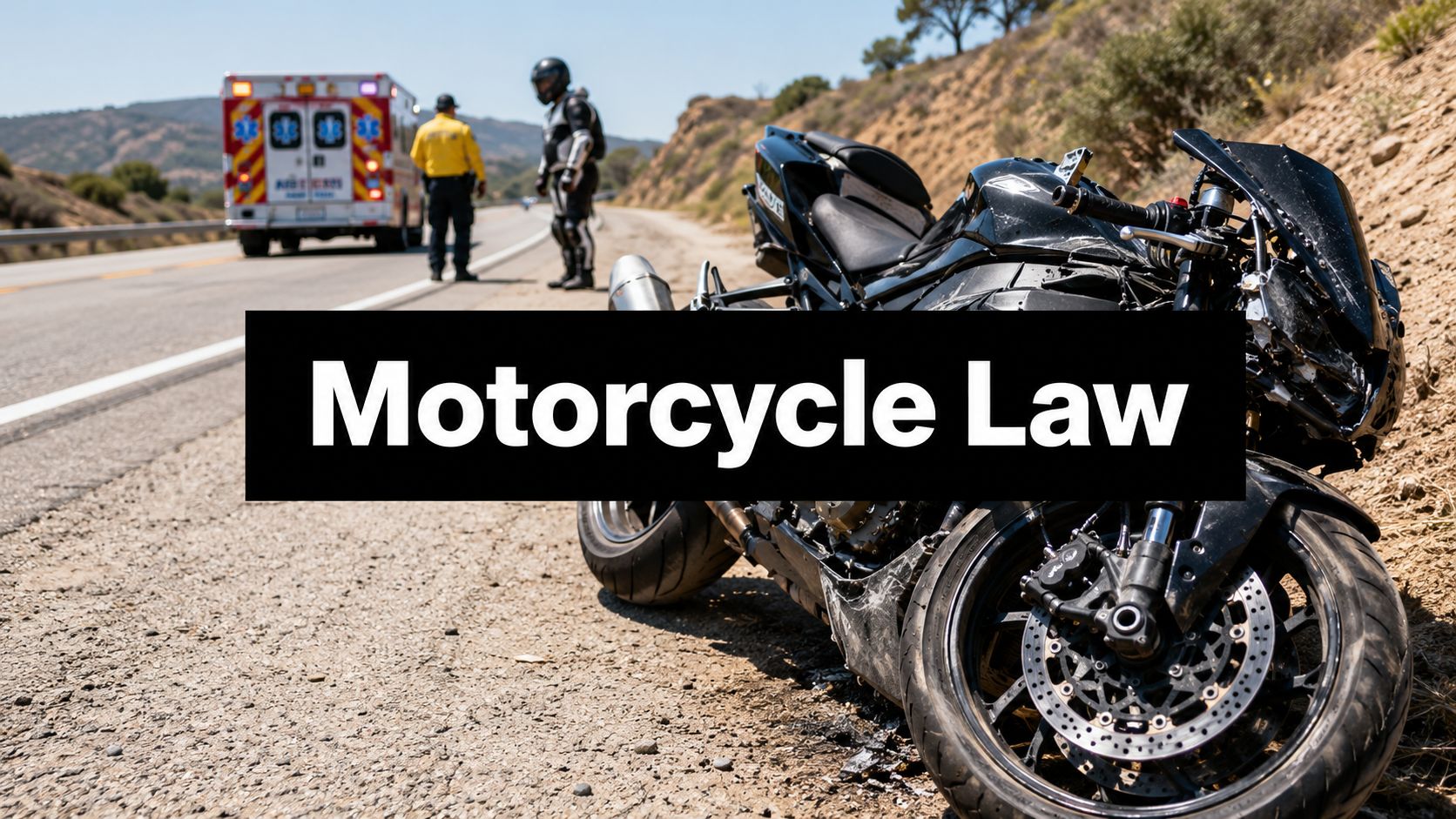
You’re standing beside a damaged motorcycle at a California intersection, trying to decide whether the pain in your shoulder is serious, whether the other driver is telling the truth, and what you should say before the police arrive. The other driver’s insurer may call soon with a friendly voice and urgent questions. Don’t treat that call as harmless. What you do after a motorcycle accident in California can affect your health, the evidence, and your ability to recover compensation.
California remains one of the country’s largest motorcycle-fatality markets. The National Highway Traffic Safety Administration’s 2024 traffic-fatality publication reported 6,228 motorcyclists killed nationwide in 2024, including 522 in California, about 8% of the national total. California’s Office of Traffic Safety also reported 583 motorcyclists killed in 2023, representing 14% of all motor vehicle fatalities in the state, as shown in its motorcycle safety data.
This article is for informational purposes only and isn’t legal advice. No attorney-client relationship exists based on your review of this article, and none of the information in this article is legal advice. The practical rules below can help you protect yourself, but an injured person should obtain advice about the specific facts, parties, insurance policies, and deadlines in their case.
What to Do Right After a Motorcycle Crash
You’re down near a busy intersection. Your helmet is still on, traffic is moving around you, and the other driver is saying, “I didn’t see you.” Your adrenaline is high, your body feels strangely numb, and you’re unsure whether moving your motorcycle will help or hurt.
Start with safety and medical care. Call 911, request police and emergency medical assistance, and don’t move an injured person unless immediate danger requires it. If paramedics tell you to stay still or remove equipment, follow their directions. A concussion, spinal injury, or internal bleeding may not be obvious while adrenaline is masking symptoms, so get evaluated even if you think you’re fine.

Protect the scene without creating another danger
If you can do so safely, photograph the intersection, vehicle positions, lane markings, traffic signals, road defects, debris, skid marks, visible injuries, motorcycle damage, and the other vehicle’s license plate. Ask witnesses for their names and contact information. Don’t assume the responding officers will locate every person who saw the collision.
Exchange names, contact details, driver’s license information, vehicle information, and insurance details. Keep your roadside conversation limited to facts. Don’t apologize, speculate, or say you caused the crash. “I’m sorry” can be interpreted as an admission, while “I’m fine” can later be used to minimize an injury.
Roadside rule: Give factual information to emergency personnel and law enforcement. Don’t negotiate fault or compensation beside the wreckage.
Notify your insurer as required by your policy, but don’t give a recorded statement about fault or injury before receiving advice. Don’t speak with the other driver’s insurer just because an adjuster calls quickly. For additional practical guidance on the initial response, review this first 72 hours after an automobile accident checklist.
Preserve your helmet, jacket, gloves, boots, and damaged motorcycle. Don’t repair, discard, or clean away evidence before it has been documented. The first hour often determines whether essential scene evidence survives, and the next several days determine whether your medical record clearly connects your symptoms to the collision.
How California Fault Rules Affect Your Recovery
California doesn’t use an all-or-nothing fault system for personal injury claims. Under pure comparative negligence, an injured person can recover damages even when they share responsibility, but the award is reduced by that person’s percentage of fault.
Consider a collision where a rider is found 30% at fault for lane-splitting at excessive speed, while a truck driver is found 70% at fault for an unsafe lane change. If the verdict is $500,000, the rider’s recovery is $350,000, because the award is reduced by the rider’s 30% share.

Fault percentages are negotiated before they’re decided
Insurance adjusters understand that every percentage assigned to the rider reduces the insurer’s exposure. They may point to speed, lane position, signaling, visibility, or helmet use and present an fault estimate as if it were established fact. It isn’t. Fault requires evidence.
Useful evidence can include:
- Dashcam footage: Video can show the other vehicle’s movement, signal use, speed context, and lane position.
- Witness accounts: Independent witnesses may confirm that the driver turned, merged, or changed lanes without properly observing the motorcycle.
- Accident reconstruction: A qualified reconstruction professional can analyze vehicle damage, roadway geometry, debris, photographs, and available video.
- Scene documentation: Traffic signals, lane markings, road conditions, lighting, and sight lines can challenge an insurer’s version of events.
- Medical records: Treatment records can connect the injury pattern to the collision and address arguments that symptoms came from another cause.
California’s rule is more forgiving than systems that bar recovery after a plaintiff crosses a 50% or 51% fault threshold, but that doesn’t make fault allocation unimportant. A rider who accepts an inflated fault percentage may permanently reduce the claim’s value. Even a theoretical recovery at 99% fault is rarely useful in practice because the remaining share may not cover the medical, financial, and litigation realities of the case.
The right approach is to investigate every participant’s conduct before accepting the insurer’s framing. Lane splitting, for example, shouldn’t be treated as an automatic admission of negligence. The actual speed, traffic conditions, roadway configuration, and actions of the other driver matter.
Helmet Laws and Equipment Compliance
California requires every motorcycle rider and passenger to wear a helmet that meets state requirements. The California Vehicle Code helmet provision addresses compliant motorcycle helmets, and California DMV guidance identifies the requirement for a U.S. Department of Transportation compliant helmet when operating a motorcycle, motor-driven cycle, or motorized bicycle.
Wearing something on your head isn’t the same as wearing legally compliant protective equipment. A novelty helmet or other noncompliant headgear can give the defense an argument that the rider violated the law and that the equipment contributed to the injury. That argument doesn’t automatically eliminate recovery under California’s comparative negligence system, but it can affect how responsibility for particular injuries is presented.
A California study found that novelty motorcycle helmets were associated with nearly twice the risk of death compared with full-face helmets, after adjusting for rider and collision characteristics. The study, available through the National Library of Medicine, didn’t find significant fatality differences among full-face, modular, open-face, and DOT half-helmets relative to one another. The practical lesson is clear, use a properly fitted, DOT-compliant helmet and preserve it after a crash.
Preserve proof that your equipment complied
Don’t throw away the helmet after impact. Photograph the DOT label before it becomes damaged or detached, preserve the helmet in its post-crash condition, and retain purchase or maintenance records if available. Photograph your jacket, gloves, boots, and other protective gear as well.
The motorcycle itself can also matter. Repairs may erase evidence of impact direction, contact points, and mechanical condition. Let the physical evidence be documented before making changes where possible.
| Requirement | Vehicle Code Section | Impact on Claim |
|---|---|---|
| Rider and passenger helmet compliance | Vehicle Code §27803 | Noncompliance may support a fault argument concerning head injuries |
| U.S. DOT-compliant helmet | DMV motorcycle guidance | The label and helmet condition can help document compliance |
| Required mirrors and related motorcycle equipment | Applicable California Vehicle Code provisions | A reported violation may be used to challenge lawful operation |
| Handlebar-height restrictions | Applicable California Vehicle Code provisions | The defense may cite an equipment violation as evidence of unsafe modification |
| Exhaust-noise limits | Applicable California Vehicle Code provisions | A citation or report reference may be used to portray the rider as reckless |
Equipment issues should be analyzed precisely. A helmet argument should relate to the injury it allegedly failed to prevent, and an equipment citation doesn’t prove that the rider caused the collision.
Claims for Passengers and Non-Rider Victims
A rider isn’t the only person who can suffer harm in a motorcycle crash. A passenger may be thrown from the motorcycle, a pedestrian may be struck near an intersection, and a rideshare passenger may be injured when another vehicle collides with the motorcycle. These victims need a claim analysis that doesn’t assume they controlled the motorcycle.

Passengers usually have a different fault position
A motorcycle passenger generally didn’t choose the operator’s speed, lane position, or decision to pass. If another driver caused the collision, the passenger may pursue that driver’s liability coverage. If the motorcycle operator also contributed, the passenger may have a claim involving the operator’s insurance as well.
That doesn’t mean a passenger’s claim is automatic. The investigation still needs to establish who acted negligently, what insurance policies apply, and whether the claimed injuries came from the crash. A passenger should preserve medical records, photographs, witness information, clothing, and any communications with insurers.
A passenger may also face questions about helmet use because California’s helmet requirement applies to passengers. The California motorcycle helmet statute makes that legal requirement explicit. However, the insurer should connect any alleged noncompliance to the specific injury rather than using it as a shortcut to deny the entire claim.
Rideshare and uninsured-driver issues require policy mapping
If an Uber or Lyft passenger is injured in a motorcycle collision, the claim may involve the motorcycle operator, the other driver, the rideshare company’s applicable coverage, and the passenger’s own uninsured or underinsured motorist policy. The fact that a rideshare was involved doesn’t answer which policy pays. The driver’s status, trip status, vehicle ownership, and the conduct of each party must be established.
Insurance stacking can become important when one policy doesn’t cover the full loss. A passenger may need to examine their own coverage, household policies, and the policies of responsible drivers. Don’t assume the first insurer that responds has identified every available source of recovery.
Passenger principle: You weren’t operating the motorcycle, so the investigation should focus on the conduct of the people and entities that were.
Pedestrians follow a similar path. Their claim usually centers on the driver or rider who created the danger, roadway conditions, visibility, and medical causation. A pedestrian’s evidence may include nearby business video, crosswalk signals, witness accounts, and photographs of the location. Non-rider victims often have a clearer liability narrative, but multiple insurance policies can still create delays and disputes.
Filing Deadlines You Cannot Miss
For a typical California personal injury claim against a private driver or company, the general deadline is two years from the accident under Code of Civil Procedure section 335.1.
A settlement conversation doesn’t automatically stop the clock. An adjuster’s investigation can continue while the deadline approaches, and a promise to “review the file” isn’t a legal extension. Protect the claim based on the accident date, not the insurer’s timetable.
Government claims use a shorter path
If a city vehicle, public transit operator, county agency, Caltrans, or another public entity may bear responsibility, the process changes. The initial government claim may need to be presented within six months, according to the verified California deadline information above. That administrative claim is separate from the later lawsuit and should be handled as an urgent issue.
Possible government involvement includes a public vehicle, dangerous public roadway condition, defective signal, or road-maintenance problem. Identify that possibility immediately, preserve photographs and location details, and obtain legal advice before assuming the ordinary private-party deadline applies.
Use a deadline file from day one
Record the date of every insurance communication, but don’t let organized paperwork create false confidence. A deadline can be missed even when the claim file is extensive.
The right move is to have a California attorney calculate the applicable deadlines and identify whether any public entity, minor, incapacity issue, or other fact changes the analysis. Don’t sign a release or accept a settlement before that review.
A motorcycle injury claim can include medical treatment, future care, lost income, reduced earning capacity, motorcycle and gear damage, pain, emotional distress, and loss of enjoyment of life. Build the claim around evidence rather than a quick estimate. Medical records, bills, wage documentation, employer records, treatment plans, and testimony about daily limitations all help connect the losses to the crash.
A practical overview of valuation issues appears in this guide to how much a personal injury case may be worth. The answer depends on the injury, treatment, prognosis, responsibility, and insurance available, not merely the fact that a motorcycle was damaged.
Expect these arguments from the defense
- “The rider was lane splitting unlawfully.” The insurer may use speed, spacing, and traffic conditions to argue that the rider increased the risk.
- “The helmet wasn’t compliant.” Counsel may argue that helmet evidence should reduce damages tied to head injuries.
- “The rider assumed the risk.” Ordinary motorcycle use doesn’t give another driver permission to drive negligently.
- “The condition was pre-existing.” Earlier medical records may be used to dispute causation, even when the crash aggravated a prior condition.
- “Treatment was inconsistent.” Gaps in care may be presented as evidence that the injury wasn’t serious.
- “The social media post proves the rider was fine.” A photograph or casual comment can be taken out of context.
Don’t give a recorded statement before understanding what the insurer is trying to establish. Don’t post about the crash, your recovery, recreational activity, or disputes with the other driver. Keep a private recovery log describing pain, limitations, appointments, medication effects, missed work, and changes in ordinary activities.
Evidence beats argument: Preserve the helmet and gear, document the scene, and secure witnesses before the insurer turns an incomplete record into its preferred story.
The first 72 hours
- Get medical care: Seek evaluation and follow the treatment plan.
- Preserve physical evidence: Keep the helmet, clothing, motorcycle, and damaged equipment.
- Document conditions: Save photographs, videos, road details, and witness contacts.
- Control communications: Notify your insurer as required, but decline adverse recorded statements.
- Create a paper trail: Keep bills, wage records, prescriptions, appointment notes, and correspondence.
Next Steps to Protect Your Claim
Prioritize the fundamentals:
- Preserve the crash evidence: Keep damaged gear and the motorcycle, and photograph everything before repair.
- Record witnesses and conditions: Write down what you remember while the sequence is fresh, without adding guesses about fault.
- Limit insurer contact: Don’t give a recorded statement or sign a release without reviewing the consequences.
- Stay off social media: Don’t post photographs, opinions, activity updates, or comments about responsibility.
- Get deadline advice: Ask whether the claim involves a private party, public entity, rideshare, employer, or multiple insurers.
The LA Law Group, APLC motorcycle accident practice is one option for California riders who want a case evaluation before dealing with insurers. A consultation should address liability, comparative fault, medical documentation, available coverage, and the steps needed to preserve the claim.
Don’t accept a settlement just because it arrives quickly. Once you sign a release, you may lose the ability to pursue additional compensation for injuries that become clearer later. Speak with a California personal injury attorney before signing anything, and ask whether the firm works on a contingency basis so you understand the cost before representation begins. It is worth asking how fees and case costs work and getting the terms in writing.
LA Law Group, APLC offers case evaluations for people injured in California motorcycle crashes, including riders, passengers, pedestrians, and rideshare occupants.
Attorney Advertising. This article is general information, not legal advice, and does not create an attorney-client relationship. Prior results do not guarantee a similar outcome.