
Multiple Car Accident in California: What to Do Next
You felt the first hit from behind, then a second jolt pushed you into the car in front, and now you’re standing on a shoulder trying to work out who hit whom while three insurers ask for your statement. That’s the confusion a multiple car accident creates, and it’s exactly why you shouldn’t treat it as one crash.
Think of each impact as its own event, with its own cause, evidence, and injury question. Once you separate the impacts, the reporting duties, fault arguments, and insurance limits become much easier to follow.
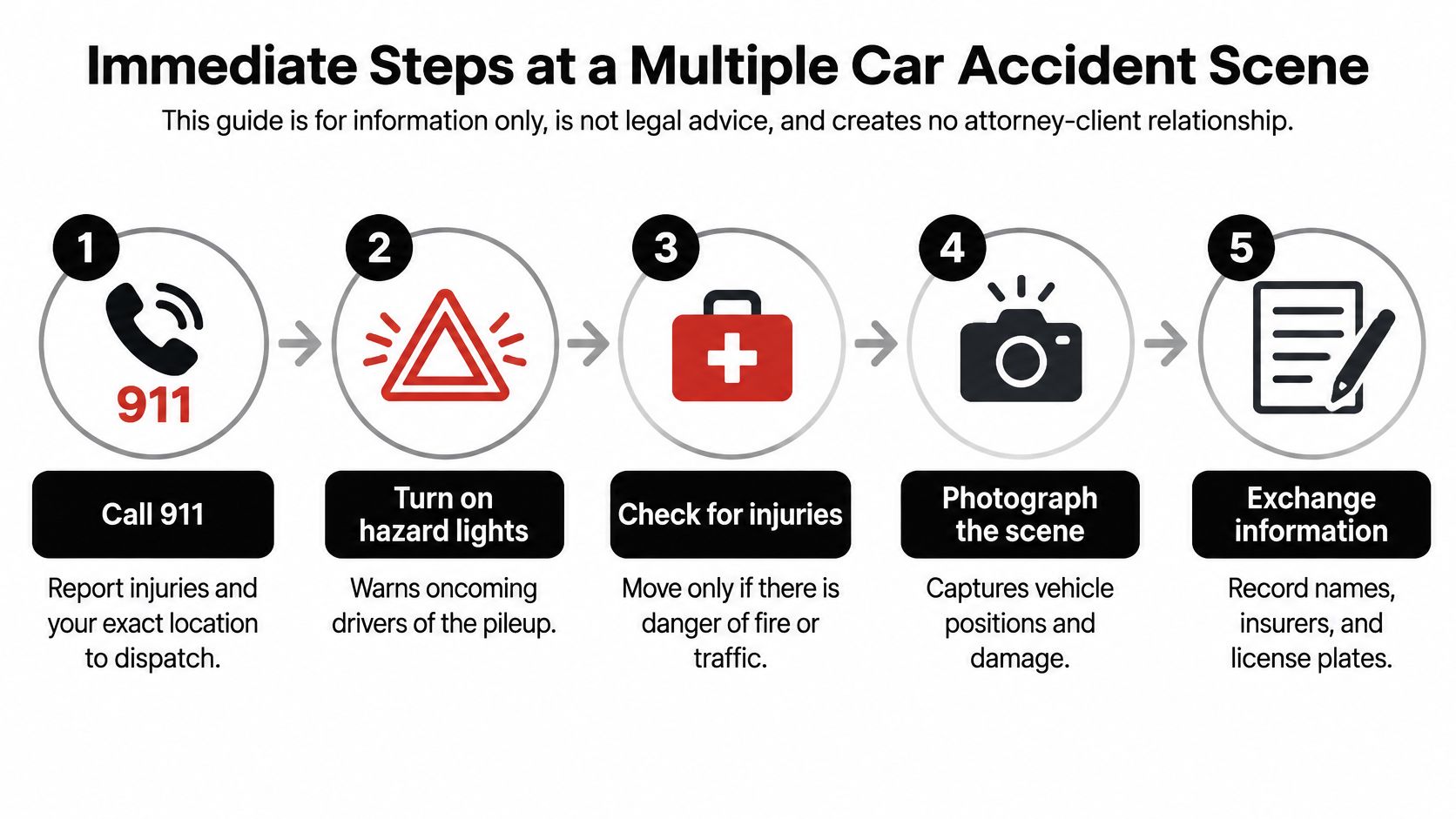
Immediate Steps at a Multiple Car Accident Scene
This guide is for information only, is not legal advice, and creates no attorney-client relationship.
You’re dealing with more than damaged bumpers. Stopped cars, debris, and drivers slowing to look can turn the first collision into a second one in the queue behind you. The order below puts safety first, then evidence, because you can’t recreate the scene once tow trucks clear it.
Safety and Reporting at the Scene
-
Check for injury and call 911 at once. Tell dispatch your exact location, direction of travel, and how many vehicles and injured people you can see. An injury that looks minor still needs medical evaluation, and the 911 timestamp later helps separate the first impact from a later one.
-
Turn on hazard lights and move only if it’s safe. If a vehicle can be driven out of a live lane without putting anyone in traffic, move it to the shoulder. If it can’t move, leave it, because pushing a disabled car across lanes creates more danger than it prevents.
-
Warn approaching drivers and keep people off the roadway. Place warning triangles or flares behind the scene where approaching drivers can see them in time to slow down. Keep passengers behind a guardrail or well off the shoulder, not between stopped vehicles where a later impact could pin them.
That warning step matters more than drivers often realize. Federal Highway Administration research on secondary crashes found that a multistate analysis covering more than 5 million crashes in 10 states identified nearly 52,000 verified secondary crashes, or approximately 1% of all recorded crashes, and about half occurred within 20 minutes of the primary event. In plain terms, the minutes right after your crash are when another driver is most likely to hit the queue.
Recording What Each Impact Did
-
Photograph before anything is moved. Capture vehicle positions, debris, lane markings, traffic signals, skid marks, and sight lines from several angles. Then photograph damage to the front and rear of each vehicle, because front and rear damage on the same car often shows it was hit twice, not once.
-
Exchange information with every driver. Record each name, driver’s license number, insurer, policy number if available, and license plate. Add passenger and witness names and phone numbers, since witnesses leave quickly and are hard to find later.
-
Get the police report number and agency. Ask whether it’s city police, sheriff, or California Highway Patrol, and write down how to request the report. That report doesn’t satisfy the separate DMV filing duty explained later, so don’t treat one as a substitute for the other.
-
Seek medical care the same day. Tell every provider about each impact you felt, not just the first one, and describe where pain started and when. Neck pain after a rear impact is common, and older readers may find whiplash recovery guidance for older adults useful context while they follow their own doctor’s instructions.
-
Write your own account while it’s fresh. Note the time, weather, lane you were in, and the order of impacts as you experienced them. Describe only what you saw and felt, and don’t guess about speed or fault, because a guess written down early can be treated later as an admission.
Practical rule: If you felt two separate jolts, write down two separate events, even if they were only seconds apart.
California Reporting Deadlines Each Driver Must Meet
California gives you 10 days to file the DMV report, and two situations trigger it. The California Driver Handbook guidance on collisions says a driver must submit a Report of Traffic Accident Occurring in California, commonly called an SR-1, to the Department of Motor Vehicles within 10 days when anyone is injured or killed, even if the injury appears minor, or when property damage exceeds $1,000.
Many drivers miss this because they assume someone else already reported it. That assumption causes most SR-1 problems after a pile-up.
Three Points Drivers Often Get Wrong
-
The SR-1 goes to the DMV within 10 days. Count from the crash date and calendar it the same day, while the date is easy to prove. Don’t wait for the police report to arrive first.
-
It’s due regardless of fault. If you believe another motorist caused everything, you still file if a trigger is met. The form reports that a qualifying crash happened, it doesn’t ask you to settle who pays.
-
A police, CHP, or insurer report doesn’t count. Those are separate reports for separate purposes, and none of them satisfies the DMV filing obligation. Learning how reporting an accident to the police works helps you keep the police process distinct from the DMV duty.
In a multiple car accident, each legally responsible driver may have an independent reporting duty rather than relying on another involved motorist. You can’t assume the driver at the back of the chain filed for everyone.
An insurance agent, broker, or legal representative can complete and submit the form for you, but the 10-day deadline still applies. Missing the threshold or deadline can create a separate compliance problem on top of the underlying crash. That second problem is avoidable, because it’s driven by a calendar date, not by a fault dispute.
How Fault Is Divided Across a Multi-Car Crash
These crashes aren’t rare, and they aren’t usually simple. The NHTSA 2023 traffic safety data reports 18,999 traffic fatalities in multi-vehicle crashes in 2023, representing approximately 46.5% of the 40,901 people killed in motor-vehicle traffic crashes that year, a 2.1% decline from 2022 while deaths in single-vehicle crashes fell by 6.1%.
Here’s a quick look at how vehicles can end up damaged in different positions after several impacts.
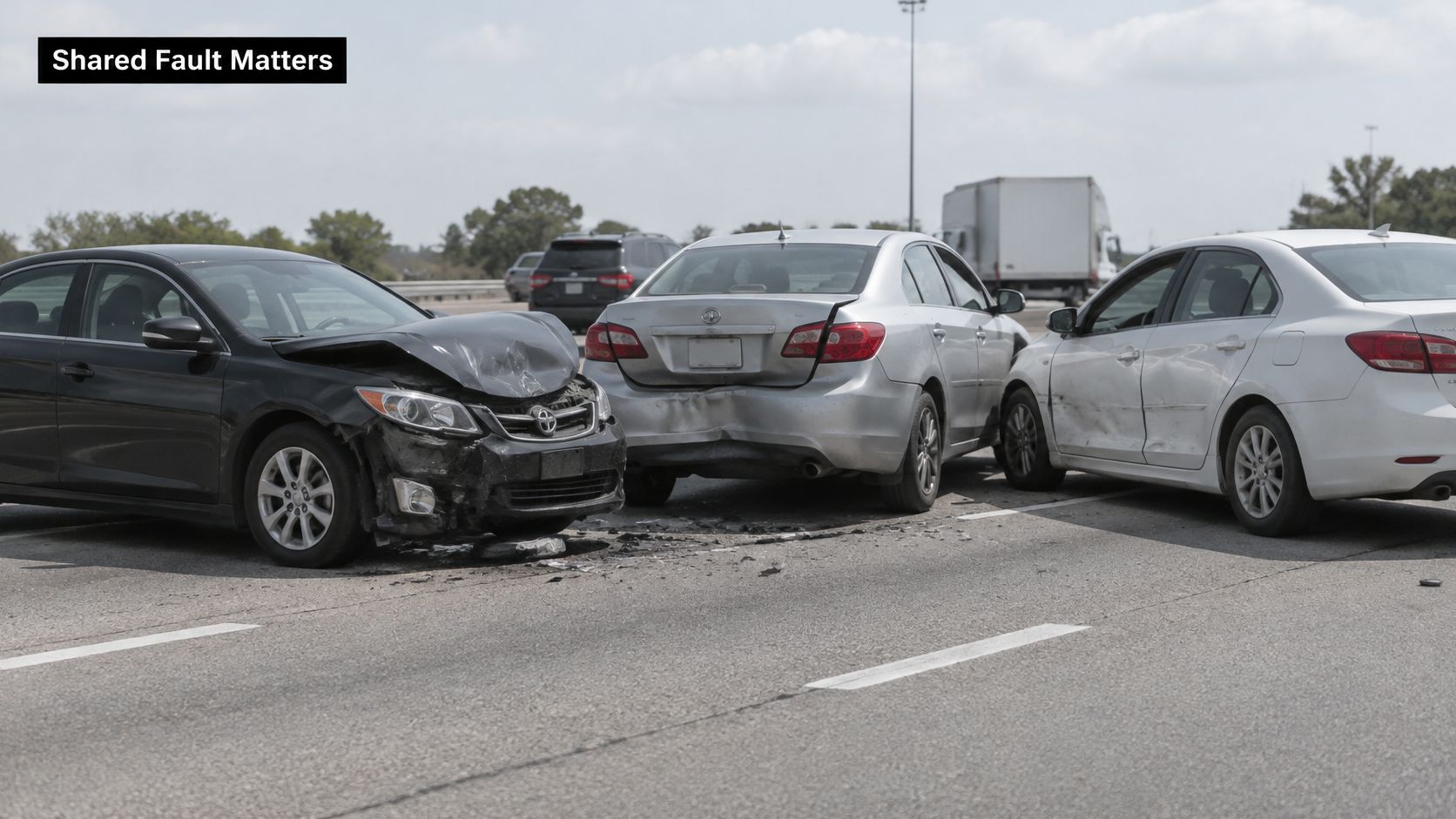
Think dominoes, but with an important twist. The first tap isn’t always what knocks the last piece down, and a chain can have several tippers, each pushing at a different moment for a different reason.
How California Splits Fault
California uses pure comparative negligence. If you’re partly at fault, your recovery is reduced by your share rather than automatically barred, which is why understanding what pure comparative negligence means matters before you accept an insurer’s percentage. Say you’re assigned 20% fault in a hypothetical example, your damages would be reduced by that share instead of disappearing entirely.
A second rule changes how money is collected from several defendants. Under Civil Code section 1431.2 (Proposition 51), non-economic damages, such as pain and suffering, are generally divided by each defendant’s percentage of fault. Economic damages, such as medical bills and lost wages, can be shared more broadly, so identifying every at-fault driver matters for both categories.
The useful question isn’t only who hit whom. It’s which act or impact caused each specific harm, and what evidence proves that link.
Why One Answer Rarely Fits Every Impact
It’s tempting to assume the driver who struck the vehicle in front automatically bears all responsibility. That shortcut fails when the chain includes unsafe following distance, delayed braking, poor roadway conditions, a defective safety system, or a later driver who failed to avoid a hazard that was already visible.
NHTSA preliminary 2025 data estimated 16,991 deaths in multi-vehicle crashes, representing 46% of traffic fatalities, even as total traffic deaths declined 6.7% from 2024. Behind those numbers sit individual sequences, and each sequence has to be proved with event-data-recorder downloads, vehicle damage sequencing, camera footage, timestamps, and reconstruction analysis rather than assumption.
Preexisting injuries add another layer. If you had an old back condition and two impacts made it worse, a medical expert may need to separate aggravation of an old condition from new harm caused by each impact. Without that separation, insurers may argue over which impact, if any, caused the symptoms you’re treating now.
Watch how a real sequence unfolds in the clip below, then use the table to match your pattern to its fault question.
Crash Patterns and the Evidence That Shifts Fault
| Crash pattern | Typical starting fault question | Evidence that can shift fault |
|---|---|---|
| Rear-end chain in stopped traffic | Did the following driver keep a safe distance and brake in time? | Braking data, following distance, whether the lead vehicle stopped abruptly |
| Secondary crash in the queue | Did the driver hit the first crash, debris or a stopped car? | Timestamps, queue position, warning-device placement, camera footage |
| Intersection side impact | Who had the right of way and was the signal or stop sign obeyed? | Signal timing records, traffic-camera footage, witness accounts |
| Lane change or merge | Did the driver changing lanes check for vehicles in the adjacent lane? | Dashcam video, vehicle damage pattern, lane-position photos |
| Head-on or median crossing | Did a vehicle cross the center line or lose control? | Skid and yaw marks, event data recorder speed and steering data |
| Vehicle pushed into another lane | Which driver started the chain, and was the pushed driver reacting reasonably? | Witness statements, camera footage, damage sequencing |
Read the table as a starting point, not a verdict. In a rear-end chain, for example, the last driver may have followed too closely, but braking data could also show the lead driver stopped abruptly for no clear reason. In a pushed-vehicle case, the middle driver may have hit you only because a car behind forced theirs forward.
Police opinions and insurer positions are inputs into that analysis, not final answers. An officer writes a preliminary view from the scene, and each insurer protects its own policyholder, so both can change when recordings, vehicle data, and medical records are compared against the timeline.
Evidence to Preserve and How to Build a Timeline
Treat your multiple car accident as a sequence, not a single bang. A first impact at 5:02 p.m. and a second impact at 5:12 p.m. may involve different drivers, different warnings, and different injuries, even though both happened in the same queue.
Time itself changes the risk. The FHWA traffic incident management synthesis reports that every additional 10 minutes that a primary incident remained active was associated with a 15% increase in the odds of a secondary incident. That’s why a timeline isn’t busywork, it’s how you show whether a later driver had time and warning to avoid you.
Building the Sequence in Order
Start with the first impact, then note how each vehicle moved or stopped afterward. Add when hazard lights, triangles, or flares were activated, when responders arrived, and when the queue formed behind the scene.
Next, slot in each subsequent impact with its own time and direction. A rear impact that pushed you forward is a different event from a side impact minutes later, and your medical description should match that order.
- Synchronize your clocks: Compare 911 timestamps, dashcam time, phone photo metadata, and toll or camera records so small clock differences don’t scramble the order.
- Sequence the damage: An expert can read crush profiles and paint transfer to tell which contact came first on a vehicle hit twice.
- Record visibility: Note sight distance, weather, sun position, and blocked views, because they affect what a later driver could reasonably see.
Evidence Sources and Why Each One Can Disappear
| Evidence | What it establishes | Why it can disappear |
|---|---|---|
| Event data recorder download | Speed, braking and throttle in the seconds before impact | Vehicle may be repaired, salvaged or its memory overwritten |
| Dashcam footage | Signal phase, lane positions and the order of impacts | Stored on a memory card or cloud account that overwrites on a cycle |
| Traffic and roadway camera footage | Timing, queue growth, lane closures and responder arrival | Agencies keep recordings on their own schedules, often briefly |
| 911 and dispatch records | When the first impact occurred and when help arrived | Audio and call logs are purged on agency retention schedules |
| Connected-car and driver-assist logs | Forward-collision warnings and automatic emergency braking activation | Manufacturer-controlled and time-sensitive |
| Scene photographs | Final vehicle positions, debris, sight distance and warning-device placement | Scene is cleared and vehicles are moved within minutes to hours |
| Witness contact details | Independent account of the sequence | Memories fade and witnesses become hard to reach |
| First-visit medical records | Which injuries were reported after which impact | Gaps invite disputes over whether a later injury came from a later impact |
Connected-car data needs careful handling. Forward-collision warnings, automatic emergency braking logs, and adaptive-cruise records may show what a vehicle detected and did, but that data is often time-sensitive and manufacturer-controlled. A warning or braking event is relevant evidence, it doesn’t automatically shift fault away from the human driver.
Finish your timeline with the first-visit medical records. If you reported neck pain after the rear impact and shoulder pain only after the later side impact, that first record links each complaint to a specific event. A gap of weeks before you mention the second injury gives insurers room to argue it came from somewhere else.
How California Insurance Limits Divide a Multi-Car Claim
One policy rarely stretches as far as people expect in a pile-up. That’s because several injured people may claim against the same limits at the same time.
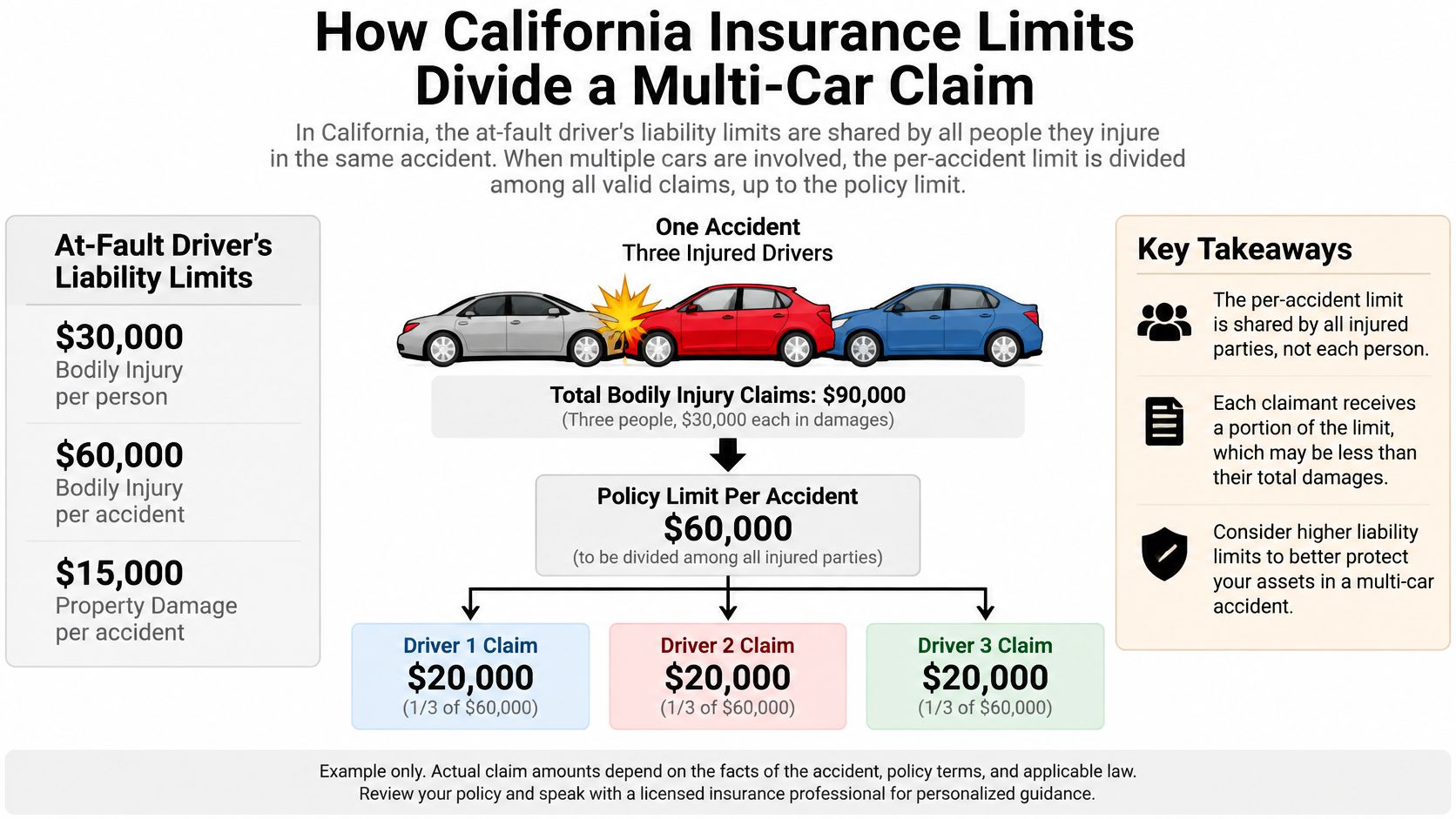
The California DMV financial responsibility guidance lists statutory minimums of $30,000 for bodily injury or death of one person, $60,000 for bodily injury or death of two or more people in one accident, and $15,000 for property damage in one accident. Reviewing California minimum car insurance requirements alongside your own declarations page shows whether a driver carried more than the floor.
California Minimum Liability Limits and How They Apply in a Pile-Up
| Coverage | California minimum | How it applies in a pile-up |
|---|---|---|
| Bodily injury, one person | $30,000 | Maximum payable to any single injured person |
| Bodily injury, two or more people | $60,000 | Aggregate cap for all injured people in one accident, still limited by the $30,000 per-person cap |
| Property damage | $15,000 | Shared across all damaged vehicles and property in one accident |
| Comprehensive and collision | Not counted toward the minimum | Covers the insured’s own vehicle, subject to the policy deductible |
A Worked Example With Four Injured Passengers
Say a driver carrying only the minimums causes a crash where four passengers each have a $25,000 injury claim, for $100,000 in total claims. Each person is under the $30,000 per-person cap, but the $60,000 aggregate cap is the actual ceiling for that policy.
Those four claims therefore share $60,000 from that policy, leaving $40,000 of the example losses not covered by it. The shortfall doesn’t mean the claims lack value, it means that one policy has run out and other policies or coverage types need checking.
Property damage works the same way. If three damaged cars each need $8,000 in repairs, that’s $24,000 in claims against a $15,000 per-accident limit, so the limit is shared rather than paid separately to each owner.
Full coverage and collision coverage are separate from liability coverage and don’t count toward the state minimum. Collision coverage addresses damage to your own vehicle subject to your deductible and policy terms, while liability coverage addresses your legal responsibility to others. These minimums are legal floors, not guarantees that a multi-vehicle crash will be fully compensated.
Coverage and Deadlines Beyond the Minimum Limits
When the at-fault driver’s limits look too small, check your own policy before assuming there’s nothing else available. Three coverages are worth confirming on your declarations page this week.
-
Uninsured motorist coverage: California insurers must offer it, and it can be rejected only in writing. It may apply when a responsible driver has no insurance.
-
Underinsured motorist coverage: This optional coverage may apply when the at-fault driver’s limits are too low to cover your losses. Check the limit and any offset language in your policy rather than guessing from the name.
-
Medical payments coverage: Often called MedPay, it can pay medical bills regardless of fault, subject to its own policy limit. It doesn’t settle the fault dispute, but it can reduce immediate out-of-pocket pressure.
Passengers aren’t limited to one policy either. You may be able to look to your own driver’s policy and to policies covering other drivers in the chain. If you were riding in a rideshare vehicle, coverage may involve the driver’s policy or the rideshare company’s policy depending on the driver’s app status at the time.
Then calendar the civil deadlines separately from the DMV duty. Personal injury claims generally must be filed within two years under Code of Civil Procedure section 335.1, and property damage claims generally within three years under section 338. Claims against public entities can require a written claim within six months under Government Code section 911.2, which is much shorter.
The 10-day SR-1 deadline is an administrative duty, not a lawsuit deadline. Filing it doesn’t extend the civil periods, and missing it doesn’t replace them, so track both tracks on the same calendar.
Confirm Your Options Before Accepting an Insurer Offer
This article is for information only, is not legal advice, and reading it creates no attorney-client relationship.
An early consultation is worth considering when several injured people share one policy, fault is disputed among three or more drivers, or you have preexisting injuries that insurers are already questioning. The same applies if you were a rideshare passenger injured by another driver, or if the at-fault driver’s limits look too low for your medical bills and lost income.

Before any recorded statement or settlement, gather four items in one folder.
- SR-1 filing date: Proof you met the DMV deadline for your multiple car accident.
- Police report number: Plus the responding agency, so the report can be pulled quickly.
- Medical timeline from the first visit: Records showing which symptoms followed which impact.
- Evidence list: Photos, witness contacts, dashcam files, and any vehicle data you have preserved.
LA Law Group, APLC offers a free initial consultation with direct attorney access, with offices in Los Angeles, Santa Monica, Chatsworth and Fremont. You can use that consultation to test whether an insurer’s fault split and limit calculation actually match your timeline.
Your next step this week is concrete. Confirm your reporting deadline and every policy limit in writing, then decide on a consultation before you sign a release or give a recorded statement that insurers can use to lock in their version of the sequence.
If several drivers and insurers are pointing at each other after your pile-up, bring your SR-1 date, police report number, medical timeline, and photos to a free initial consultation where you can speak directly with an attorney about each separate impact. Visit LA Law Group, APLC to request that review before you accept an offer that treats multiple impacts as if they were one simple crash.
Attorney Advertising. This article is general information, not legal advice, and does not create an attorney-client relationship. Prior results do not guarantee a similar outcome.