
Passenger in Car Accident Who Do I Sue: A Practical Guide
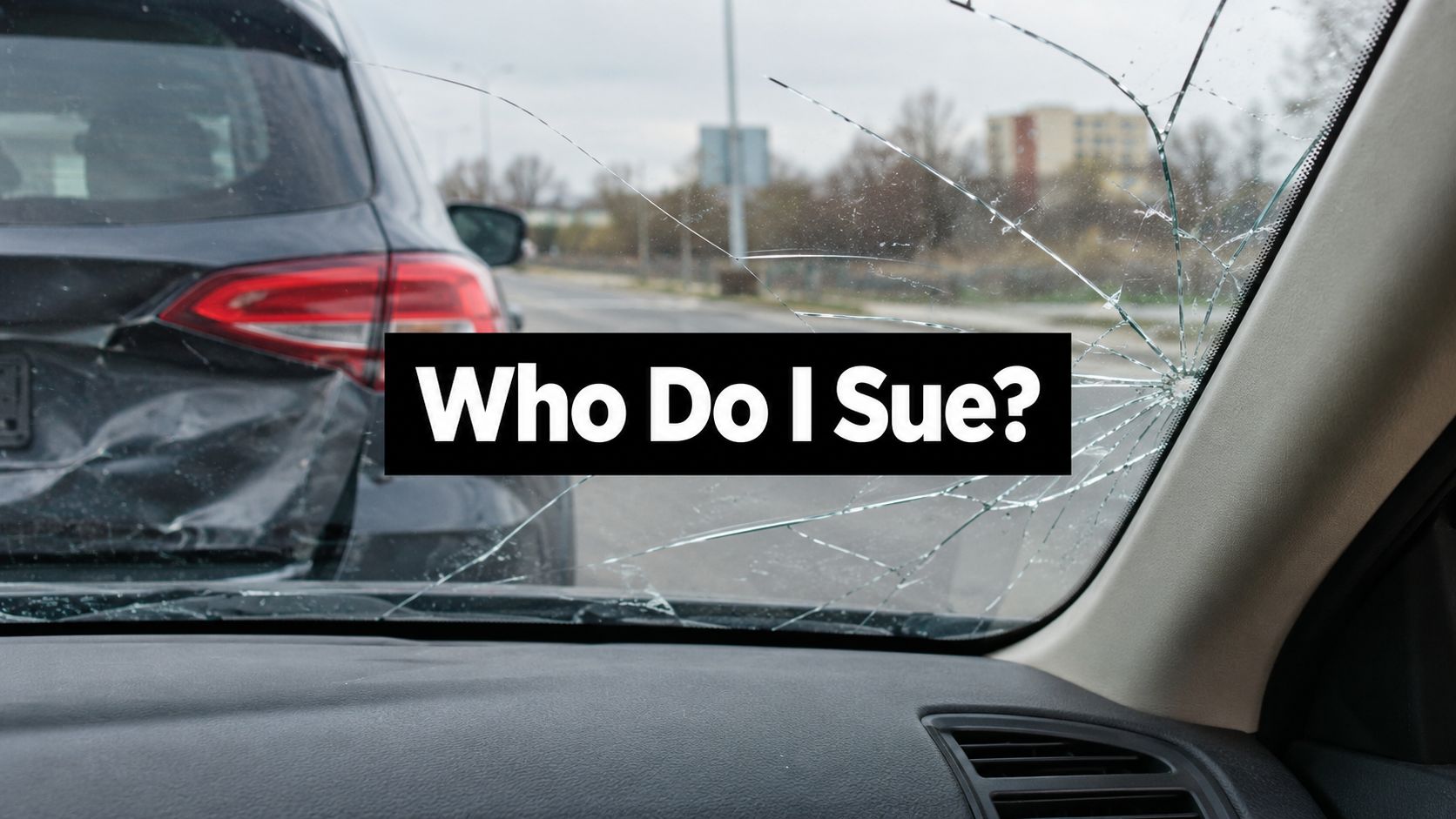
You were riding in the passenger seat when the crash happened. Now your neck hurts, your medical bills are arriving, you’ve missed work, and everyone involved is blaming someone else. You may also be worried that pursuing compensation means suing a friend, relative, rideshare driver, or coworker.
The question, “Passenger in a car accident, who do I sue?”, has a practical answer: possibly more than one party. In California, an injured passenger may have a claim against the driver of the vehicle they occupied, the other driver, or both. Other possibilities include a vehicle owner, an employer, a rideshare company, a government entity, or a vehicle manufacturer. The right approach is to identify every potentially responsible party, preserve evidence, pursue insurance first, and escalate to a lawsuit when the claim, injuries, or coverage justify it.
What Your Situation Looks Like Right Now
Suppose you’re riding in the front passenger seat of a friend’s car in Los Angeles. Your friend runs a red light, another vehicle hits the car in the intersection, and you’re taken to the emergency room. Your friend says the other driver caused everything. The other driver says your friend entered the intersection illegally. Meanwhile, both insurance companies want your version of events before you fully understand your injuries.
That situation is common in structure, even when the details differ. You may be dealing with pain, medical appointments, lost wages, vehicle damage, and conflicting accounts at the same time. The fact that you weren’t driving doesn’t leave you without options. It can expand the pool of possible defendants because you may pursue the host driver, the other driver, or both when their negligence contributed to the collision.
Practical rule: Don’t decide who is responsible based on friendship, the first insurance call, or the police officer’s initial impression. Liability should be investigated from the evidence.
California treats an injured passenger as a third-party claimant. You generally aren’t required to prove which driver was most responsible before making a claim, because fault can be allocated among negligent parties. That matters when both drivers tell different stories or when one policy has inadequate limits.
Your immediate priorities are straightforward:
- Get medical care: Treat injuries promptly and follow the provider’s instructions.
- Preserve evidence: Save photographs, reports, medical records, bills, and witness information.
- Identify insurance: Find every policy that might respond to the crash.
- Avoid premature statements: Don’t give a recorded statement or sign a broad release before you understand what you’re signing.
- Track deadlines: California’s standard personal injury deadline is generally 2 years from the accident date, while claims involving a public entity can require a written government claim in as little as 6 months.
Every Party a Passenger May Have a Claim Against
The host driver is the first potential defendant, not necessarily the last. If the driver you were riding with sped, ran a stop sign, drove while distracted, or made an unsafe turn, their insurance may cover your injuries. Your relationship with that person doesn’t erase your claim. In most passenger cases, the insurance carrier handles the defense and payment rather than requiring you to pursue the individual’s personal assets.
The other driver may also be responsible. A crash can involve a host driver who made a mistake and another driver who was speeding, following too closely, or changing lanes unsafely. California’s comparative-fault system allows responsibility to be divided, so you may present claims against both drivers while the evidence determines each party’s share. A passenger’s ability to pursue multiple drivers is especially important when the drivers blame each other.
The broader defendant roster
A careful investigation should also examine these parties:
- Vehicle owner: An owner may face a claim when they negligently entrusted the vehicle to a driver they knew was unsafe, unlicensed, impaired, or otherwise unfit. Evidence can include prior warnings, communications, driving history, or testimony about the owner’s knowledge.
- Employer: If the driver was working, the employer may have responsibility depending on the driver’s job duties and the circumstances of the trip. Delivery companies, trucking businesses, and companies providing vehicles to employees require a review of employment records, route information, time logs, and company policies.
- Rideshare company: A passenger injured during an Uber or Lyft trip may need to identify the driver’s status in the app, whether a ride had been accepted, and which insurance layer applied at the moment of impact. Rideshare accident guidance discusses why the app record and trip status matter.
- Government entity: A dangerous roadway, defective traffic signal, missing warning, or other public-property condition may create a claim, but special notice and claim procedures can apply. Preserve photographs and report the condition quickly.
- Vehicle or component manufacturer: Defective brakes, airbags, tires, seat belts, or other components may shift part of the case toward a product-liability claim. Keep the vehicle intact and avoid repairs or disposal before an investigation.
- Alcohol provider: Claims against a bar or other alcohol provider are limited and fact-dependent. They require a close examination of the applicable California rules and the evidence connecting the provider to the crash.

The evidence determines which names belong in the claim. Police reports, photographs, vehicle damage, traffic-camera footage, witness statements, phone records, electronic vehicle data, employment records, and insurance documents can each connect a party to the crash. Practical defendant-identification guidance recommends preserving evidence early and identifying all insurance layers before filing.
Practical Steps to Take After the Crash
Start with your body, not the paperwork. Get evaluated promptly, even if the pain seems manageable. Some injuries become clearer later, and a treatment gap gives an adjuster an argument that the condition wasn’t caused by the crash or wasn’t serious.
At the scene, ask someone to document what you can’t. Photograph each vehicle, the road layout, traffic controls, visible injuries, license plates, and the other driver’s insurance card. Collect names, phone numbers, and email addresses for witnesses. Don’t argue about fault or post an account of the crash online.
Build the record in order
Request the police report when it becomes available. It may contain statements, diagrams, citations, vehicle information, and the officer’s observations. It isn’t the final word on liability, but it can preserve details that become harder to recover later.
Notify the relevant insurers, but be disciplined:
- Your own coverage: Ask about medical-payment coverage, personal injury protection where applicable, and uninsured or underinsured motorist benefits.
- The host policy: Provide notice to the insurer for the vehicle you occupied.
- The other driver’s policy: Identify that carrier and open a claim without agreeing to a final settlement before your injuries are understood.
- Rideshare coverage: If the crash involved Uber or Lyft, preserve the trip receipt, app messages, driver information, and trip status.
You can report a claim without giving a detailed recorded statement immediately. An adjuster’s job is to evaluate exposure for the insurer, not to protect your interests. Don’t sign a blanket medical authorization or release that gives an insurer unrestricted access to unrelated records.

Keep one dedicated folder, whether physical or digital, for medical bills, appointment records, wage-loss documentation, insurer letters, claim numbers, photographs, and repair information. A short daily symptom journal should record pain, sleep disruption, medication effects, mobility limits, and missed work. Those details help show how the injury affects ordinary life, not just what appears on a billing statement.
The following video provides additional general information about immediate post-crash decisions.
Insurance Claim or Lawsuit and How to Choose
For a California passenger, start with the insurance claim, then decide whether litigation is necessary. A claim lets you submit medical records, establish liability, identify every applicable policy, and negotiate without filing in court. It usually costs less time and avoids court filing expenses. The trade-off is control. The insurer may deny responsibility or value your injuries below their fair value, especially before doctors can assess future treatment.
A lawsuit gives you formal tools to obtain evidence, question witnesses, and pursue damages when the carriers will not make a fair offer. It also requires proof of negligence, causation, and damages through records, discovery, testimony, and possibly trial. The process takes longer, and attorney fees and case expenses depend on your representation agreement.
When the claim should become a lawsuit
Consider filing when:
- Liability is denied: One or more carriers refuse responsibility or blame you for the collision.
- Coverage is inadequate: California’s minimum bodily-injury liability limits are $30,000 per person and $60,000 per accident for policies issued or renewed on or after January 1, 2025 (Vehicle Code section 16056). Passenger medical bills can consume those limits quickly, so identify every policy and potential defendant.
- The injury is substantial: Permanent impairment, future medical care, significant wage loss, or major disruption to daily life should not be resolved through a rushed settlement.
- Multiple parties are involved: The host driver, other driver, vehicle owner, employer, rideshare company, or a government entity may have different defenses and insurance. A coordinated investigation is often more useful than accepting the first offer.
In no-fault states like New York, passengers must clear a serious-injury threshold before suing for pain and suffering, a rule that does not apply in California.

Before accepting payment, confirm that you understand your medical outlook, all available policies, and the effect of signing a release. If the at-fault driver has no insurance or too little coverage, review uninsured and underinsured motorist claim information to see whether your own policy may provide another recovery path.
How Fault and Damages Actually Work in California
California uses comparative fault. In plain English, the decision-maker assigns percentages of responsibility and reduces your recovery by the percentage assigned to you. A passenger who rode in a vehicle usually has a stronger position than a driver because the passenger generally didn’t choose the speed, lane change, braking, or traffic maneuver that caused the collision.
That advantage isn’t automatic. An insurer might argue that you failed to use a seat belt, knowingly entered a vehicle with an obviously impaired driver, or otherwise contributed to the harm. Whether that argument succeeds depends on evidence, the injury mechanism, and California law applied to the facts.
Fault follows evidence
Consider a collision involving a stop sign and a sudden lane change. The host driver may bear responsibility for failing to stop, while the other driver may share fault for moving into the occupied lane. The passenger’s claim can proceed against both, with the final allocation based on reports, photographs, witnesses, vehicle damage, traffic evidence, and testimony.
The damages analysis is separate from fault. A claim may include:
- Medical expenses: Emergency care, diagnostic services, medication, therapy, and future treatment supported by medical evidence.
- Lost income: Pay lost during recovery and, where supported, reduced earning capacity.
- Pain and suffering: Physical discomfort, emotional distress, sleep problems, and limits on ordinary activities.
- Future care: Treatment or assistance reasonably connected to a lasting injury.
- Property damage: Personal property damaged in the collision, where legally recoverable.
Passenger claims can also involve uninsured or underinsured motorist coverage. That coverage is governed by policy language and statutory rules, and some jurisdictions apply serious-injury thresholds or other restrictions. California passengers should have counsel review the policy rather than assume the other driver’s coverage is the only available source.

The key distinction is simple: your damages may be substantial even when you didn’t cause the crash, but the amount you can collect depends on proof, fault allocation, available coverage, and applicable procedural rules.
How to Pick the Right Attorney for Your Case
Confirm that the attorney is admitted in California, handles passenger and motor-vehicle injury claims, understands insurance coverage, and has actual litigation and trial experience. A lawyer who only negotiates straightforward claims may not be the right fit for a disputed multi-driver collision.
A consultation should address the crash sequence, your treatment, missed work, available policies, witnesses, photographs, and any concerns about the host driver. Bring the police report if you have it, every insurer letter, medical records, bills, wage information, and photographs. The attorney should explain possible defendants, likely evidence, significant risks, and the next decision point without promising a result.
Questions worth asking
- Strategy: Which parties and policies will you investigate first?
- Evidence: How will you preserve vehicle data, surveillance, witness accounts, and medical proof?
- Timing: What could delay the claim, and what deadlines require immediate action?
- Communication: Who will answer questions, and how will updates be provided?
- Fees: Is representation contingent on recovery, and which litigation costs may be charged separately? It is worth asking how fees and case costs work and getting the terms in writing.
- Settlement: How will you decide whether an offer reflects the full injury picture?
It should explain the percentage, case expenses, medical liens, costs if the case doesn’t recover money, and whether expenses are deducted before or after the fee calculation.
Red flags include a guaranteed outcome, pressure to sign immediately, vague answers about fees, refusal to discuss adverse evidence, or a lawyer who cannot explain the difference between an insurance claim and a filed lawsuit. A practical lawyer-selection guide can help you prepare for the first meeting.
One option for California passengers is LA Law Group, APLC, which offers personal injury representation and free initial consultations. Compare any firm’s proposed strategy, fee agreement, communication plan, and experience with the needs of your specific crash.
Your Action Plan and an Important Disclaimer
The first days after a crash can affect both your health and your claim. Use this checklist:
- Get examined by a doctor within 24 hours: Tell the provider your symptoms began after the collision and identify every affected area.
- Photograph vehicles and the scene: Capture vehicle damage, road conditions, traffic controls, visible injuries, and license plates.
- Collect information from every driver: Get names, contact information, insurance details, vehicle information, and rideshare records when relevant.
- Request the police report: Keep it with your claim documents and flag factual errors for discussion with counsel.
- Avoid recorded statements until counsel reviews them: Notify an insurer, but do not give a detailed statement or sign a broad authorization immediately.
- Track treatment and expenses: Record appointments, prescriptions, mileage, out-of-pocket costs, missed work, and daily limitations.
- Confirm the filing deadline that applies to your case: Review the deadlines discussed earlier. Claims involving a public entity may require written notice in as little as 6 months, so do not wait to identify every potentially responsible party.
This article provides general information, not legal advice. Reading it does not create an attorney-client relationship. Laws, deadlines, insurance rules, and procedures can change. California readers should confirm the requirements for their situation with a licensed attorney admitted in the relevant jurisdiction before acting.
If you were injured as a passenger, contact LA Law Group, APLC to discuss the drivers, insurers, vehicle owners, employers, rideshare companies, or public entities that may be responsible for your losses. The firm offers a free initial consultation to review the collision and explain practical next steps before you choose between an insurance claim and a lawsuit.
Attorney Advertising. This article is general information, not legal advice, and does not create an attorney-client relationship. Prior results do not guarantee a similar outcome.