
Pedestrian Car Crash in CA: A Step-by-Step Legal Guide
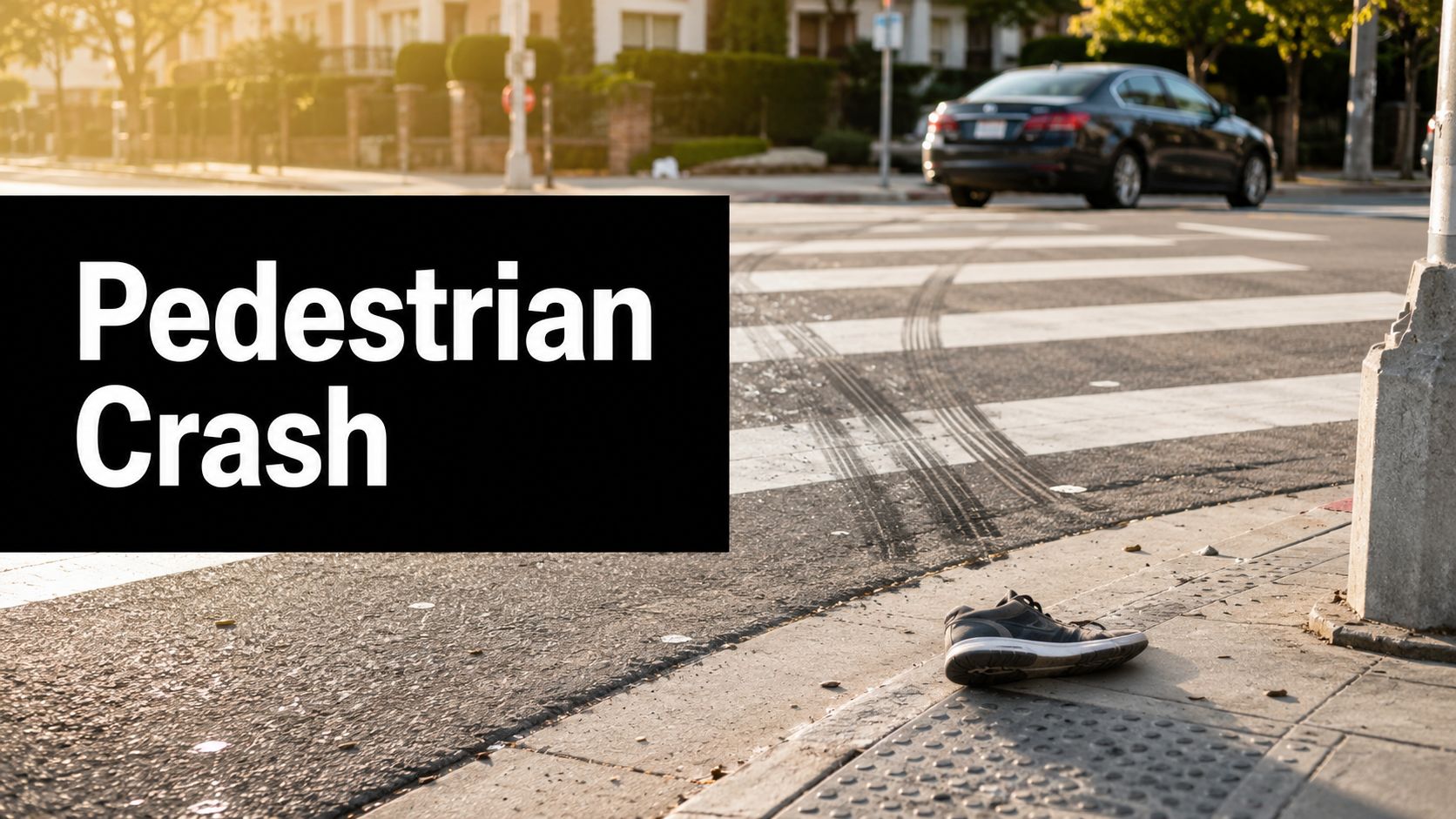
You’re sore, shaken, and probably replaying the impact in your head. Maybe you remember the headlights. Maybe you only remember waking up on the pavement, your phone somewhere out of reach, with strangers telling you not to move. That’s how a pedestrian car crash often starts for victims in California. Confusion first. Questions second. Pain later, once the adrenaline drops.
You also need to know this isn’t a rare edge case. In the United States, pedestrian fatalities rose 78% from 2009 to 2023, reaching 7,314 deaths in 2023, and pedestrians accounted for 18% of all crash fatalities that year, according to the Insurance Institute for Highway Safety pedestrian fatality data. If you’ve been hit, you’re dealing with a serious event, not a paperwork nuisance.
I’m going to be direct. Your health comes first, but your legal position starts forming immediately. What you do in the first minutes, the first day, and the first week can shape the entire claim. This article is for informational purposes only. It is not legal advice, and reading it does not create an attorney-client relationship.
Your Guide Through the Aftermath of a Pedestrian Accident
A pedestrian car crash turns ordinary life into a logistics problem overnight. You’re trying to get imaging, follow-up care, pain medication, time off work, rides to appointments, and answers from people who suddenly care a lot about what you said at the scene. If you don’t act carefully, the insurance company will use that chaos against you.
California claims get messy fast because fault is rarely established clearly at the start. Drivers say you came out of nowhere. Adjusters ask loaded questions. Police reports can be incomplete. Meanwhile, your body may not fully declare the injury for a day or two. That gap creates risk.
What matters most right now
You need to think in this order:
- Medical stability: Get evaluated and follow through with treatment.
- Evidence preservation: Lock down facts before they disappear.
- Communication control: Say less, document more.
- Legal timing: Don’t miss deadlines and don’t let the insurer frame the story first.
Practical rule: If you were hit by a vehicle, assume the case is more serious than it looks in the first few hours.
A lot of victims make the same mistake. They treat the crash like a misunderstanding that can be cleared up with common sense. That’s not how claims work. Claims are built on records, photos, witness accounts, scene details, medical documentation, and consistency. You need a clean file, not just a sincere story.
Why California victims need a different mindset
California is not forgiving when you wait too long, guess at facts, or trust the adjuster to “work it out.” You need to protect your credibility from day one. That means no casual speculation, no minimizing your pain, and no quick settlement just because you need money this week.
You don’t need to know everything today. You do need to avoid the mistakes that can damage your case before it starts.
Immediate Steps to Take at the Scene
The first hour matters because your body is vulnerable and the scene is unstable. Get yourself out of danger first. In National Safety Council pedestrian fatality data summarizing NHTSA findings, 83% of pedestrian traffic deaths in 2023 occurred in urban settings, and 74% happened in dark conditions. That tells you something important. A street that already hurt you can hurt you again if you stay exposed in traffic.
Start with this checklist.

Protect your body before you protect your case
If you can move safely, get to the sidewalk, shoulder, median, or another place away from active traffic. If moving causes sharp pain, dizziness, numbness, or weakness, stay where you are and wait for paramedics. Don’t force yourself up to prove you’re okay.
Call 911 immediately, or tell someone nearby to do it. Say a pedestrian has been hit by a car and give the exact location. Be specific about landmarks, cross streets, direction of travel, and whether you’re in the roadway.
Your words matter right away. Don’t say “I’m fine” because you want to stay calm or avoid attention. Say what you feel. Head pain, neck pain, hip pain, trouble breathing, blurred vision, shock, nausea, confusion. All of it.
What to say and what not to say
Use simple factual language.
- Say: your name, location, and that you need police and medical help.
- Say: where you hurt and whether you hit your head or lost consciousness.
- Don’t say: “It was my fault.”
- Don’t say: “I didn’t see the car.”
- Don’t argue: with the driver, passengers, or bystanders.
Stay calm and stay factual. The scene is not the place to solve liability.
If the driver approaches you, get identifying information if you can do it safely, but don’t debate what happened. You’re not there to negotiate. You’re there to survive the scene and create an official record.
A short video can help reinforce the basics after a crash.
Before you leave the scene
Do these things if your condition allows:
- Wait for police unless emergency transport makes that impossible.
- Accept medical evaluation even if you think the injury is minor.
- Identify the vehicle by plate, make, model, and color.
- Get witness names and phone numbers if people saw the impact.
- Keep your damaged items like shoes, glasses, clothing, backpack, and phone case.
Don’t apologize. California insurers love apologies because they recast them as admissions. Human decency is one thing. Handing the defense a statement is another.
How to Document Everything for Your Claim
Treat the crash scene like evidence that’s already starting to vanish. Tire marks fade. witnesses leave. Surveillance footage gets overwritten. The strongest pedestrian car crash claims are built by people who document aggressively and early.

According to the NHTSA pedestrian crash investigation manual, reconstruction depends on recording the point of impact, the final rest positions of the vehicle and pedestrian, and the surrounding physical evidence. When those basics aren’t captured, proving speed, angle, movement, and fault gets much harder.
What to photograph before the scene changes
Use your phone. Don’t worry about artistic quality. Worry about coverage.
Take photos and short video of:
- The vehicle: front end, hood, windshield, mirrors, bumper, side panels, and license plate.
- Your injuries: cuts, bruises, swelling, torn clothing, blood, abrasions, casts, stitches.
- The roadway: crosswalk markings, lane lines, curb ramps, medians, potholes, debris, skid marks.
- Traffic controls: stop signs, signals, pedestrian signals, walk indicators, countdown displays.
- The environment: lighting, shadows, parked cars, bus stops, obstructed views, storefronts, weather conditions.
Take wide shots first, then medium shots, then close-ups. If there’s a crosswalk or signal, step back far enough to show how it relates to the impact area.
Build a record that an adjuster can’t easily twist
Make one note on your phone with the basics while they’re fresh:
| Item | What to record |
|---|---|
| Time | Approximate time of impact and time police arrived |
| Location | Street, cross street, direction you were walking |
| Signal status | Walk signal, flashing hand, no signal, or no marked crossing |
| Driver behavior | Turn, speed, distraction, failure to yield, backing up |
| Your condition | Pain points, dizziness, confusion, inability to stand |
Then preserve everything after the scene. Don’t wash blood off clothing and throw it away. Don’t replace broken glasses before taking photos. Don’t repair or discard personal property without documenting it.
Record this the same day: what you saw, what you heard, where you looked before crossing, what the driver did, and what happened after impact.
Witnesses and cameras matter more than most people realize
Ask witnesses for their names and direct phone numbers, not just social handles. If they’re willing, ask them to text you a one-line summary of what they saw. That timestamp can become useful later.
Also look around for cameras:
- Storefront cameras
- Apartment or condo entry cameras
- Parking lot surveillance
- Transit or bus cameras
- Doorbell cameras facing the street
You may not be able to get the footage yourself, but you can identify where it likely exists. That’s enough for your lawyer to move quickly.
Start an injury file immediately
Create one folder, digital or paper, and keep everything there:
- ER records and discharge papers
- Urgent care and primary care notes
- Imaging reports
- Prescriptions
- Receipts
- Work absence records
- Mileage to medical appointments
- Photos by date
If your pain changes, document that too. Insurance companies attack gaps, inconsistencies, and silence. A good injury diary closes those gaps before they open.
Navigating Calls from Police and Insurance Adjusters
After the crash, your phone becomes part of the battlefield. Police may call. The driver’s insurer may call quickly. Sometimes your own carrier calls before you’ve even had a full medical workup. You need discipline here.
How to speak with police without harming your claim
Be cooperative and factual. Identify yourself, explain where you were, and describe what you observed. If you don’t know something, say you don’t know. If you didn’t see the vehicle until impact, say that plainly. Don’t guess about speed, distance, or signal timing unless you know.
Get these basics before the conversation ends:
- Officer’s name
- Badge number
- Report number
- Agency name
- How to request the report
Don’t fill silence by speculating. A lot of bad case facts start as casual guesses made by injured people who were trying to be helpful.
Insurance adjusters are not neutral
The at-fault driver’s adjuster may sound polite, patient, and “just trying to get your side.” That’s not the mission. The mission is to gather statements that reduce payout value.
Here’s the short version. Give identifying information. Confirm how to reach you. Then stop.
A clean response sounds like this:
I’m still receiving medical evaluation. I’m not prepared to give a recorded statement or discuss details at this time.
That’s enough. You do not owe the other side a recorded interview while you’re hurt, medicated, or still learning what your injuries are.
Common traps California victims fall into
Insurers often push the same themes in pedestrian car crash claims. Watch for these moves:
- “You came out of nowhere.” They want to frame the crash as unavoidable.
- “You were distracted.” They’re fishing for phone use or inattention.
- “You weren’t in the crosswalk.” They want an easy comparative fault argument.
- “You said you were okay.” They use early shock statements against later treatment.
- “We can send a quick check.” They want a cheap release before the full injury picture is known.
Don’t sign medical authorizations from the other side without legal review. Don’t sign a release because rent is due. And don’t assume your politeness will be returned with fairness.
Understanding Liability and Your Rights in California
California law gives injured pedestrians important rights, but you need to understand how those rights apply in a claim. Many victims are misled in this area. They think being partly at fault means they have no case. That’s wrong.
California follows pure comparative negligence. In plain English, you can still recover compensation even if you share some responsibility for the crash. Your recovery is reduced by your percentage of fault, not erased.
Comparative negligence in real life
Say you crossed outside a marked crosswalk, but the driver was speeding through a poorly lit corridor and failed to keep a proper lookout. The defense will focus on the crossing choice. Your side should focus on the whole event, including vehicle movement, road conditions, visibility, and driver conduct.
That broader view matters because liability in a pedestrian car crash is not just about whether you were inside painted lines. Research on crash severity has identified vehicle type, vehicle weight, speed limits, and the pedestrian’s crossing location as key variables, as explained in the peer-reviewed study on pedestrian injury severity factors. The road context matters. The vehicle matters. The crossing location matters. No honest analysis reduces everything to one sentence.

What the defense will argue
Expect the insurer to build one of these narratives:
| Defense theme | What they’re trying to do |
|---|---|
| Jaywalking | Increase your share of fault |
| Poor visibility | Claim the driver couldn’t avoid the impact |
| Sudden entry into roadway | Make the crash sound unavoidable |
| Minor property damage | Undercut the seriousness of your injury |
| Delayed treatment | Suggest you weren’t really hurt |
Your response should be evidence-based, not emotional. If the driver had an unobstructed line of sight, that matters. If the area was known for fast traffic, multiple lanes, or difficult crossing geometry, that matters too. If there were signal issues, blocked views, or a turning movement through a pedestrian path, those facts can change the case.
Dangerous roadway design can expand liability
Some crashes are not just driver-negligence cases. They may also involve bad roadway design, maintenance failures, or dangerous traffic controls. Recent research found higher severe pedestrian-crash risk where roads had heavier traffic volumes, more lanes, and higher speed limits, with additional concern around features and conditions such as small intersection angles, some signal configurations, dark conditions without street lighting, and alcohol impairment, according to the study on roadway features linked to severe pedestrian crashes.
That has practical consequences. A careful attorney may investigate whether a city, county, property owner, contractor, or another entity played a role. In California, that analysis can be critical because public-entity claims follow different procedures and much shorter notice rules than ordinary insurance claims. If a dangerous intersection contributed to what happened, delay is expensive.
Fault in a pedestrian crash is often layered. Driver conduct is one layer. Road design can be another.
The statute of limitations is not flexible just because you’re injured
In California, the general deadline to file a personal injury lawsuit is typically two years from the date of injury. Miss that and your right to file a claim can vanish. There are exceptions and shorter claim deadlines in some situations, especially when a public entity may be involved. That’s why waiting to “see how you feel in a few months” is risky.
You also need to understand damages. A proper claim usually includes more than the first emergency bill. Depending on the facts, damages may include:
- Past medical expenses
- Future medical care
- Lost wages
- Loss of earning capacity
- Pain and suffering
- Out-of-pocket costs tied to the injury
Insurance companies often value only what they can see immediately. You need to value what the injury will ultimately cost you.
Don’t let one bad fact define the entire claim
Maybe you weren’t in a crosswalk. Maybe it was dark. Maybe you had stepped out between intersections. None of that automatically ends the case. It changes the analysis. That’s different.
California law allows nuance. Insurance companies prefer shortcuts. Don’t adopt their version of your case before the evidence is collected.
When to Hire a Pedestrian Accident Attorney
You get home from the ER, your phone starts ringing, and the insurance company sounds friendly. Do not mistake speed for fairness. In California pedestrian cases, the other side often starts building a defense before you have even had time to process what happened.

Signs you shouldn’t handle it alone
Hire a lawyer early if your injuries are serious, your medical care is ongoing, or the insurer is already trying to pin part of the blame on you. That is not paranoia. It is how pedestrian claims are defended in California.
Watch for these warning signs:
- You have significant injuries: broken bones, a head injury, surgery, nerve damage, scarring, or lasting pain.
- The driver claims you caused it: this is often the setup for a comparative negligence argument to cut what they pay.
- The crash happened outside a clean crosswalk scenario: insurers use facts like poor lighting, mid-block crossing, dark clothing, or distraction to argue you were partly at fault.
- A public roadway condition may be involved: faded markings, a broken signal, poor lighting, blocked sight lines, or a dangerous intersection can change the case and shorten deadlines.
- You are being rushed: requests for a recorded statement, broad medical authorizations, or a quick check usually help the defense, not you.
- Your work is affected: missed paychecks, reduced hours, and limits on future work need proof and proper valuation.
A good pedestrian accident attorney does far more than bargain over one medical bill. Your lawyer should secure video before it is erased, identify witnesses, examine scene conditions, frame the case under California comparative negligence rules, and prove the full cost of the injury instead of the cheapest version of it.
Why timing matters
Early representation changes the case. It protects evidence, stops careless communication with adjusters, and keeps the defense from freezing the facts in a form that hurts you later.
That point is even stronger in California. If a city, county, or other public entity may share fault, the claim process can move on a much shorter track than an ordinary injury case. Miss that window and you can lose a valuable part of the case. If the insurer is already suggesting you were jaywalking, inattentive, or “hard to see,” you need counsel before those themes harden into the official story.
LA Law Group, APLC handles pedestrian accident and personal injury matters and offers free initial consultations. Whether you contact that firm or another California injury lawyer, get someone involved before you give the defense more room to shape the record.
Hire counsel sooner than feels comfortable. Waiting for the claim to get “serious” is how injured pedestrians lose evidence, bargaining power, and money.
This article is for informational purposes only. It is not legal advice, and reviewing it does not create an attorney-client relationship.
If you were injured in a pedestrian car crash in California and need help understanding your options, LA Law Group, APLC offers a free consultation to discuss the facts of your situation, the insurance issues involved, and the next procedural steps.
Attorney Advertising. This article is general information, not legal advice, and does not create an attorney-client relationship. Prior results do not guarantee a similar outcome.