
Pedestrian Struck by Vehicle: What to Do Next
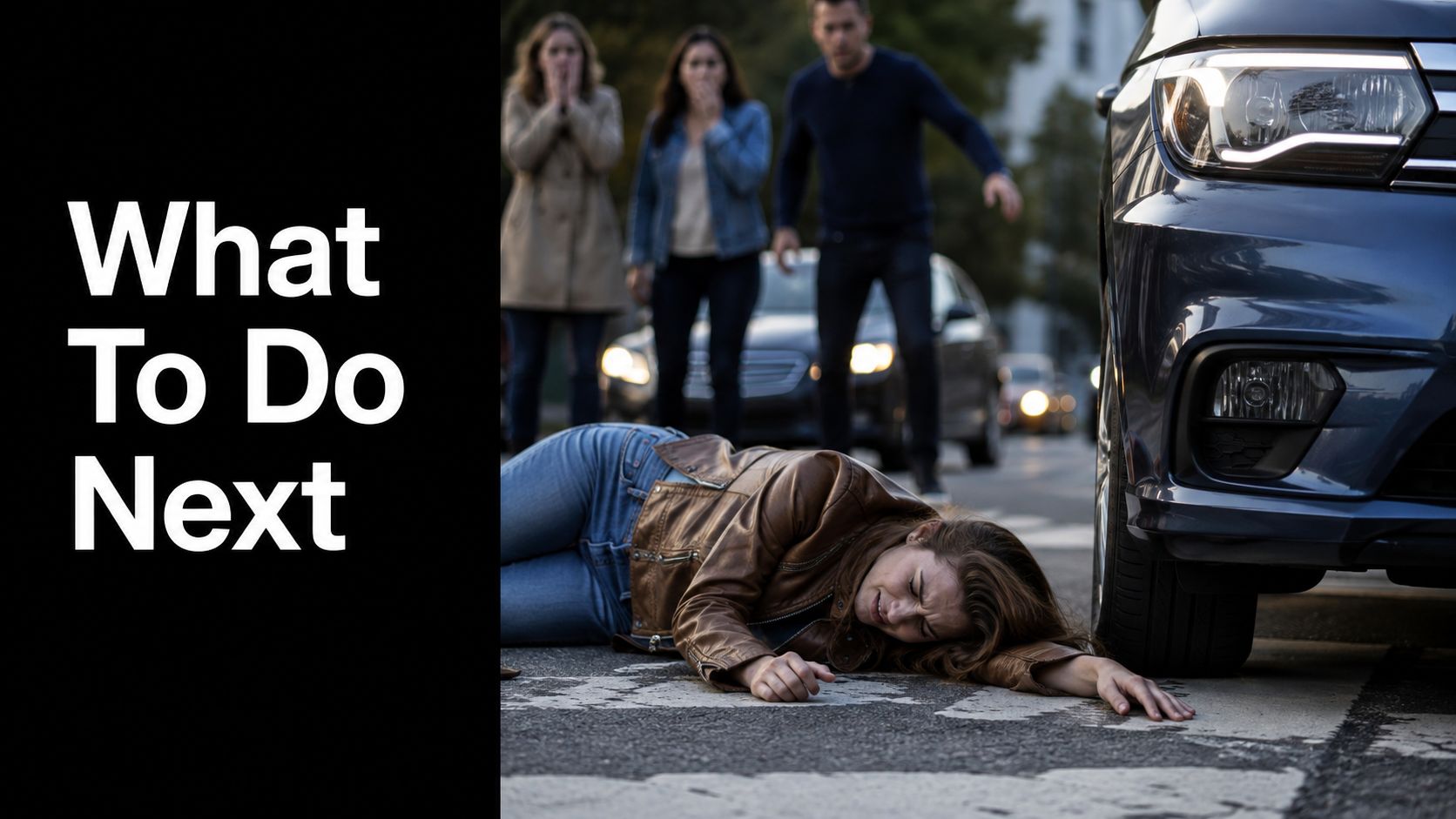
You’re standing at a Los Angeles intersection, trying to understand why your leg won’t support you. A stranger is holding your phone. Someone is asking whether you can move. The driver is speaking to the police, traffic is passing, and you’re still running on adrenaline. You may feel embarrassed, confused, or convinced that the crash was minor because you’re awake.
Treat it as serious. A pedestrian struck by vehicle claim involves medical evaluation, scene evidence, insurance coverage, and legal deadlines. In California, the first few hours can determine whether critical footage is preserved, whether hidden injuries are documented, and whether an insurer later argues that your own conduct caused the harm.
This article is for informational purposes only and isn’t legal advice. No attorney-client relationship exists based on your review of this article, and none of the information in this article is legal advice. The practical steps below are general guidance for people dealing with a pedestrian collision in California, including hit-and-run and nighttime urban crashes. If you need basic post-crash safety guidance while arranging care, you can also browse MedAmerica Rehab Center advice.
The First Moments After a Pedestrian Crash
The first hour rarely looks organized. You may be on the pavement near a crosswalk, surrounded by witnesses who saw different parts of the impact. One person may remember the vehicle’s color, another may have noticed a streetlight was out, and a third may have started recording on a phone. Those details can disappear quickly unless someone preserves them.
Call 911 and ask for both law enforcement and emergency medical help. Don’t argue with the driver, speculate about fault, or apologize. Even a polite statement such as “I didn’t see the car” can later be presented as an admission, especially when the driver’s insurer is looking for a way to shift responsibility.
Assume the injury is bigger than it looks
A vehicle transfers substantial force into a person with no protective structure around the body. You can have a head injury, chest trauma, abdominal bleeding, pelvic damage, and fractures at the same time. A visible scrape or painful ankle may distract everyone from a more dangerous injury elsewhere.
Emergency-trauma guidance emphasizes a full-body evaluation because pedestrian-struck patients commonly suffer injuries to the lower extremities, head and face, upper extremities, pelvis, thorax, spine, and abdomen. One emergency medicine review reported lower-extremity injury in 49.56% of cases and head, face, or neck injury in 38.07%, with additional injuries across multiple body regions. Those figures are discussed in emergency guidance on pedestrian-struck trauma.
Practical rule: Being able to stand, speak, or walk away doesn’t prove you’re medically safe.
Give paramedics a complete account of what hurts, what feels numb, whether you struck your head, and whether you briefly lost awareness. Tell the emergency department about dizziness, confusion, vomiting, chest pain, abdominal pain, neck pain, and difficulty breathing. Don’t minimize symptoms because the driver seems apologetic or because you’re worried about causing trouble.
Treat the scene as evidence
The collision site often changes before you can return. Vehicles move, debris is swept away, witnesses leave, and a camera may record over its footage. If you’re physically unable to document the scene, ask a trusted bystander to do it, and make sure that person preserves the original files.
The first moments should establish a basic record:
- Call details: Confirm that the crash was reported and obtain the incident or report number when available.
- Witnesses: Ask for names, phone numbers, and email addresses. Independent witnesses can matter more than statements from people connected to the driver.
- Driver information: Record the driver’s name, license plate, insurance information, and vehicle description if the driver remains.
- Immediate symptoms: Tell medical personnel about every symptom, even if it seems unrelated to the apparent impact point.
- Your clothing and property: Keep torn clothing, broken glasses, a damaged phone, shoes, or other items exactly as they were after the crash.
A pedestrian collision isn’t a fender-bender involving a person. It’s a multi-region trauma event and a potential liability dispute. Your job in the first hour is simple: get evaluated, avoid damaging statements, and preserve what may prove how the collision happened.
Protecting Your Health and Preserving Evidence Immediately
Health comes first, but medical care and evidence preservation should happen together. If you’re hurt, don’t walk into traffic to photograph skid marks or confront the driver. Ask a bystander, family member, or investigator to handle documentation while you receive treatment.

The first 60 minutes
Request a full-body trauma assessment. A clinical review found that people struck by vehicles can experience more serious injury patterns than other blunt-trauma patients, including intracranial hemorrhage, pulmonary contusion, pneumothorax, flail chest, pelvic fractures, and limb fractures. Ask clinicians to evaluate your head, neck, chest, abdomen, pelvis, and extremities instead of focusing only on the most obvious fracture or bruise.
Photograph the scene from multiple positions. Capture the vehicle’s location, its relationship to the crosswalk or curb, traffic signals, lane markings, debris, skid marks, road defects, lighting, weather, and nearby signs. Take wide shots that show context and close shots that show damage. Preserve the original photographs rather than relying only on edited or compressed versions.
Photograph injuries and damaged clothing. Photograph swelling, bruising, abrasions, lacerations, casts, wounds, and visible changes over time. Put torn clothing and damaged personal items in a clean container. Don’t wash, repair, discard, or alter them before speaking with counsel.
Collect witness information. Ask witnesses what they saw, but don’t coach them or pressure them to adopt your version. Record their contact information and, if they voluntarily offer a statement, preserve it in the original form. Witnesses may remember the vehicle’s movement, lighting, lane position, or whether a signal changed before impact.
Identify cameras immediately. Look for traffic cameras, security cameras on storefronts, apartment buildings, gas stations, parking structures, buses, and nearby homes. Photograph the camera locations and note the business name. A written preservation request may be needed before footage is overwritten.
Speed changes the medical risk
Impact speed is one of the most important severity indicators. A transportation safety synthesis places severe-injury risk at 10% at 16 mph, 25% at 23 mph, 50% at 31 mph, 75% at 39 mph, and 90% at 46 mph. Its death-risk thresholds are 10% at 23 mph, 25% at 32 mph, 50% at 42 mph, 75% at 50 mph, and 90% at 58 mph, as detailed by the AAA Foundation’s pedestrian impact-speed research.
That doesn’t mean you must calculate the vehicle’s speed at the roadside. It means you shouldn’t dismiss a collision as minor because the car appeared to move slowly. The same synthesis notes that pedestrians have about a 90% chance of surviving crashes at 20 mph or below, but less than a 50% chance at 30 mph or above. Medical evaluation remains necessary at every speed.
Preserve the original file, not just the screenshot. Digital evidence is easier to challenge when nobody can explain who created it, when it was saved, or whether it was altered. Guidance on maintaining chain of custody for digital evidence is useful when family members or witnesses collect videos and photographs.
Don’t leave the emergency department without understanding your discharge instructions, follow-up appointments, warning signs, and medication restrictions. Keep every medical record, bill, prescription, referral, imaging report, and work note. The insurer will compare your treatment history against your allegations, and gaps invite arguments that the injury wasn’t serious.
Reporting the Crash and Building Your California Claim Record
A police report is important, but it isn’t the entire claim record. It may omit a witness, misstate the lighting, describe the collision location too broadly, or record the driver’s version before physical evidence is analyzed. Read it when it becomes available and identify errors promptly.
California also requires a driver involved in a reportable collision to submit an SR-1 to the California Department of Motor Vehicles within 10 days when the crash causes injury, death, or property damage exceeding $1,000. The California DMV collision-reporting information explains the filing process. If you’re the injured pedestrian, ask a California attorney or another qualified professional whether the reporting obligation applies to your circumstances and how to document compliance.

Hit-and-run evidence doesn’t disappear with the driver
Hit-and-run cases require immediate investigation. In the United States, 24% of pedestrian deaths in 2024 involved a hit-and-run driver, and the Insurance Institute for Highway Safety reports that the share rose from about 20% in 2015 through 2019 to 25% in 2024. Those figures come from IIHS pedestrian fatality data.
If the driver fled, report the direction of travel, vehicle type, color, distinctive damage, partial plate, headlights, decals, and any words exchanged. Don’t guess. Separate what you personally observed from what someone else told you.
Investigators should look for:
- Vehicle debris: Broken mirrors, lens fragments, trim pieces, and paint chips may identify the vehicle.
- Paint transfer: Paint on clothing, shoes, or a bicycle can connect the vehicle to the pedestrian.
- Surveillance footage: Request preservation from nearby businesses, residences, transit systems, and public agencies.
- Witness accounts: Ask each witness to write down what they remember independently.
- Digital records: Save original videos, metadata, text messages, and photographs without cropping away context.
Nighttime and urban locations need extra documentation
Night crashes create arguments about visibility, lighting, clothing, and whether the pedestrian was visible to the driver. The evidence indicates why this matters. In 2024, 76% of pedestrian fatalities occurred in darkness and 84% occurred in urban areas, according to the IIHS source above.
Document every light source, including streetlights, business signs, vehicle headlights, glare, shadows, and obstructions. Use location tools to record the exact intersection, then save street-view images showing crosswalk markings, signal placement, lane configuration, and nearby cameras. Don’t assume the scene will look the same later.
Request the police report using its report number and ask how to obtain supplemental materials, photographs, diagrams, and witness information. Ask the relevant city or transportation agency to preserve traffic-camera footage before routine deletion. The claim should still make sense if the driver is later identified, if the vehicle is found through debris, or if the case proceeds through uninsured-motorist coverage.
Navigating Insurance Companies Without Undermining Your Claim
The driver’s insurer isn’t your advocate. Its adjuster may sound sympathetic while collecting statements that support comparative-fault arguments, disputing medical causation, or justifying a low settlement. Your own insurer also needs timely notice, particularly if a hit-and-run driver can’t be identified.
Expect three common requests: a recorded statement, a broad medical authorization, and a quick settlement. None should be handled casually.
The requests that create leverage for the insurer
A recorded statement can lock you into an incomplete account before doctors know the full extent of your injuries. You may forget a symptom, describe a location inaccurately, or say that you’re “doing okay” because you’re still in shock. The adjuster may later compare that casual phrase with months of treatment.
A medical authorization can give the insurer access to medical records unrelated to the collision. That creates opportunities to argue that an old complaint caused the current pain, even when the records have little to do with the accident. Provide relevant records through a controlled process, not an unrestricted release covering your entire history.
An early offer is often calculated before future care, lost income, permanent limitations, or the full course of treatment is known. Once you sign a release, you may lose the ability to seek more compensation for injuries that later become obvious.
Don’t trade finality for speed. A settlement can close the claim before you understand what the injury will require.
Use a claims log. Record the adjuster’s name, company, phone number, date, time, topic, and any documents requested. Keep communications factual. Don’t post photographs, opinions, jokes, check-ins, or recovery updates on social media. An innocent post can be presented out of context.
Hit-and-run coverage requires its own strategy
Your uninsured or underinsured motorist coverage may matter when the driver flees, has no insurance, or carries insufficient limits. Notify your own carrier promptly, but don’t assume your insurer will automatically value the claim fairly. It may investigate the same questions as an adverse carrier, including notice, vehicle contact, medical causation, and comparative fault.
This video provides a visual overview of common insurance-claim concerns:
If an adjuster demands a statement or sends a release, pause. Consult counsel before responding, especially when liability is disputed, the driver fled, you have multiple injured body regions, or surgery and long-term treatment are possible. A California attorney can also review your policy for uninsured or underinsured motorist provisions and coordinate communications.
For a broader discussion of handling insurance issues in California, see this California insurance lawyer resource. The point isn’t to refuse every communication. It’s to stop giving the insurer uncontrolled access to your words and records before your claim is understood.
Understanding Potential Defendants and Recoverable Damages
The driver is the obvious defendant, but not always the only one. A careful investigation asks who controlled the vehicle, who created the road condition, whether a mechanical failure contributed, and whether alcohol service or employment duties played a role.
Potential defendants can include:
- The driver: A claim may involve failure to yield, distraction, speeding, impairment, or unsafe turning.
- An employer: If the driver was working, the employer may become relevant under an employment-based liability theory.
- A government entity: A dangerous design, missing signal, defective crosswalk, or inadequate lighting may implicate a city, county, or other public entity.
- A manufacturer or parts supplier: Brake failure or another mechanical defect can change the investigation.
- A bar or restaurant: California’s dram-shop rules are limited, but an alcohol-service investigation may still matter in the right facts, particularly where statutory exceptions or independent negligence theories apply.
Don’t let the first policy limit or first settlement offer define the case. Identify every potentially responsible party and every available policy before evaluating settlement.
California pedestrian injury damage categories
California injury claims generally divide damages into economic and non-economic losses. Punitive damages are different. They aren’t routine compensation for an ordinary negligent collision and require facts supporting the applicable legal standard, such as particularly wrongful conduct.
| Damage Category | What It Covers | Example |
|---|---|---|
| Economic damages | Financial losses caused by the injury | Emergency care, medical treatment, lost wages, and future care costs |
| Non-economic damages | Human consequences that don’t come with a simple invoice | Pain, emotional distress, disability, disfigurement, and loss of enjoyment |
| Punitive damages | Exceptional damages tied to sufficiently wrongful conduct | Conduct that meets the legal standard for punishment rather than ordinary negligence |
Medical bills are only one part of the economic picture. A pelvic fracture, brain injury, spinal injury, or multiple fractures may require follow-up care, rehabilitation, assistive equipment, or changes to work. Lost wages may also understate the effect when the injury reduces future earning capacity.
Pain and suffering evidence should connect the injury to daily life. Describe sleep disruption, mobility limits, missed family activities, fear of traffic, cognitive changes, and the tasks you can no longer perform normally. This California compensation discussion on pain and suffering provides additional context, but no online category table can determine your claim’s value.
California’s comparative-fault rules can reduce recovery when a factfinder assigns responsibility to the pedestrian, but they don’t automatically erase a claim. The evidence must address the entire collision, including the driver’s speed, line of travel, visibility, signal phase, and reaction time.
California Legal Deadlines and When to Bring in an Attorney
California personal injury claims generally carry a two-year deadline from the crash date for filing a lawsuit. Claims involving a government entity can require a government claim within six months, depending on the facts and the public entity involved. The California personal injury statute-of-limitations resource discusses these deadlines, but deadlines can be affected by specific facts, so don’t rely on a general article to calculate yours.

Waiting is still a mistake even when the filing deadline seems distant. Cameras overwrite footage. Businesses change ownership. Vehicles get repaired or sold. Witnesses forget lane positions and signal changes. Insurers also interpret silence, delayed treatment, and incomplete reporting as opportunities to challenge the claim.
What early representation actually does
An attorney’s value in the first weeks isn’t limited to sending demand letters. Early counsel can:
- Send preservation notices: Put businesses, public agencies, transit operators, and insurers on notice that relevant footage, vehicle data, photographs, and records must be preserved.
- Investigate the collision: Retain an accident-reconstruction professional when speed, visibility, vehicle movement, or signal timing is disputed.
- Control insurance communications: Respond to recorded-statement requests, medical authorizations, policy inquiries, and settlement offers.
- Coordinate medical liens: Help organize treatment and payment arrangements so you aren’t pushed into a premature release.
- Identify defendants: Investigate employers, government entities, manufacturers, and additional insurance coverage.
The timeline should be practical:
- At the scene: Call 911, obtain emergency care, identify witnesses, and preserve photographs and video.
- During the first days: Follow medical instructions, request the police report, notify appropriate insurers, and preserve clothing and digital evidence.
- During the first weeks: Investigate cameras, road conditions, vehicle evidence, employment, coverage, and potential public-entity responsibility.
- Before any release: Understand your diagnosis, future treatment, damages, insurance limits, and legal deadlines.
- Before the deadline: File the required claim or lawsuit, or obtain a written legal strategy that protects your rights.
This article is for informational purposes only and isn’t legal advice. No attorney-client relationship exists based on your review of this article, and none of the information in this article is legal advice. If you were struck by a vehicle, speak with a qualified California personal injury attorney promptly, particularly when the crash occurred at night, the driver fled, or a government road condition may be involved.
LA Law Group, APLC offers free initial consultations for pedestrian injury and personal injury matters, including claims involving vehicle strikes, disputed liability, and uninsured or underinsured drivers. Visit LA Law Group, APLC to request a case assessment and discuss the evidence, insurance coverage, and deadlines affecting your claim.
Attorney Advertising. This article is general information, not legal advice, and does not create an attorney-client relationship. Prior results do not guarantee a similar outcome.