
Premises Liability Lawsuit in California What to Know
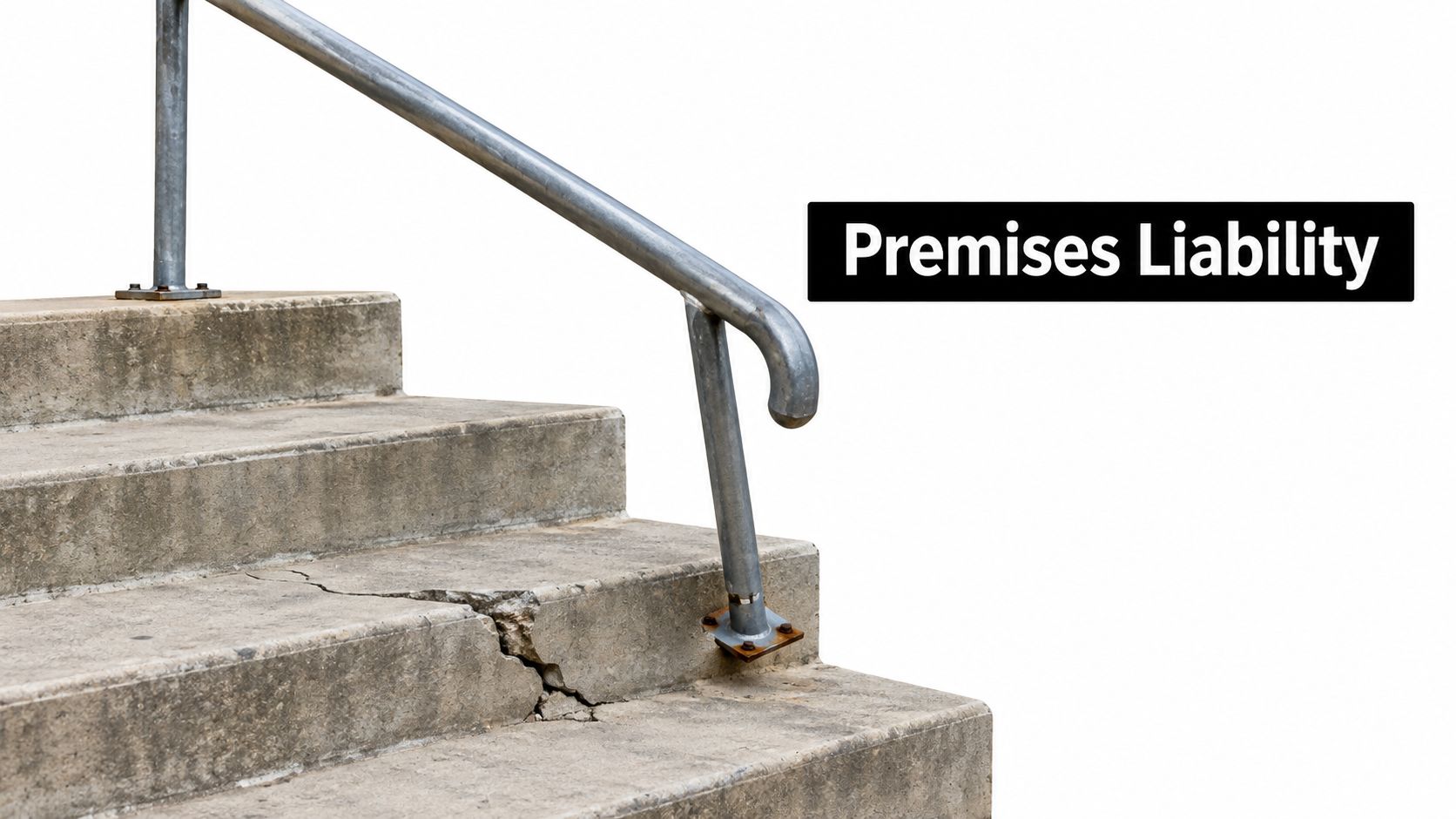
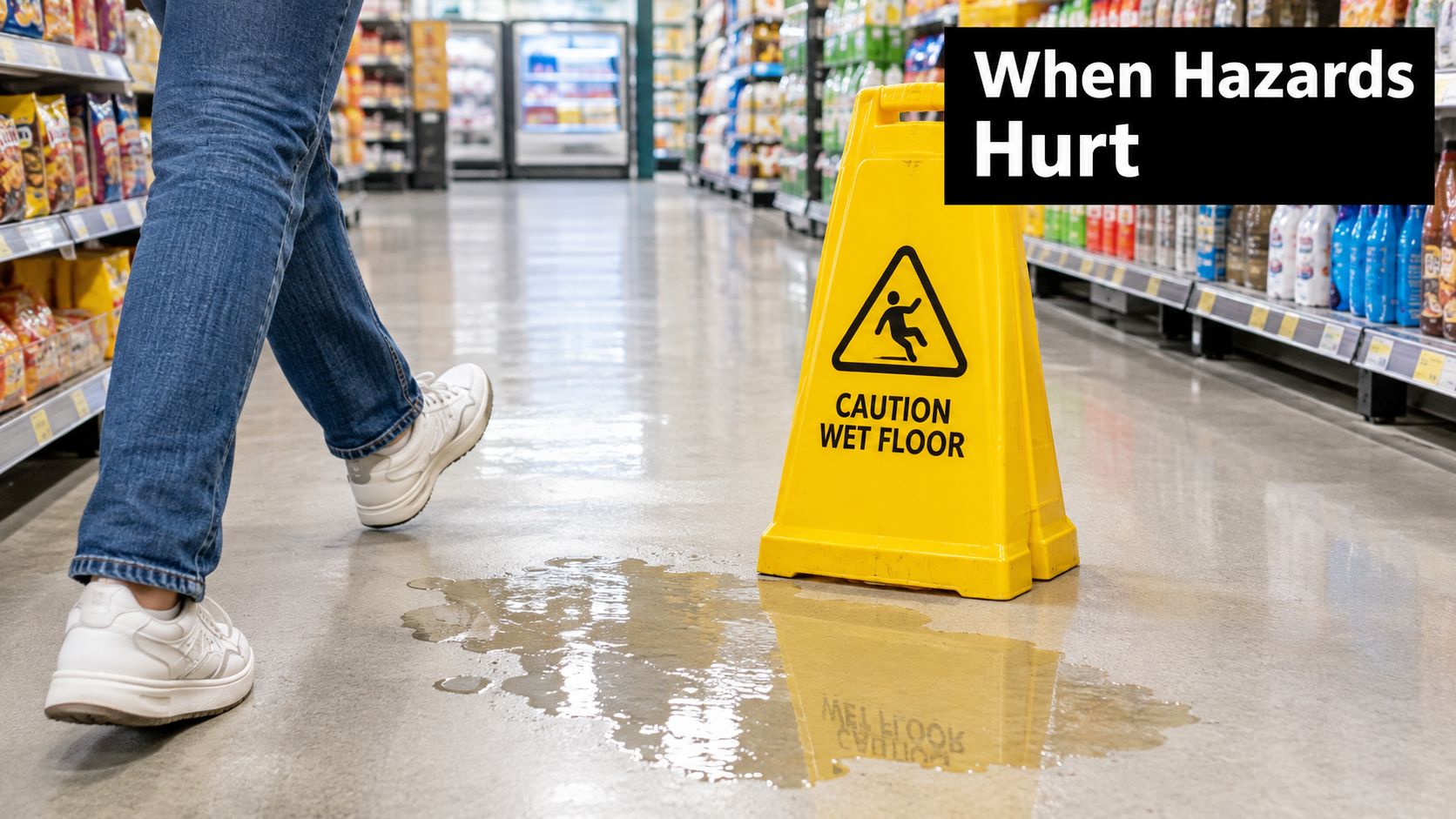
You’re leaving a grocery store when your foot slides through a wet patch near the entrance. A yellow caution sign stands several steps away, but the floor is still slick. Your wrist hurts, your clothing is soaked, and you’re unsure whether to report the fall, photograph the area, or head home.
A similar problem can arise from a broken apartment stair, a cracked parking surface, poor lighting, an unsecured dog, or a pool without adequate safeguards. A premises liability lawsuit asks whether a dangerous condition on property caused harm and whether the person or entity responsible for managing that property acted reasonably.
Important: This article is for informational purposes only and isn’t legal advice. No attorney client relationship exists based on reviewing this article, and none of the information in this article is legal advice.
When a California Property Hazard Becomes a Legal Claim
The fall itself doesn’t automatically establish liability. A California claim usually turns on a sequence of questions. Was there a dangerous condition? Who owned, occupied, leased, or controlled the area? Did that person or business know, or reasonably have a way to know, about the condition? Was the condition a substantial factor in causing the injury?
These questions apply to ordinary places people use every day. A shopper may slip on a spill, a tenant may trip over a damaged walkway, or a guest may fall because a stairway lacked a safe handrail. The important facts often involve property-management decisions that happened before the accident, including inspections, cleaning, repairs, warnings, lighting, security, and incident reporting.
Premises liability cases are a substantial part of civil tort litigation. In a Bureau of Justice Statistics study of tort cases disposed of in the nation’s 75 most populous counties during a one-year period, claims involving inadequately maintained or otherwise dangerous residential or commercial property accounted for 17% of all tort cases. Automobile-accident claims were the most frequent category at 60%, while premises liability was the second-largest reported category, according to the Bureau of Justice Statistics tort-case study.
A wet floor also creates a practical issue that people often overlook. Water damage, flooring deterioration, and repair history may help explain how a surface became unsafe and whether the condition was recurring. For general background on flooring and water-related repairs, Eagle Restoration’s repair advice may help you understand why the physical condition of a floor matters.
The legal framework is easier to follow when you separate it into four parts: control of the property, negligent use or maintenance, actual harm, and causation. California’s approach also requires careful attention to notice, because an owner doesn’t always need to admit seeing a hazard for evidence to support a claim. A practical overview of the state’s rules is available in California premises liability law.
Four Building Blocks Every California Claim Must Prove
Think of a premises claim as a house. If one load-bearing part is missing, the legal structure may not support recovery.
Control is the foundation
The defendant must have owned, leased, occupied, or controlled the property. Title ownership is only one possibility. A tenant, property manager, retail operator, landlord, maintenance company, or other entity may have authority over the specific area or condition that caused the injury.
That’s why identifying the right defendant requires more than looking up the property owner. Ask who had responsibility for inspections, cleaning, repairs, warnings, lighting, security, or incident reports. A lease, management agreement, vendor contract, or internal policy may show that another party controlled the hazard.
Negligent maintenance forms the walls
The plaintiff must show that the defendant negligently used or maintained the property. California’s central question is generally whether the person responsible for the property acted as a reasonably careful property manager would under the circumstances.
Reasonable care means action, not just ownership. A responsible party may need to discover unsafe conditions, repair them, replace defective features, protect visitors, or provide an adequate warning.
A property doesn’t need to be perfect. The issue is whether the response to a foreseeable danger was reasonable. A warning sign may matter, but its location, visibility, timing, and effectiveness can become factual questions.
Harm is the roof
There must be actual harm. This may include a physical injury, related medical treatment, lost income, damage to personal property, or other legally recognized losses. A near miss can be frightening, but a premises liability claim generally requires proof of injury or compensable damage.
Causation connects the structure
Finally, the negligent condition must have been a substantial factor in causing the harm. It isn’t enough to show that an accident occurred somewhere on the property. The evidence must connect the defect, spill, inadequate security, animal, or other condition to the mechanism of injury.
California’s jury guidance identifies these four linked elements: control, negligent use or maintenance, harm, and negligence as a substantial factor in causing that harm, as explained in California Civil Jury Instructions on premises liability. Comparative fault may also matter if the injured person’s own lack of care contributed to the event. That issue can affect recovery without necessarily answering the separate question of whether the property condition was dangerous.
How California Replaced Visitor Labels With Reasonable Care
Before California changed its approach, a visitor’s legal status could dominate the duty analysis. Traditional categories included invitees, licensees, and trespassers. Those labels attempted to describe why a person entered the land, but they could produce rigid results that didn’t always reflect the actual danger or the property possessor’s conduct.
On August 8, 1968, the California Supreme Court decided Rowland v. Christian, 69 Cal.2d 108. The court rejected the idea that entrant status should automatically control the possessor’s duty. Instead, the court focused on whether the possessor acted as a reasonable person would in managing the property, including consideration of the probability of injury to others. The decision is available through the California Supreme Court opinion in Rowland v. Christian.
What the decision changed
Rowland made the condition of the property and the possessor’s conduct more important than a rigid label. A shopper, tenant, guest, or other visitor shouldn’t assume that a claim fails because the person wasn’t formally invited in the same way as a customer.
The decision also addressed concealed dangers. If an occupier knows about a dangerous condition and knows that someone is likely to encounter it, failing to repair the condition or provide an adequate warning may support a negligence claim. That principle puts attention on what the responsible party knew, what it should have anticipated, and what it did in response.
Visitor status still isn’t irrelevant. A person’s purpose, location, conduct, and relationship to the property can provide context. A trespasser, a tenant using a common area, and a customer entering a store may present different facts. But the category alone doesn’t automatically resolve the duty question in California.
Why this matters after an accident
Suppose an apartment tenant trips over a broken light fixture in a shared hallway. The tenant’s status explains why the person was there, but the more useful questions concern control and maintenance. Who knew the fixture was broken? Who received complaints? Who had authority to replace it? Was the hallway inspected? Did the darkness make the defect harder to see?
The same analysis applies to a guest injured near a pool or a shopper who encounters a spill. The case depends on reasonable property management under the circumstances, not on a shortcut that treats the visitor’s label as decisive. That’s why evidence about inspection systems, warnings, repairs, and recurring hazards often matters more than assumptions about why the injured person entered the property.
Common California Property Cases and What Triggers Them
A grocery-store spill may remain on the floor long enough for employees to discover it, clean it, or place a warning. A photograph showing the liquid, the surrounding floor, the sign’s location, and the entrance path can help establish what the scene looked like immediately after the accident.
A broken sidewalk or parking-lot surface raises different questions. Was the crack visible, deteriorated, recurring, or located where pedestrians naturally walked? Did the property manager receive complaints? Did lighting, rain, merchandise, or parked vehicles make the defect harder to see?
Stair and balcony cases often involve structural maintenance, handrails, lighting, code-related conditions, or prior repair requests. A tenant may know that a stair felt loose for weeks, while a visitor may have only seconds of experience with it. That difference affects what evidence exists, but it doesn’t by itself decide liability.
Other fact patterns
-
Negligent security: A claim may involve inadequate lighting, broken gates, missing locks, or other security conditions. The analysis can require attention to the property’s use, foreseeable risks, prior incidents, and the measures provided.
-
Pool injuries: Unsecured access, defective barriers, missing warnings, or unsafe surfaces may matter. Photographs should capture gates, latches, signs, water conditions, surrounding surfaces, and the route a person took.
-
Dog incidents: Responsibility may depend on the animal’s conduct, the owner or handler’s control, warnings, fencing, and the location of the event. Preserve photographs of injuries and the surrounding area, and identify witnesses promptly.
-
Rental maintenance: A landlord, tenant, manager, contractor, or owner may each have different responsibilities. Leases and maintenance records can show who was supposed to inspect, repair, warn, or respond to complaints.
-
Retail conditions: Shelving, merchandise placement, floor transitions, escalators, carts, and checkout areas can each create distinct hazards. Surveillance may show the condition’s existence, customer traffic, employee response, and whether a warning was used.
This video provides additional general context about premises-related disputes and property conditions:
Across these examples, the recurring questions are consistent. Did the condition exist? Was it dangerous? Who controlled it? Was there a reasonable opportunity to discover it? What response was available? Did the condition materially contribute to the injury?
Proving the Owner Knew or Should Have Known
Notice is often the hardest practical issue. A person may know exactly where they fell but have no idea when the spill, defect, or obstruction appeared. California’s analysis recognizes two routes: actual notice and constructive notice.
Notice means the responsible party knew about the condition. An employee may have seen the spill, a tenant may have submitted a repair request, or an earlier incident report may describe the same hazard. Constructive notice means the facts support an inference that a reasonable inspection system should have discovered it.
The relevant sequence is the hazard’s lifecycle. How was it created? How long did it exist? Was it visible or recurring? When should an inspection have occurred? How much time was available to clean, repair, block, or warn? California’s jury guidance describes the dangerous-condition inquiry as involving an unreasonable risk, knowledge or reason to know, and failure to repair, protect, or adequately warn, as explained in CACI guidance on dangerous conditions.
| Notice Pathway | What It Means | Example Evidence |
|---|---|---|
| Actual notice | The defendant knew about the condition before the injury. | A complaint, employee observation, incident report, text message, or prior maintenance entry. |
| Constructive notice | The condition existed long enough, or recurred often enough, that a reasonable inspection system should have found it. | Deterioration photographs, surveillance, inspection logs, repeated complaints, maintenance history, or evidence of missing inspections. |
Preserve evidence before the scene changes
A store may clean a spill. A landlord may repair a stair. Weather may dry a surface, lighting may change, and foot traffic may erase marks or move objects. Evidence preservation should begin immediately, especially when nobody admits seeing the condition form.
-
Photograph the hazard from multiple distances. Capture a wide view showing location and pathway, a medium view showing surrounding features, and close images showing texture, depth, residue, damage, or deterioration.
-
Keep original files. Don’t rely only on edited screenshots. Retain original photographs and available metadata, then make a separate backup.
-
Identify witnesses. Record names and contact information for people who saw the condition, the fall, your immediate symptoms, or what employees did afterward.
-
Write down the scene. Note the exact location, lighting, weather, warning signs, floor condition, clothing, footwear, and what you felt immediately before losing balance.
-
Request surveillance preservation. Ask the property owner or manager in writing to preserve relevant video, incident reports, employee schedules, inspection records, and maintenance communications.
-
Keep damaged items. Preserve shoes, clothing, broken glasses, damaged phones, or other property in their post-incident condition.
-
Track symptoms and treatment. Keep medical records, appointment information, prescriptions, restrictions, and a plain-language symptom log.
A case doesn’t necessarily fail because no employee saw the hazard being created. The physical appearance, recurrence, duration, and inspection history may support an inference about how long it existed. That inference becomes much harder when the scene and records disappear.
Filing Your Claim and Building a Strong Evidence File
Medical care should come first when you’re injured. Tell the provider what happened, identify the body parts affected, follow treatment instructions, and keep records. Prompt reporting also creates an early account of the event, although you should describe what you know accurately rather than guess about facts you didn’t observe.
Report the incident to the property owner, manager, store, landlord, or another responsible representative. Request a copy of the incident report or preserve your own written account of who received notice, what was said, and when the report was made.
Build the file around responsibility and timing
A useful evidence file should connect the accident to the people and systems responsible for the property:
-
Scene evidence: Original photographs, videos, measurements, lighting details, weather information, and a location map.
-
People evidence: Witness information, employee names, statements, medical providers, and anyone who observed the condition before or after the event.
-
Property evidence: Leases, management agreements, vendor contracts, inspection policies, cleaning schedules, work orders, maintenance logs, prior complaints, incident databases, and surveillance retention information.
-
Injury evidence: Medical records, bills, prescriptions, work restrictions, wage documentation, and notes describing how the injury affects daily activities.
Digital records can be particularly important. A written inspection policy may say that employees must check an area, while electronic work orders, staffing records, access logs, or maintenance software may show whether anyone performed that inspection. Contracts may also identify a contractor, but assigning work to another company doesn’t end the factual inquiry into control, notice, or the duty owed to visitors.
California’s ordinary personal-injury limitations period is two years from the date of injury under Code of Civil Procedure section 335.1, according to the California Courts’ personal-injury guidance. The same court materials identify premises liability as a personal-injury claim and provide form PLD-PI-001(4) for a premises-liability complaint. Different rules may apply to government entities and other special situations, so don’t assume the ordinary deadline governs your claim.
Good intake prevents avoidable confusion about dates, names, insurance information, prior injuries, and communications. A practical resource on legal intake mistakes to avoid can help you organize information before speaking with counsel. For a related explanation of proof in a floor-accident claim, see how to prove negligence in a slip and fall.
Damages Fault and Practical Next Steps in California
A successful claim may involve compensation for medical care, lost income, pain, limitations on ordinary activities, and other losses supported by the evidence. The specific value depends on the injury, treatment, prognosis, records, liability proof, insurance, and defenses. A general discussion of types of damages can help explain the categories, but it can’t determine what any individual claim is worth.
Comparative fault may reduce recovery when the injured person’s conduct contributed to the event. A property owner may argue that the condition was open and obvious, that the visitor wasn’t paying attention, or that another person created the hazard. Those arguments aren’t always conclusive. Visibility, lighting, distractions, warnings, the reason the person encountered the condition, and the time available to avoid it may all require a fact-specific analysis.
Responsibility can also be divided among an owner, tenant, manager, contractor, business operator, or another party. A lease or vendor agreement may allocate duties between those parties, but the agreement doesn’t automatically resolve every question involving visitors. Prior complaints, recurring conditions, inspection gaps, and actual repair practices may show who had control and whether the safety system worked.
Insurance adds another layer. Understanding general liability coverage may help you identify why policy information and timely notice matter, but coverage disputes and claim handling require individual review.
Save the original evidence, report the incident, seek appropriate medical care, identify every person or company connected to the property, and verify the deadline that applies to your circumstances. This article is for informational purposes only and must not be construed as legal advice. No attorney client relationship exists based on reviewing this article, and none of the information in this article is legal advice.
LA Law Group, APLC can evaluate a California premises liability claim, help identify responsible property controllers, and organize evidence involving hazardous conditions, maintenance records, and injuries. Visit LA Law Group, APLC to request a case assessment and discuss your next steps.
Attorney Advertising. This article is general information, not legal advice, and does not create an attorney-client relationship. Prior results do not guarantee a similar outcome.