
Reporting Unsafe Driving: Your 2026 Guide to Legal Steps
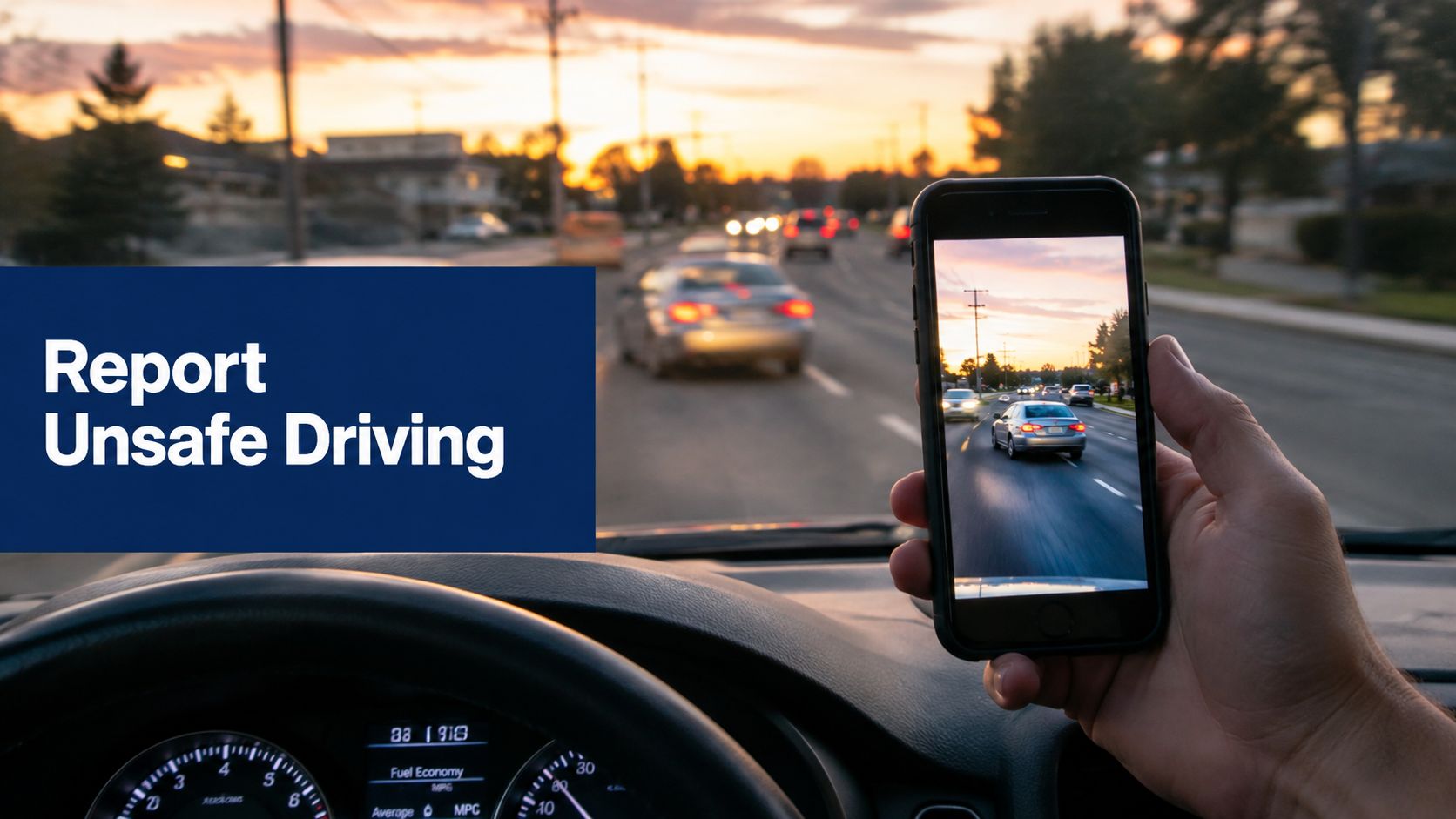
You’re driving home, you see a car weaving across lanes, and the driver keeps blasting through traffic like the rules don’t apply. Your first instinct is usually the right one, get safe, remember what you saw, and decide whether this is a 911 problem or a non-emergency report.
This article is for informational purposes and not to be construed as legal advice. No attorney client relationship exists based on the review of this article, and none of the information in this article is legal advice.
The mistake many individuals make is simple: they either call the wrong number or do nothing at all. Reporting unsafe driving works best when you match the channel to the danger, document the facts, and understand that some reports trigger immediate enforcement while others start an administrative review.
Assessing the Situation and Your Immediate Options

A dangerous driver doesn’t give you much time to think. The right move is to get out of the way, keep your distance, and decide whether the behavior is an active emergency or a report you can make after the fact.
Practical rule: If the driver is creating an immediate threat, call 911. If the danger has passed or the behavior is ongoing but not instantly life-threatening, use a non-emergency channel and document what you saw.
The public safety stakes are real. The World Health Organization reports that road traffic crashes kill approximately 1.16 million people each year worldwide, with between 20 and 50 million more suffering non-fatal injuries annually, and it notes that road traffic injuries are the leading cause of death for children and young adults aged 5 to 29. It also says more than 90% of road traffic deaths occur in low- and middle-income countries, even though those countries have around 60% of the world’s vehicles. That is why dangerous driving is not a minor annoyance, it’s a safety issue with serious consequences. WHO road traffic injuries fact sheet
Three paths, not one
In California, your options fall into three buckets. Call 911 when the danger is happening now, use the California Highway Patrol non-emergency line, 1-800-TELL-CHP (1-800-835-5247), when the conduct is serious but not currently life-threatening, and use an administrative complaint when you are dealing with a pattern, a fitness-to-drive issue, or a driver who needs formal review rather than an immediate stop.
A lot of people overreact by dialing 911 for behavior they could report later, or underreact because they assume no one will do anything unless there’s a crash. Both choices waste time. The better approach is blunt, specific, and calm, because reporting unsafe driving gets more traction when you can explain what happened, where it happened, and why it still matters.
Choosing Between 911 and Non-Emergency Reporting Channels

The decision is not complicated if you stay focused on risk. 911 is for active danger, a crash in progress, a driver who appears impaired and is still moving, a hit-and-run underway, or a car that’s closing distance fast enough to cause a collision. The CHP non-emergency line is for conduct you’ve already seen, like sustained aggressive driving over several miles, when the risk is real but not immediate.
A useful benchmark comes from U.S. roadway data. The National Safety Council reports that speeding-related behaviors accounted for 18.5% of fatal crashes in NHTSA-linked data, with 10,739 deaths classified under driving too fast for conditions, exceeding the posted limit, or racing. NHTSA also reported 11,288 speeding-related traffic deaths in 2024, representing 29% of all traffic fatalities that year. Speeding is not a side issue, it’s one of the most common contributors to fatal roadway harm. National Safety Council aggressive driving facts
What makes 911 the right call
Call 911 when a driver is an active threat to life. That includes a car swerving across lanes, a vehicle that just caused a collision and kept going, or a person behind the wheel who looks medically unfit and is creating immediate danger on the road. If the risk is unfolding in front of you, emergency dispatch is the right channel.
If you have to choose between “overreacting” and “waiting too long,” choose the safer route. Dispatchers would rather screen out a non-emergency than miss a real danger.
What belongs on a non-emergency tip
Use 1-800-TELL-CHP when the incident has ended or the threat is ongoing but not immediate. California-oriented guidance also points people to the CHP line for non-emergency reporting and to 911 for immediate danger, while giving the DMV re-examination route for licensing review. A non-emergency report is the right move for repeat reckless driving near your neighborhood, a dangerous commute pattern you’ve seen before, or a vehicle that keeps cutting people off without creating an instant crash.
For local police, the same logic applies. Neighborhood speeding complaints, school-zone concerns, and recurring unsafe driving patterns usually belong on the non-emergency side unless someone is in immediate danger. The more exact your report, the less likely it is to disappear into a generic complaint queue.
Collecting Evidence That Makes Your Report Actionable

A report without details is easy to ignore. The useful version names the vehicle, fixes the location, and describes the conduct in plain language that a dispatcher, officer, or DMV reviewer can act on.
Start with the basics
Write down the date and time, the location, the direction of travel, and the vehicle description. If you can safely see it, note the license plate number, along with the make, model, and color. The driver description matters too, especially when a report goes to an administrative reviewer who needs more than a vague complaint.
Use a short, concrete description of the behavior. “Driving crazy” is useless. “Crossed the center line twice, tailgated two cars, and nearly struck a cyclist near the intersection” is the kind of report that can be reviewed.
Do not put yourself in danger to gather proof. If you need to speed up, follow too closely, or focus on your phone instead of the road, you’ve already made the situation worse.
Capture evidence safely
Dashcam footage can help, but only if you’re already using it and it doesn’t distract you. The same goes for photos. If you can’t safely capture the plate or the road conditions, skip it and keep driving.
A good report doesn’t need theatrics. It needs enough detail to show pattern, location, and risk. That same principle appears in behavior-based safety systems, where observers identify the unsafe act, record it, and use the data to target recurring risk rather than relying on a vague complaint. Research on structured observation and feedback also shows why this matters, with one commercial-vehicle safety program producing a 66% lower event rate per 1,000 miles driven by the end of the study relative to baseline, and teen-driver feedback users showing 6.1 unsafe events per 1,000 miles versus 35.3 in controls. DOT behavior-based safety study
Filing Administrative Complaints and DMV Re-Examination Requests

Some drivers don’t need a patrol car, they need a formal review. That’s especially true when the issue looks like a medical, cognitive, or emotional fitness problem, or when the complaint is really about a pattern of unsafe conduct that should reach a licensing authority.
The California DMV process can require a Request for Driver Re-examination (DS 699). California Highway Patrol guidance for immediate danger is to call 911, and for non-emergency reporting to use 1-800-TELL-CHP (1-800-835-5247). California-oriented reporting guidance also says a usable report should include the location and direction of travel, a description of the unsafe behavior, and, where possible, the license plate number, make/model, and color of the vehicle. California unsafe driver reporting guide
California reporting channels by situation type
| Situation Type | Primary Channel | Required Information | Expected Timeline |
|---|---|---|---|
| Immediate danger on the road | 911 | Location, direction of travel, behavior, vehicle details if safe to observe | Immediate response |
| Ongoing but non-immediate unsafe driving | CHP non-emergency line | Plate number if possible, vehicle description, location, direction, conduct | Case-specific review |
| Fitness-to-drive concern | DMV DS 699 re-examination request | Driver identity, observed behavior, relevant safety facts | Administrative review, often not immediate |
| Pattern complaint involving a fleet or commercial driver | Employer or regulator complaint channel | Trip details, company name, vehicle identifiers, observed conduct | Review depends on the recipient |
Fitness-to-drive complaints are different
Many people overlook the core issue. If the driver appears impaired by a medical or cognitive condition, the focus may shift from punishment to whether they should remain licensed. Updated guidelines in states such as Arizona and Utah approach these reports as a review process, which takes time rather than a quick hotline call. This difference is crucial when the risk is ongoing instead of immediate. New Zealand police guidance on reporting unsafe drivers
State systems can be strict about what they accept. Florida requires an unsafe-driver report to be in writing and to include the driver’s full name, date of birth, address, and a full description of the alleged physical or mental disability for anyone over 15 years of age. Missouri likewise requires a completed Driver Condition Report (Form 4319) and asks for identifying details such as name, date of birth, driver license number, current address, and license plate number. Florida unsafe driver reporting
Rideshare and commercial complaints need different routing
If the unsafe driver is in an Uber or Lyft, report through the app and preserve screenshots of the trip, the driver name, vehicle, and time of ride. For commercial vehicles, use the company’s safety channel and any regulator complaint portal that applies. The point is the same, get the complaint into the system that can discipline the driver or the fleet.
What Happens After You File Your Report
The part that frustrates people most is the silence. You file a report, then nothing visible happens, and it feels like nobody cared. That feeling is common, but it doesn’t mean the report was wasted.
The practical reality is that different reports trigger different responses. Some lead to an immediate stop if an officer sees the same vehicle and confirms the danger. Others become a note in an enforcement system, a warning letter, or a licensing review that takes time. When the issue is fitness to drive, the review can involve medical information, testing, or a re-examination request rather than a traffic ticket.
Expect a process, not a dramatic scene
If you submitted a detailed report, keep a copy of everything. Save screenshots, written notes, timestamps, and any confirmation number you receive. If the agency contacts you, answer directly and stick to what you personally observed.
A strong report can matter even when you never hear back. Agencies track patterns, and pattern tracking is often how recurring risk gets surfaced.
One field evaluation of a reporting-and-enforcement program used 4,737 driver contacts across two enforcement waves, issued citations in 72% of contacts, and then measured outcomes across exposure, knowledge, self-reported behavior, and observed driving behavior. The intervention increased reported exposure to safety messages from 17.7% pre-period to 67.3% post-period, while violation rates fell 23% to 46% at intervention sites and stayed flat at comparison sites. That’s the value of combining reporting with visible enforcement and follow-up. Field evaluation of unsafe-driving intervention
What to keep for your records
Hold onto the following:
- Your original notes, because memory fades fast after a stressful road event.
- Any dashcam file or photo, if you captured one safely.
- The report number or confirmation, if the agency gave you one.
- A timeline of later incidents, if the same driver keeps appearing.
If there’s no visible action right away, don’t assume the system failed. Sometimes the report is one more piece in a larger file that gets reviewed later.
When Unsafe Driving Becomes a Personal Injury Matter
If the dangerous driver hits you, the question changes immediately. You’re no longer just a concerned witness, you’re dealing with a potential personal injury claim, and the first hours after the collision matter far more than many realize.
The core move is preservation. Get medical care, ask for the police report, photograph the vehicles and scene if you can do so safely, and keep every record tied to the crash. If you previously documented the driver’s unsafe behavior, that history can strengthen the story of how the collision happened and why the driver’s conduct was unreasonable.
Unsafe drivers often come with predictable defenses. Insurance adjusters minimize injuries, dispute fault, and push fast settlements before the full picture is clear. That’s why early legal review matters. A lawyer can preserve evidence, track down witnesses, coordinate with investigators, and keep the insurance company from controlling the narrative.
California injury claims also run on deadlines, and people who wait too long can lose the right to bring a case. Don’t sit on a claim because the injuries seem manageable at first or because you’re still unsure whether you want to sue. Get the file reviewed while the evidence is still fresh and the options are still open.
The compensation picture is broader than medical bills. Depending on the crash, a claim can also involve lost income, future treatment, and other damages tied to the harm you suffered. If the crash happened in a rideshare, commercial vehicle, or fleet vehicle, those layers can make the case more complicated, not less, so you want counsel involved early.
If you were hit by a reckless driver, or you’re dealing with a crash caused by someone who should never have been on the road, LA Law Group, APLC can review the facts, preserve the evidence, and explain your options in plain English. Visit LA Law Group, APLC to speak with a team that handles California injury claims with a direct, client-focused approach.
Attorney Advertising. This article is general information, not legal advice, and does not create an attorney-client relationship. Prior results do not guarantee a similar outcome.