
Slip and Fall in a Grocery Store: What to Do Next
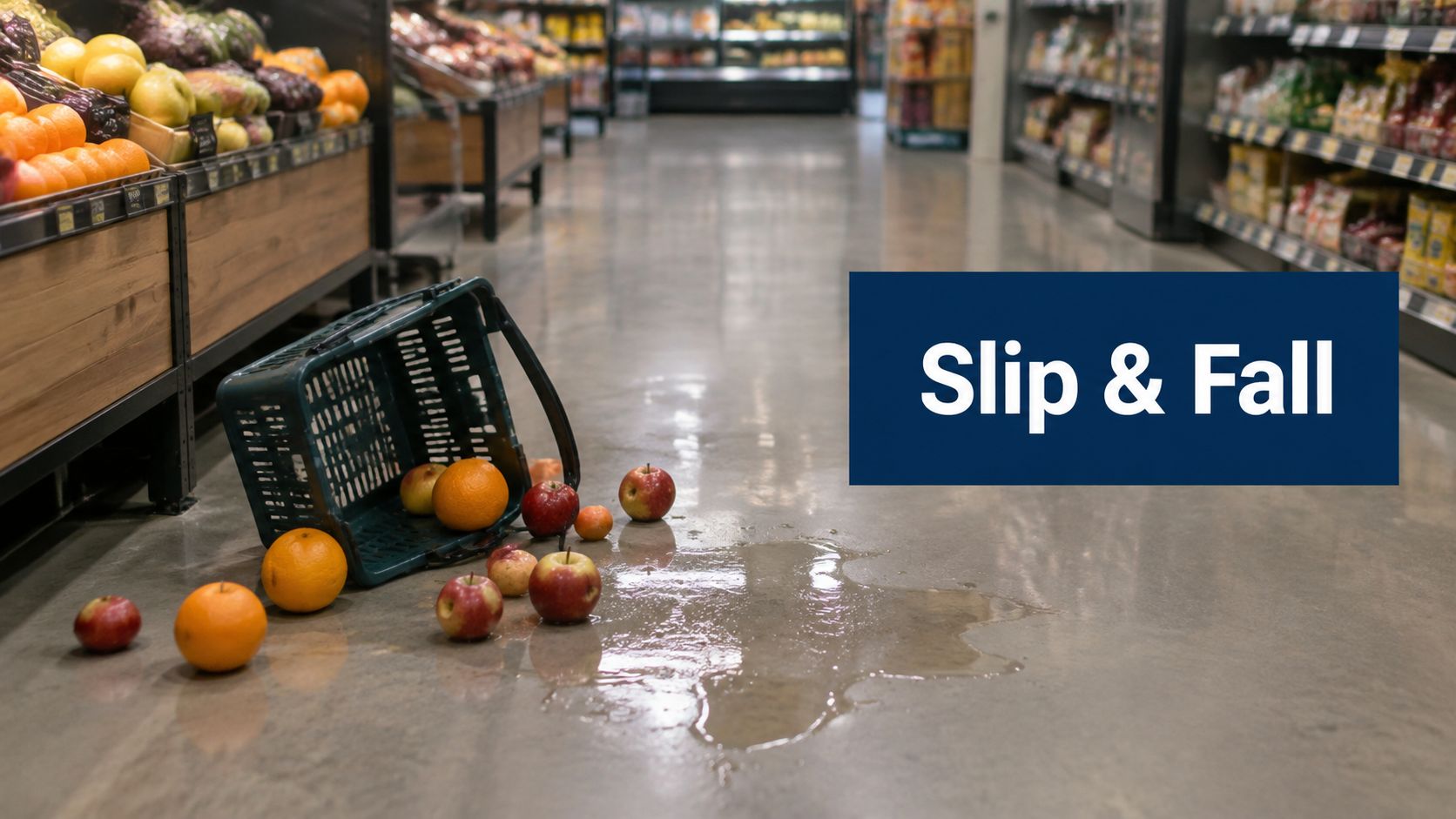
You’re walking past the freezer aisle when your foot shoots forward. A moment later, you’re on the floor, your cart is tipped over, and an employee is asking whether you’re all right. The spill may be gone before you leave the store. That makes the first minutes after a slip and fall in a grocery store important, not because a fall automatically creates a claim, but because the store’s inspection records, surveillance footage, and cleaning timeline may determine whether you can prove notice.
This article is for informational purposes only and isn’t legal advice. No attorney-client relationship is created by reading this article, and none of the information in this article is legal advice. The practical focus is straightforward: protect your health, report the incident, preserve evidence, and determine whether the store knew or should have known about the dangerous condition.
Immediate Actions After Your Grocery Store Fall
The first priority is your body, not the paperwork. Don’t stand up quickly just to reassure employees or shoppers. Check for severe pain, numbness, weakness, dizziness, confusion, bleeding, or difficulty moving. If you struck your head, lost consciousness, or have serious symptoms, ask someone to call emergency services. Otherwise, arrange prompt evaluation at an emergency department, urgent-care clinic, or through your doctor, even if the pain seems manageable.
A fall can injure your head, neck, back, hip, shoulder, or wrist without producing obvious symptoms immediately. Medical evaluation also creates a contemporaneous record connecting your symptoms to the incident. Delaying treatment gives an insurer an opening to argue that the injury came from something else or wasn’t as serious as you now report.

Report the incident without speculating
If you can safely remain at the scene, ask for the store manager. State the basic facts: where you fell, what you observed on the floor, and that you were injured. Don’t apologize, guess how long the spill existed, or say you weren’t paying attention. Those casual statements can later be presented as admissions.
Ask the manager to create an incident report and record:
- Exact location: Identify the aisle, department, endcap, freezer, checkout area, or entrance.
- Time and date: Note when the fall occurred and when you reported it.
- Hazard description: Describe liquid, food, debris, a leak, a mat, or another condition without exaggerating.
- Employee details: Write down the names and job titles of employees who assisted you or cleaned the area.
- Report information: Request the incident or report number and ask how to obtain a copy.
You can ask whether cameras cover the location and request preservation of footage showing the area before and after the fall. Don’t sign a release, provide a recorded statement, or accept a settlement before you understand your injuries and legal position.
Practical rule: Leave for medical care if you need it, but make sure the store receives a prompt report and preservation request.
Documenting the Scene and Preserving Critical Evidence
Grocery-store hazards are temporary. Employees may clean a spill, move merchandise, place cones, or repair a leaking freezer within minutes. Once the floor changes, the central question becomes harder to answer: what condition existed when you fell, and how long had the store had an opportunity to discover it?
If you’re physically able, photograph the scene before leaving. Start with a wide image showing the aisle or department, then take closer images of the exact hazard. Photograph from several angles so the condition and its visibility are clear.
Follow an evidence sequence
Use this order:
- Photograph the hazard. Capture the liquid, food, debris, uneven surface, damaged mat, or leaking equipment.
- Show the surroundings. Include aisle signs, shelving, displays, freezer cases, lighting, and sightlines.
- Record warnings. Photograph cones or wet-floor signs, including their distance and position relative to the hazard. If none exist, document that condition carefully.
- Preserve personal evidence. Photograph visible injuries and keep the clothing and shoes you wore. Don’t wash or discard shoes that may contain liquid, food, or residue.
- Identify witnesses. Ask for names, phone numbers, and email addresses. A witness may have seen the spill before the fall, observed an employee’s response, or heard a manager discuss the condition.
- Write your account. Record what you were doing, where your foot landed, what the surface felt like, who responded, and when cleanup began.
Don’t try to estimate an exact duration unless you have a factual basis. Instead, note clues such as tracked footprints, cart marks, drying edges, dirty liquid, or shoppers navigating around the area. Those details may help establish whether the condition was newly created or had existed during routine store operations.

Ask for preservation, then create your own record
Request preservation of surveillance footage, incident reports, inspection logs, cleaning records, and maintenance records for the relevant area. A request doesn’t guarantee production, but it puts the store on notice that the evidence matters. Keep your request, the store’s response, receipts, medical records, bills, work restrictions, and communications with insurers in one folder.
The operational timeline matters more than a generic statement that the store “checks the floors.” The useful sequence is hazard creation, inspection, discovery, response, and remediation. A gap between the last documented inspection and the fall may support constructive notice. Missing or inconsistent records may also become important, but don’t assume missing paperwork proves liability by itself.
Understanding California Premises Liability Law
A grocery store fall does not establish liability by itself. California generally requires proof of a dangerous condition, the store’s actual or constructive notice, failure to take reasonable corrective action, causation, and injury-related damages. The store’s inspection and cleanup practices often decide whether that proof exists.
California grocery stores must take reasonable steps to keep areas used by customers reasonably safe. Actual notice means the store knew about the specific hazard. An employee may see milk leaking from a damaged container, receive a customer complaint, or walk past a spill without cleaning it. Knowledge held by a store employee can count as the store’s knowledge, even if a senior manager never personally saw the condition.
Constructive notice applies when a hazard existed long enough, or appeared under circumstances, that a reasonable inspection should have discovered it. A persistent freezer leak, visibly dirty puddle, or food spread across a busy aisle may support that argument. Inspection logs, surveillance footage, and cleaning records matter because they can establish the operational gap between hazard creation and the fall.
A jar dropped moments before an accident presents a harder notice issue. If the evidence shows the jar broke immediately before the fall and employees had no reasonable opportunity to find it, the store may argue it lacked notice. The relevant facts include the inspection interval, footage, witness observations, tracked residue, and the spill’s physical condition.

Reasonableness is tied to store operations
A written safety policy carries little weight if employees do not follow it. Relevant practices may include scheduled floor sweeps, prompt spill cleanup, warning signs, equipment maintenance, and manager verification. The store-and-mall research summarized in the Bureau of Labor Statistics retail injury discussion found that incidents commonly occurred inside establishments, on the same level, and involved water, liquid spills, or food on the floor. The practical lesson is clear: routine inspection and housekeeping may matter more than unusual building design.
Retail fall exposure is substantial. The same BLS report recorded 34,190 days-away-from-work cases involving falls, slips, or trips in private retail trade in 2018, and a retail injury rate of 3.5 cases per 100 full-time workers, compared with 3.3 in 2017. CDC and NIOSH materials report that 75% of slips, trips, and falls in wholesale and retail establishments are same-level injuries, as described in the CDC and NIOSH retail safety publication. That evidence supports close attention to flat-floor hazards, inspection frequency, and cleanup response.
California also follows comparative negligence principles. If the store claims you were distracted, failed to see a visible hazard, or contributed to the fall, that argument may reduce recovery rather than eliminate the claim. Lighting, aisle congestion, visibility, your reason for looking elsewhere, and the store’s available safety measures all matter.
Building Your Case with Operational Evidence
A fall photo proves a condition existed when the picture was taken. It doesn’t necessarily prove when the condition appeared or whether store personnel should have found it. Operational evidence fills that gap.
Start with the records closest to the accident:
- Surveillance footage: May show when the spill appeared, whether employees passed it, whether customers reported it, and how quickly the store responded.
- Inspection logs: Can identify the last floor check, the employee responsible, and whether the store followed its stated schedule.
- Cleaning and spill logs: May show prior complaints, cleanup times, and whether the response occurred before or after your fall.
- Maintenance records: Can reveal a recurring leak, damaged freezer, broken pipe, or flooring problem.
- Employee schedules and training records: Help identify who was assigned to the area and whether required safety procedures were followed.
- Prior incident records: May show repeated hazards in the same aisle or department, although relevance depends on the specific facts and applicable evidence rules.
Send a written preservation demand quickly. Ask the store to preserve footage covering the aisle, nearby intersections, entrances, and employee work areas, not just the few seconds showing the fall. Ask for native footage when appropriate, along with timestamps and camera identifiers. A lawyer can use formal discovery if the store refuses to provide records voluntarily.
Critical evidence types in grocery store fall cases
| Evidence Type | What It Proves | Retention Period | How to Obtain |
|---|---|---|---|
| Surveillance footage | Movement, hazard timing, employee response, and warning placement | Store-specific and not guaranteed | Written preservation request, then formal discovery if needed |
| Inspection logs | Last documented floor check and assigned employee | Store-specific | Request from the store or seek through discovery |
| Cleaning records | Spill reports, cleanup timing, and response practices | Store-specific | Written request, subpoena, or discovery |
| Maintenance tickets | Ongoing leaks, equipment defects, or repairs | Store-specific | Request maintenance records through counsel or discovery |
| Witness statements | What others saw before and after the fall | Depends on the witness | Collect contact details and written recollections promptly |
Don’t overvalue a single document. A completed log may look favorable to the store, but footage could show that the recorded inspection didn’t occur. Conversely, a missing log isn’t automatically proof that no inspection happened. Compare records against employee testimony, camera timestamps, receipts, weather conditions, and the physical evidence.
Evidence principle: The strongest case usually tells a timed story, not merely a story about a painful fall.
The CDC and NIOSH publication identifies housekeeping and inspection deficiencies as the dominant category in store and mall slip-and-fall research, while design deficiencies accounted for the least. That makes the store’s daily execution especially important. Another Montclair State University research record identifies an operational verification gap, reporting that only 46% of supermarket managers verified walk logs daily, while 40% did so weekly and 11% monthly. Those figures don’t decide an individual claim, but they show why you should investigate whether the store’s written policy matched what managers verified.
Common Store Defenses and How to Counter Them
The store’s first response often targets notice. It may claim the spill appeared moments before the fall, no employee saw it, or no customer reported it. That defense matters only if the operational evidence supports it. Surveillance may show employees passing the hazard, recurring leaks may explain how the condition developed, and inspection logs may reveal an unexplained gap.
“You weren’t paying attention”
A store may argue that you were looking at a phone, reaching for merchandise, or failing to watch the floor. California’s comparative-negligence rules allow a fact finder to consider your conduct, but your distraction does not excuse an unaddressed hazard. Examine whether the liquid blended into the floor, displays blocked your view, or the store placed the condition in a busy walking area.
State the facts accurately. Glancing at a shelf while walking normally does not necessarily make clear liquid reasonably avoidable, particularly when the hazard was difficult to see from your approach.
“The hazard was open and obvious”
Visibility depends on the customer’s actual viewpoint. Lighting, floor color, reflections, product displays, cart traffic, and the direction you approached from can all affect whether the condition was detectable. Surveillance footage and photographs should show the floor as it appeared before the fall, not only after someone points out the hazard.
“Warning signs were posted”
A cone can warn customers, but it cannot clean a spill or repair the source. Check whether it was visible, close enough to provide meaningful warning, positioned before the hazard, and present when you fell. A sign behind a display or several feet away may have offered little practical protection. Its presence does not end the inquiry.
“We inspect regularly”
Test that statement against the store’s actual operations. Compare its written policy with completed inspection logs, employee schedules, surveillance timestamps, cleanup records, and the floor’s condition. The CDC retail and wholesale safety materials identify housekeeping and inspection deficiencies as a major area of concern in retail and wholesale slip-and-fall research. The point is operational: a policy has limited value if employees did not follow it, managers did not verify it, or footage contradicts the paperwork.
Do not treat one record as conclusive. A completed log may look favorable to the store, while video shows that the recorded inspection never occurred. A missing log does not automatically prove that no inspection happened. Compare every record with employee testimony, camera times, receipts, weather, and physical evidence.
Evidence principle: The strongest case usually tells a timed story, not merely a story about a painful fall.

Pursuing Fair Compensation for Your Injuries
Build the claim around proof, not an early settlement number. Gather medical bills, treatment records, work restrictions, lost-income documentation, photographs, witness information, store communications, and evidence showing the hazard and the store’s response. Potential damages may include reasonable medical expenses, lost wages, reduced earning capacity, pain and suffering, and future care when supported by the facts and applicable law.
A claim usually begins with the store or insurer. Don’t provide a recorded statement, sign a broad medical authorization, or accept a release before you know the extent of your injuries. A settlement may close the claim permanently, including claims for problems that haven’t fully appeared yet.
California deadlines can be strict and depend on the defendant and circumstances. It is worth having a California premises-liability attorney evaluate the timeline, evidence, comparative-fault issues, and available insurance. It is also worth asking who will handle your case, how evidence will be preserved, how fees and litigation costs work, and whether the lawyer has handled grocery-store notice disputes.
For informational purposes only, this article isn’t legal advice and isn’t a substitute for advice from a licensed attorney. No attorney-client relationship is created by reading this article, and none of the information in this article is legal advice. The legal disclaimer guidance reflects the importance of stating those limits clearly.
If you were injured in a grocery store, LA Law Group, APLC can evaluate the incident, help preserve surveillance footage and store records, and discuss premises-liability representation in California. Visit LA Law Group, APLC to request an initial consultation and take the next step before critical evidence disappears.
Attorney Advertising. This article is general information, not legal advice, and does not create an attorney-client relationship. Prior results do not guarantee a similar outcome.