
Toxic Exposure Attorney: Your Legal Guide for 2026
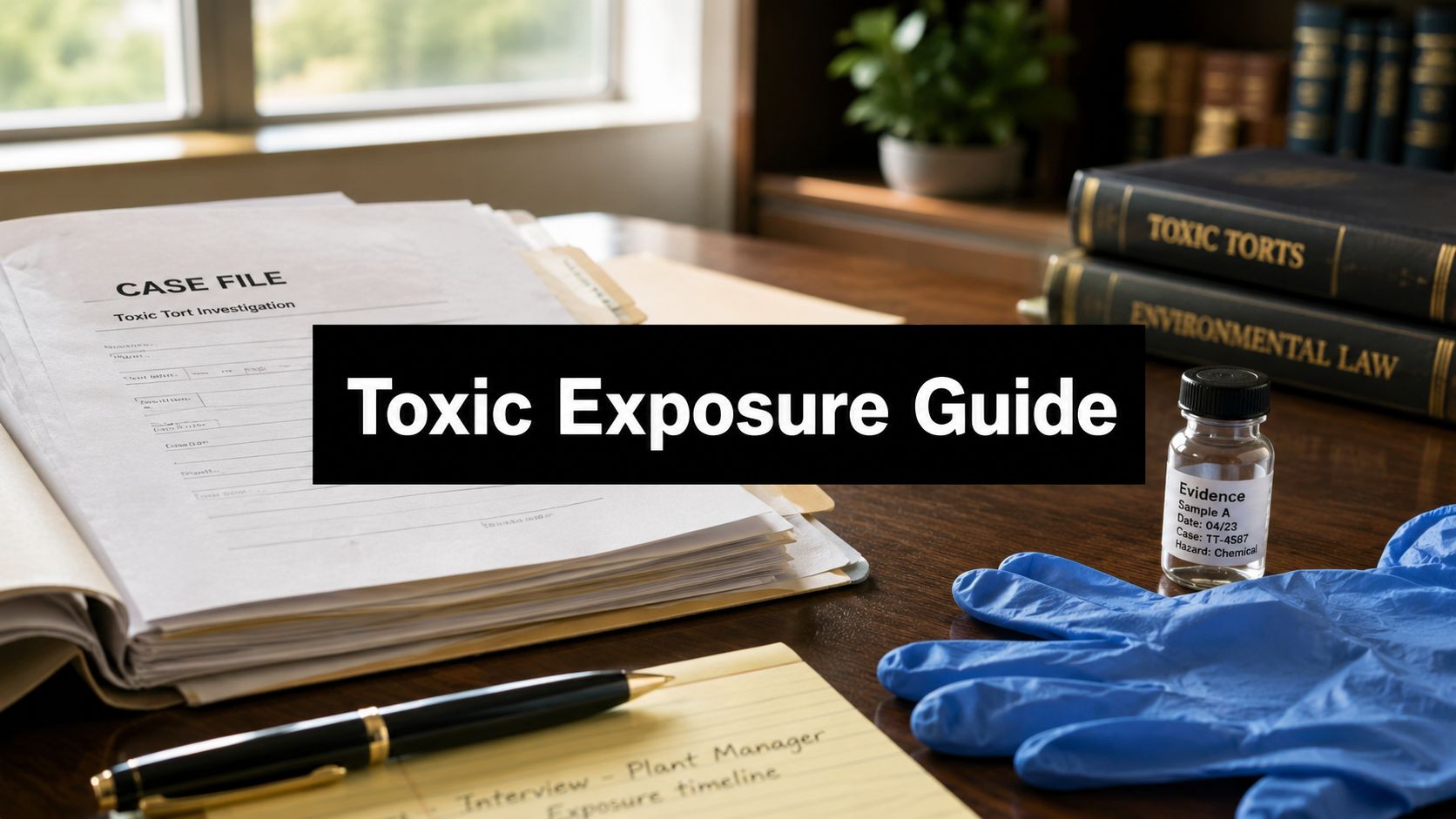
You might be staring at a doctor’s note that still doesn’t answer the underlying question. Your symptoms are real, but the exposure happened months or years ago, maybe at work, maybe in the apartment, maybe through water you trusted every day. That gap is exactly where people start wondering whether anyone can still help, whether the evidence is already gone, and whether the law even sees delayed illness as a valid injury.
A toxic exposure attorney is the lawyer people turn to when the harm is slow, hidden, or medically complicated. These claims usually don’t begin with a clean, obvious accident. They start with a cough that won’t quit, a diagnosis that seems to come out of nowhere, a missing warning label, or a water test that raises more questions than it answers.
When Harm Shows Up Years After the Exposure
A warehouse worker starts getting headaches and shortness of breath long after a job change. A renter learns that mold was behind the breathing problems that kept coming back. A family gets test results after drinking water from the same tap for years, and now everyone wants to know the same thing, what happened, and can it be tied back to the exposure?
That delay is the normal pattern in toxic exposure cases. The law built its modern toxic tort framework around mass injury events like the asbestos litigation wave, which by the early 2000s had produced hundreds of thousands of claims and helped shape the playbook for identifying the exposure source, proving disease causation, and sorting liability across manufacturers, employers, and property owners. That history matters because toxic exposure claims often involve long latency periods, where symptoms may not show up for years or even decades after contact with the hazardous substance. Tor Hoerman Law’s chemical exposure guide
Why delayed symptoms confuse people
People usually expect legal cases to look like car crashes. You see the wreck, you know the date, and the injury follows right away. Toxic exposure doesn’t work that way, and that’s why people feel lost when they first ask whether they have a case.
A delayed diagnosis can make a legitimate claim look uncertain from the outside. The question isn’t whether the harm came on slowly. The question is whether the exposure can be documented well enough to connect the dots. That’s why toxic exposure lawyers spend so much time on records, testing, and expert review instead of just retelling a story.
The first job is not to guess. It’s to reconstruct the exposure history before memory and paperwork fade.
That reconstruction is often what separates a vague suspicion from a claim with real legal traction. The case often turns on medical science, workplace records, and environmental proof, not just on who got hurt and when.
What a Toxic Exposure Attorney Does
A toxic exposure attorney works between two worlds. One side is medicine, where doctors look at diagnosis, testing, dose, and latency. The other side is law, where the questions are who may be responsible, which deadlines apply, and whether the exposure meets the causation standard. If a lawyer cannot connect those two sides, the case can stall before it gets any real traction.
The role is broader than filing paperwork
This kind of lawyer handles claims involving hazardous substances, delayed illness, and hard-to-prove causation. Toxic tort guides describe the proof tools that often matter most, including blood tests, urine screenings, imaging, preserved evidence such as contaminated clothing or product labels, and medical records.
The job is closer to building a scientific record than filling out forms. In many claims, the attorney works with industrial hygienists, toxicologists, and medical professionals who can explain how exposure happens and why it matters. The lawyer may also have to sort through several possible defendants at once, especially when a manufacturer, employer, contractor, or property owner may each share part of the blame.
The settings they handle
The range is wider than many people expect. A toxic exposure attorney may handle cases involving:
- Workplace chemicals, where exposure happens through job duties, poor ventilation, or missing protective gear.
- Contaminated water, where the problem may involve a neighborhood source or a private water supply.
- Mold and building contamination, where a hidden condition inside a home or workplace leads to respiratory problems.
- Lead, pesticides, solvents, and industrial pollutants, where the harm can build gradually and the proof depends on records as much as symptoms.
The source of exposure is not always obvious at first. A missing label, a delayed diagnosis, or an ordinary-looking water bill can become important pieces of the claim because they help show where the exposure came from and when it may have started.
If the exposure source is hard to name, the case usually needs someone who knows how to build that fact pattern from scratch.
Hiring this type of lawyer makes the most sense when the exposure is delayed, the illness may have several possible causes, or more than one party could share responsibility. A general lawyer can help with simple injury claims. A toxic exposure attorney is the one you want when the facts are scientific, layered, and disputed.

A short video can also help you visualize how the case gets built.
Common Types of Toxic Exposure and the Injuries They Cause
People usually recognize their case faster when exposures are grouped by setting instead of by chemistry lesson.
Workplace exposure often starts with routine contact
Workplaces can expose people to asbestos, silica, benzene, and solvents through daily tasks that don’t feel dramatic in the moment. Oil rig litigation materials also describe hydrogen sulfide gas, drilling fluids, chemical additives, and diesel exhaust as examples of hazardous substances that can cause long-term harm.
The injuries tied to these settings often develop slowly. Respiratory disease, neurological damage, and cancer can emerge after repeated contact rather than after one obvious release. That’s why people sometimes miss the connection until a doctor asks about old jobs, safety logs, or the materials used on site.
Homes, buildings, and community settings create a different kind of concern
A person may never work around chemicals and still face exposure through mold, lead paint, contaminated drinking water, or airborne contamination in the community. These cases often feel more confusing because the exposure is woven into ordinary life. People are drinking, sleeping, cleaning, or raising children in the same place where the harm is happening.
The injuries in these settings can include asthma-like symptoms, chemical irritation, developmental concerns, and other chronic conditions. The legal issue is often not a single spill but a repeated pattern that’s hard to see until the medical picture gets clearer.
Consumer products can also be part of the story
Some claims involve tainted cosmetics, cleaning products, or imported goods that carry hidden hazards. In those cases, the injury might be a skin reaction, a burn, or a longer-term illness that only later gets tied back to the product. The common thread is the same. The exposure is often ordinary, and the harm only becomes obvious later.
Latency is what makes these cases hard. The body can be injured long before the legal file starts.
Legal Pathways for Toxic Exposure Claims
Once the exposure is clear, the next question is where the case belongs. That answer changes everything, because the defendant, the available damages, and the filing rules all shift depending on the legal path.
The right pathway depends on who caused the harm
A personal injury claim fits when the injured person is bringing the case for their own illness or injuries. A wrongful death claim fits when the exposure led to a death and the family is pursuing recovery. Workers’ compensation may apply when the exposure happened on the job, though that system is usually narrower than a civil lawsuit.
Environmental and public nuisance claims often come up when a community is affected by contaminated water, soil, or air. Class actions and mass torts are more likely when many people share the same exposure source, though not every toxic exposure case can be handled as a class action. The reason is simple, individual medical histories, exposure levels, and injury patterns can differ too much for one single class-wide outcome.
A few scenarios make the difference easier to see
If a cleaner was exposed to solvents at work and later develops a serious illness, workers’ comp may be part of the picture, but a third-party claim may also exist if a manufacturer or contractor helped create the danger. If a neighborhood discovers contaminated water, the case may point toward environmental litigation rather than an individual workplace claim. If several family members are affected by the same building condition, the facts may support separate claims that share evidence, even if they don’t fit neatly into one class.
One event can support more than one theory. That’s why early intake matters. The wrong label on the case can narrow the options before the evidence is even fully assembled.
How a Toxic Exposure Attorney Proves Causation
Causation is where these cases are won or lost. The proof usually starts with a three-part structure used across toxic tort litigation, first, a hazardous substance existed, second, the claimant was exposed, and third, the exposure caused the injury or illness. California adds a more concrete requirement in some cases, the exposure must be a substantial factor in causing the injury.
The evidence has to line up
That proof rarely comes from one witness or one document. Toxic exposure lawyers usually work with medical records, diagnostic testing, environmental or workplace sampling, preserved physical evidence, and regulatory data. They also rely on expert testimony from toxicologists, industrial hygienists, and medical doctors, because lay testimony usually can’t establish the scientific effect of a dose or the medical link between contact and disease.
A solvent case shows how the pieces fit. The lawyer identifies the chemical, confirms where and when the person was exposed, gathers diagnostic records showing the illness, and then connects those facts to expert analysis about how the exposure pathway could produce the injury. A PFAS water claim follows the same logic, only the evidence may lean more heavily on water records, regulatory findings, and long-term consumption history.
What readers usually miss
The hardest part is not proving that exposure happened in a general sense. The hard part is proving that this exposure, at this level, over this time, caused this condition. That’s why environmental sampling, preserved labels, and old medical records matter so much. They give the attorney a chain of proof instead of a guess.
Practical rule: if the defense can argue that the illness came from something else, the case needs stronger science, not just stronger feelings.
A strong toxic exposure attorney knows how to build that chain before the defense has a chance to break it apart.
California Deadlines and Regulatory Touchpoints
Many toxic exposure cases get lost on the calendar, not on the merits. Someone has a real injury, a real exposure, and real evidence, then misses the deadline that governs the claim.
The deadline question is rarely simple
California personal injury claims generally run under a statute of limitations that depends on when the injury was discovered or should have been discovered, which matters a lot in latent disease cases. Claims against government entities can have shorter deadlines, and workers’ compensation uses its own filing timeline. Toxic exposure cases often require a lawyer to sort through those layers before the injury file even gets fully organized.
Regulations shape the proof too
Workplace exposure can intersect with Cal/OSHA rules, which affect safety procedures and hazard communication. Hazardous sites may involve the Department of Toxic Substances Control, DTSC. Consumer and environmental warnings can also involve the California Office of Environmental Health Hazard Assessment and Proposition 65 notices.
Federal standards matter as well. In April 2024, the U.S. EPA finalized the first national drinking-water limits for several PFAS chemicals, a major marker of how seriously low-level contamination is now being treated. A recent 2024 analysis estimated at least 45% of U.S. tap water samples contained one or more PFAS compounds, which helps explain why drinking-water concerns keep coming up in new claims.
The practical lesson is straightforward. A claim can be strong on facts and still fail if the wrong deadline passes. The sooner a lawyer identifies the exposure date, discovery date, and applicable agency rules, the better the odds that the case survives.
Damages, Settlement Process, and Contingency Fees
People usually want to know two things after the cause becomes clear, what can be recovered, and how long this is going to take. Toxic exposure cases often take longer than routine injury claims because the medical proof and expert review take time to assemble.
The money categories are different, but they all depend on proof
The main damages buckets are economic damages, which include medical bills, lost wages, future care, and property loss, and non-economic damages, which cover pain, suffering, and loss of quality of life. Punitive damages are more limited in California toxic cases and depend on the conduct and facts.
| Damages Category | What It Covers | Supporting Evidence |
|---|---|---|
| Economic damages | Medical expenses, lost income, future treatment, property loss | Bills, wage records, treatment plans, repair estimates |
| Non-economic damages | Pain, suffering, daily disruption, reduced quality of life | Medical notes, testimony, family observations, activity limits |
| Punitive damages | Rare, conduct-based damages where the facts support them | Internal records, warnings, conduct evidence, expert review |
Settlement value is built, not guessed
A settlement usually starts with medical record review and expert opinions on causation. From there, the lawyer prepares a demand package, negotiates with the other side, and decides whether trial makes more sense than settlement. The timeline often stretches because the exposure history, medical science, and multiple defendants all need to be lined up.
Many injury lawyers work on a contingency basis. It is worth asking how fees and case costs work and getting the terms in writing.
Choosing the Right Attorney and Working with LA Law Group
A consultation should feel like an informed conversation, not a sales pitch. The best first questions are simple, and they tell you a lot about whether the lawyer understands toxic exposure cases or just injury law in general.
What to ask before you sign anything
It is worth asking whether the attorney has handled cases involving your kind of exposure, whether they work with experts, and whether they’re prepared for trial if settlement fails. It is also worth asking how they communicate about fees, case costs, and deadlines. If language support matters, it is worth asking about that directly too.
- Similar case experience: Ask about cases involving the same substance, setting, or illness.
- Expert access: Find out whether the lawyer regularly works with toxicologists, industrial hygienists, and medical experts.
- Trial readiness: Ask what happens if the defense refuses to settle.
- Fee clarity: Confirm the contingency-fee structure and how case costs are handled.
- Communication: Ask whether the office can communicate clearly in Spanish if that’s important for you.
How LA Law Group fits into that picture
LA Law Group, APLC offers free initial consultations, direct attorney access, and Spanish-language support for California clients. The firm is based in Chatsworth, and its broader practice in personal injury, civil litigation, and business law can be useful when a toxic exposure case overlaps with property issues, contract disputes, or a small business injury claim. Those connections matter when the exposure problem isn’t isolated to one person or one legal theory.

A few questions come up often. In the first 30 days after suspected exposure, start saving medical records, photos, labels, bills, and any documents that show where the exposure happened. Low-level or chronic exposure can still matter when the science supports a connection and the proof is organized carefully. PFAS drinking-water cases are usually built around exposure history, testing, regulatory data, and the specific defendants connected to the water source.
This article is for informational purposes only and is not legal advice. No attorney-client relationship is created by reading it, and none of the information here should be taken as individualized legal counsel.
If you think a chemical, water, mold, or workplace exposure may be tied to a diagnosis in your life or your family’s life, contact LA Law Group, APLC for a free initial consultation and get the facts reviewed before deadlines, records, or missing evidence make the case harder to prove.
Attorney Advertising. This article is general information, not legal advice, and does not create an attorney-client relationship. Prior results do not guarantee a similar outcome.