
Tripped on Sidewalk: Secure Your Claim in 2026
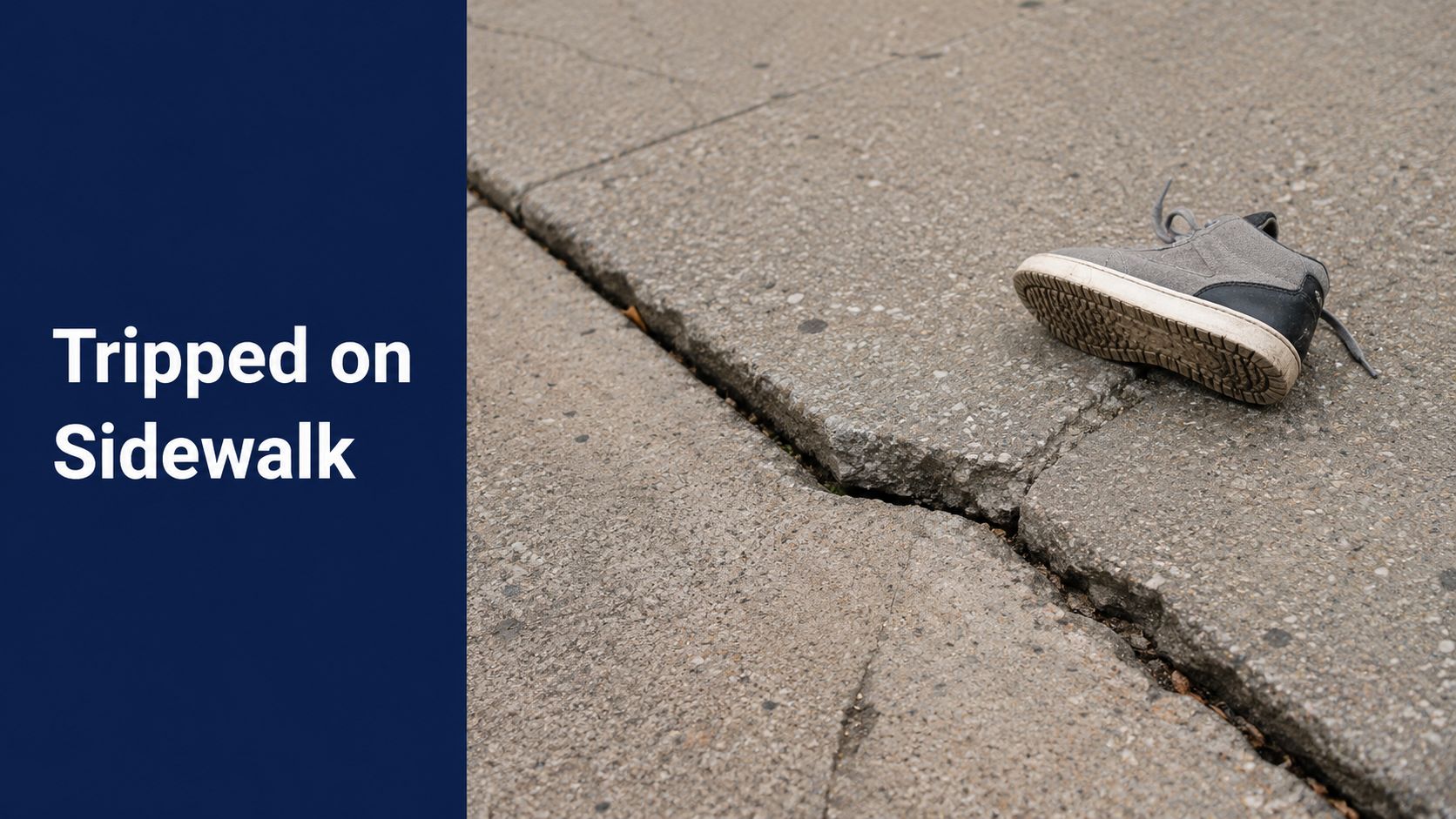
You’re walking, looking ahead, maybe carrying coffee or checking directions, and then your toe catches a lifted slab or broken edge. The next few seconds are a blur. Pain, embarrassment, confusion, and a very practical question all arrive at once: what do I do now?
If you’ve tripped on a sidewalk in California, the first day matters more than is commonly recognized. Good claims often get damaged early, not because the injury wasn’t real, but because the wrong party was reported, the defect wasn’t photographed, or the deadline was misunderstood. California sidewalk cases are full of procedural traps, especially when a public sidewalk may be involved.
This article is for informational purposes and not to be construed as legal advice. No attorney client relationship exists based on the review of this this article and none of the information in this article is legal advice.
Your First Steps After a Sidewalk Fall
The first priority is your body. The second is the evidence that will disappear if you wait.
A sidewalk fall can cause injuries that don’t fully show themselves until hours later. Head injuries, wrist fractures, knee damage, and back injuries can feel minor at first and become much worse by the evening. That’s why immediate medical care matters, both for your health and because the medical record links the fall to the injury.
It’s a serious public safety problem documented in a national study on sidewalk and street pedestrian injuries.

What to do in the first hours
- Check yourself before standing up fast. If you hit your head, feel dizzy, or can’t bear weight, get help immediately.
- Get medical attention the same day if possible. Urgent care, the ER, or your physician is better than “waiting to see.”
- Report the incident without guessing about fault. State where you fell and what happened. Don’t speculate. Don’t say you were clumsy, distracted, or “fine.”
- Photograph the defect before someone fixes it or weather changes it.
- Get names and phone numbers for witnesses.
- Write down the exact address, nearest intersection, and time.
Practical rule: If you can only do two things on day one, get medical care and get photos of the exact spot.
A written report can help, but the content matters. Keep it simple. “I tripped on a raised section of sidewalk in front of this address and fell forward” is useful. A rambling explanation about what you might have done wrong often gets used against you later.
If you need guidance about preserving a possible claim, a legal consultation can help you avoid the most common mistakes.
How to Document Everything to Protect Your Claim
Strong sidewalk cases are built, not assumed. The surface condition, location, witness names, and early medical records are what turn “I fell” into something you can prove.
**Critical evidence includes photographing the hazard and injuries, obtaining a written incident report, and collecting witness contact information.
Photograph the defect like it may disappear tomorrow
That’s not dramatic. It’s realistic.
Sidewalks get patched. Cones appear. Rain changes visibility. Shadows make cracks look smaller or larger. If you’re physically able, take multiple photos right away:
- Wide shots: Show the full sidewalk area, nearby building, curb, and cross street.
- Mid-range shots: Show how the defect sits in the walking path.
- Close-ups: Capture the crack, uplift, hole, or broken edge from more than one angle.
- Photos with context: Include missing warnings, poor lighting, debris, or an obstructed path if those conditions mattered.
- Injury photos: Bruising, cuts, swelling, torn clothing, damaged shoes.
Don’t rely on one dramatic close-up. Defense lawyers often argue that a tight photo hides the surrounding conditions. You want both detail and context.
Get witness information before people leave
Witnesses are often willing to help in the moment and hard to track down later. Ask for:
- Full name
- Phone number
- Email if they’re comfortable sharing it
- A short note about what they saw
If someone saw your foot catch the exact raised slab, that matters. If someone only heard the fall afterward, that can still help, but it isn’t the same.
The best witness is the person who saw both the defect and the fall, not just the aftermath.
Create your own record that same day
Memory changes fast after pain, medication, and stress. Write a short timeline while it’s fresh. Include what shoes you wore, the direction you were walking, lighting conditions, whether you were carrying anything, and exactly where your foot caught.
A simple evidence log helps. Here’s a practical way to organize it:
| Evidence type | What to save | Why it matters |
|---|---|---|
| Scene photos | Defect, address, surroundings | Shows the dangerous condition existed |
| Injury photos | Bruises, swelling, cuts | Documents visible harm early |
| Medical records | Intake notes, diagnosis, imaging | Connects the fall to your injuries |
| Witness details | Names, phones, emails | Supports how the fall happened |
| Incident report | Written notice to owner or manager | Helps establish timely reporting |
In more serious cases, visual presentation becomes part of case strategy, especially when injuries are complex or anatomy matters.
If you’re trying to sort out whether your facts fit a viable case, it helps to review how premises liability claims are generally handled.
Identifying the Responsible Party in California
Determining liability for a sidewalk fall in California is rarely as simple as blaming the city. Responsibility turns on who owned, controlled, repaired, or created the condition, and that answer affects both your legal theory and your deadline.
I see this mistake often. Someone falls in front of a store, assumes the sidewalk is public, and spends weeks dealing only with the business or its insurer. Then the records show a city department maintained that stretch, or a utility company cut into the concrete, or a contractor left an uneven patch. By the time the right target is identified, valuable time may already be gone.

The usual categories of defendants
- A city or other public entity: This applies when the sidewalk is part of public infrastructure and a government agency owned or maintained it.
- A private property owner or tenant: Liability may fall on a business, landlord, or occupier if the dangerous condition was tied to an area they controlled, altered, or were obligated to maintain.
- A utility company: Manhole covers, vaults, grates, access panels, and related repairs often point toward a utility rather than the city.
- A contractor: Recent construction, patchwork, trenching, or temporary walking hazards can place responsibility on the company that performed the work.
The key issue is control. Title records matter, but they do not answer every sidewalk case. A commercial tenant may control the entrance path used by customers. A property owner may have a duty under a local ordinance or lease. A contractor may have created the hazard even if it no longer had crews on site when the fall happened.
That is why a broad California personal injury claim review often starts with identifying every party that touched the area before deciding where the claim should go.
What California plaintiffs still have to prove
California premises liability law still requires proof of the basics. The injured person must show the defendant owned, leased, occupied, or controlled the property, was negligent in its use or maintenance, caused harm, and that the negligence was a substantial factor in causing that harm, consistent with California Civil Jury Instructions on premises liability.
On paper, that sounds clean. In practice, sidewalk cases get fought over notice, control, and whether the defect was dangerous enough to require a fix.
A city may argue it had no notice of the uplifted slab. A store may argue the walkway was outside its leased area. A contractor may argue its work passed inspection months earlier. Defendants also raise the “open and obvious” defense, especially where the crack, height differential, or broken edge is visible in daylight. That defense does not automatically defeat a claim under California law, but it does change how the case must be framed. The question becomes whether the condition still created an unreasonable risk despite being visible, and whether the property owner should have anticipated that pedestrians would encounter it anyway.
The short video below gives a useful general look at how sidewalk injury responsibility can be analyzed.
What helps identify the right defendant
Start with the exact location. Then look for clues tied to control and recent work.
Photos that show the storefront, curb markings, utility covers, painted locate marks, construction signs, or fresh concrete often matter more than a close-up of the crack alone. County parcel maps, city public works records, permits, maintenance logs, and business leases can all become part of the analysis. In stronger cases, the early investigation answers two questions quickly: who had the duty, and who had notice.
Guessing hurts cases. Sending notice to the wrong party can do more than slow things down. In California, it can push a claim into a deadline problem that is hard to fix later.
Navigating Critical California Claim Deadlines
You trip on a broken sidewalk in Los Angeles, go to urgent care, miss work, and assume you have time to sort out the legal side later. That assumption causes problems fast in California. If a city, county, or other public agency may be involved, the short deadline usually controls first.

The deadline that surprises people after a sidewalk fall
California has two very different timing rules that get confused all the time. A claim for money or damages against a public entity generally must be presented within six months of the injury under the California Government Claims Act. A lawsuit against a private property owner is usually governed by the two-year statute of limitations in Code of Civil Procedure section 335.1. The California Courts self-help materials explain that difference clearly in their overview of suing a government agency in California.
That difference changes what a careful lawyer does in the first few weeks.
If there is any real chance the sidewalk was controlled by a public entity, treat the six-month deadline as the working deadline until the records prove otherwise. Waiting to see how your treatment develops can cost you the claim before the medical picture is even clear.
Public claim versus private lawsuit
These deadlines do different jobs, and confusing them is expensive.
| Situation | Key deadline | Why it matters |
|---|---|---|
| Public entity may be involved | 6 months | A written government claim usually must be presented before any lawsuit can be filed |
| Private owner or business | 2 years under CCP § 335.1 | This is the usual filing deadline for a personal injury lawsuit |
| Unclear ownership | Treat as urgent immediately | Delay can close off the public claim while everyone is still figuring out who controlled the sidewalk |
A 311 complaint is not the same as a government claim. An insurance claim is not the same thing either. Neither one should be assumed to satisfy the statutory claim requirement.
That is one of the biggest procedural traps in California sidewalk cases.
Mistakes that turn a valid case into a deadline fight
I see the same problems repeatedly in fall cases involving sidewalks and walkways:
- Waiting for full medical treatment before acting: The claim should be protected first. Treatment can continue while ownership and notice are being investigated.
- Sending notice to the wrong place: A report to a city department, maintenance hotline, or risk office may not meet the legal presentation rules.
- Assuming private ownership without checking: Sidewalk responsibility can involve a city, a county, a transit agency, or another public entity even when a business is nearby.
- Using informal negotiations as a substitute for filing: Settlement talks do not stop the clock.
- Focusing only on injuries: In California, timing and defendant identity are tied together from day one.
There is also a practical trade-off here. Filing early protects the case, but filing carelessly can create avoidable disputes about location, ownership, or how the incident happened. The answer is not delay. The answer is a prompt, accurate claim investigation.
If several weeks have already passed
Act now.
Pull together the incident date, exact location, photos, witness information, medical records, and any report or correspondence you already made. Then get a legal review focused on two issues first: who controlled that stretch of sidewalk, and which deadline applies.
In many sidewalk cases, the first hard question is not case value. It is whether the claim can still be brought at all.
Common Defenses and Realistic Settlement Expectations
Once a claim is opened, the other side starts looking for reasons not to pay. In sidewalk cases, those defenses are often predictable. The important part is recognizing them early and building the record that answers them.
One of the most common California defenses is the open and obvious argument. A property owner says the condition was visible, so there was no duty to warn. California law does recognize that owners may have no duty to warn about hazards that are easily visible to a reasonable person, but the defense is not absolute. An owner may still need to use reasonable care to address a known hazard if it’s foreseeable that someone would encounter it out of necessity, as explained in this analysis of California’s open and obvious doctrine.

How the open and obvious defense is actually used
Defense lawyers don’t just say, “The crack was visible.” They usually build around that point.
They may argue you had a clear line of sight, the weather was fine, the defect contrasted with the sidewalk color, or nothing blocked your view. They may also argue you were distracted, wearing improper footwear, or could have taken a different route.
That’s why context evidence matters so much. A condition may be visible in a still photo and still be unreasonably dangerous in real life. Pedestrian traffic, shadows, glare, a narrow path, the need to approach an entrance, or other obstacles can all change the analysis.
A visible defect isn’t automatically a defensible defect.
Other defenses you should expect
A defendant may also argue:
- Lack of notice: They didn’t know about the condition and shouldn’t have known.
- Trivial defect: The elevation change or crack was too minor to create liability.
- Causation problems: Your injury came from a prior condition, not the fall.
- Comparative fault: You share blame for not seeing or avoiding the defect.
California cases often turn on notice. Did the owner know, or should the owner have known, about the problem long enough that reasonable inspection would have found it? That question is often answered through photos, maintenance records, witness observations, and the physical nature of the defect itself.
What settlement value usually depends on
Clients usually want a number early. That’s understandable, but there isn’t one universal sidewalk-fall value. The same type of fall can produce very different outcomes depending on injury severity, treatment, liability evidence, and whether the defendant is private or public.
Those numbers are only a starting point. What moves a case up or down is usually a combination of facts like these:
| Factor | Lower value tendency | Higher value tendency |
|---|---|---|
| Liability clarity | Unclear defect, poor photos, weak notice | Strong defect evidence, timely documentation |
| Injury proof | Limited treatment, gaps in care | Consistent treatment and objective findings |
| Economic loss | Minimal wage loss or bills | Substantial medical expense or lost income |
| Defense risk | Strong obviousness or trivial defect arguments | Foreseeable hazard and solid rebuttal evidence |
What helps settlement and what hurts it
What helps is consistent treatment, clean documentation, and a theory of liability that makes sense from the start. If the photos show the exact defect, the records show prompt care, and the ownership investigation is solid, the claim becomes easier to evaluate.
What hurts is delay and inconsistency. If there’s no photo of the actual sidewalk condition, no witness information, no timely report, and treatment starts late, the defense gets room to argue that the condition wasn’t serious or the fall wasn’t the cause of the injury.
There’s also a practical point many people miss. Settlement advantage comes from trial readiness, not from demand-letter language. Defendants pay more attention when the file looks organized, documented, and prepared for litigation if necessary.
When and How to Contact LA Law Group for Help
Some sidewalk cases are simple only on the surface. Then the file opens and the underlying issues appear. Who controlled the walkway? Was it a public entity? Has the shorter deadline already started running? Will the defect be called trivial? Is the owner going to argue the condition was open and obvious?
That’s usually the point where legal help stops being optional in practical terms. If your injuries are significant, your medical bills are growing, or the responsible party isn’t clear, get the case reviewed while the evidence is still available.
When it makes sense to reach out
You should consider speaking with counsel quickly if any of these apply:
- You suspect public property involvement: The shorter filing window changes everything.
- The defect has already been repaired: Early photos and investigation become more important.
- You missed work or needed ongoing care: Damages need to be documented carefully.
- The insurer or owner is denying responsibility: That usually means the case needs structured proof, not more informal discussion.
One option in California is LA Law Group, APLC, which offers sidewalk injury consultations and can evaluate issues like public-entity claim timing, liability, and claim filing steps based on the available facts.
What to prepare before the call
You don’t need a polished case package. You do need the basics gathered in one place:
- Incident date and exact location
- All photos and videos
- Medical records or discharge paperwork
- Witness names and phone numbers
- Any report made to a business, landlord, city, or manager
- Insurance correspondence if you’ve received any
Bring facts, not conclusions. A good intake starts with documents, timeline, and location.
A useful consultation should help you answer three questions quickly. Who may be liable, what deadline controls, and what evidence still needs to be preserved before it’s lost.
If you’ve tripped on a sidewalk and you’re unsure what to do next, contact LA Law Group, APLC for a consultation focused on claim deadlines, liability, and evidence preservation. Early guidance can help you protect your rights before a sidewalk is repaired, a witness disappears, or a filing deadline passes.
Attorney Advertising. This article is general information, not legal advice, and does not create an attorney-client relationship. Prior results do not guarantee a similar outcome.