
What Is Car Structural Damage: Identify & Protect Your
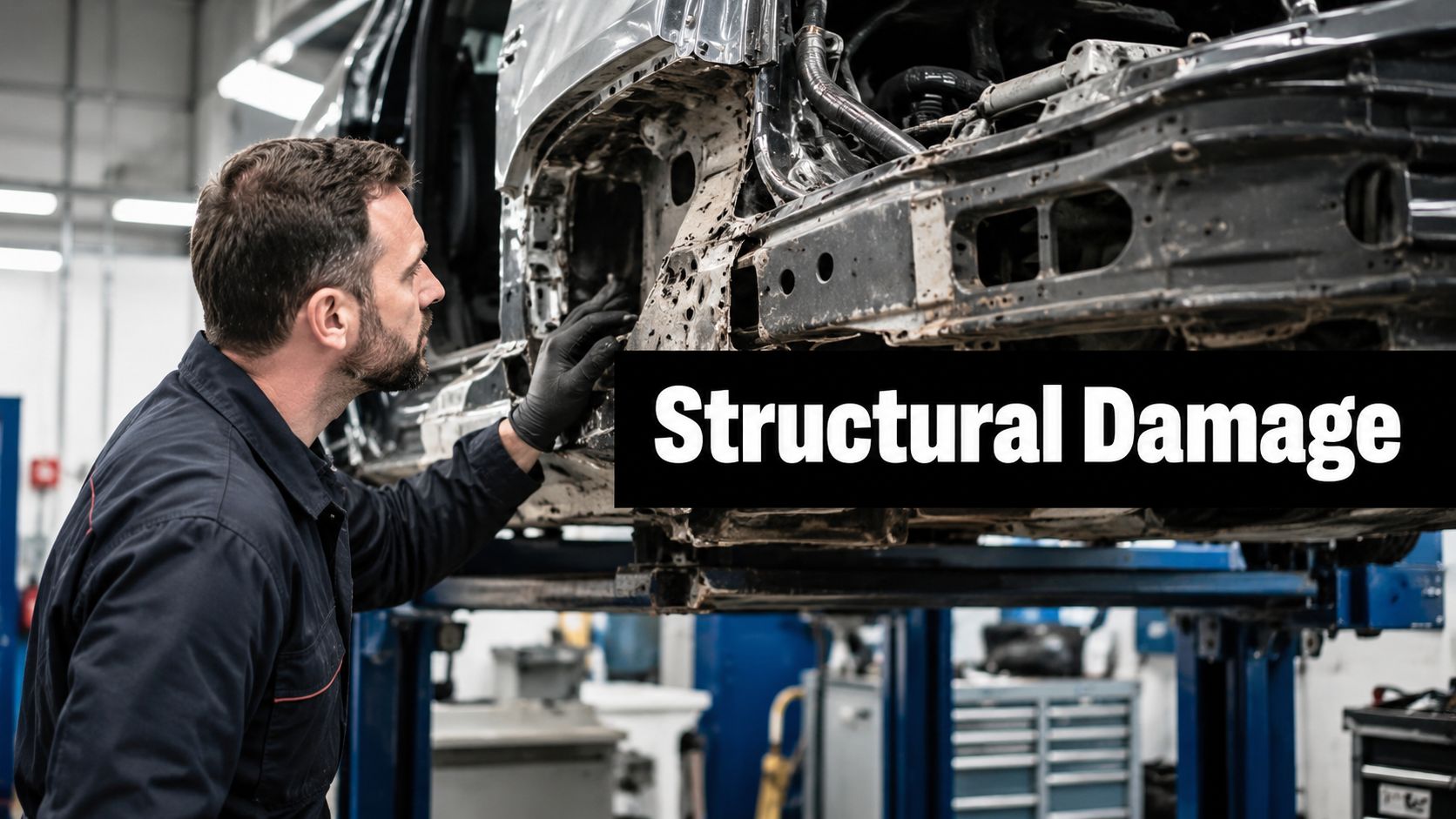
Car structural damage is harm to a vehicle’s core framework or skeleton, not just surface damage, and vehicles with documented structural damage typically lose 15% to 35% of their pre-accident resale value even after quality repairs. If you’re standing in a body shop parking lot, reading an insurance estimate, or trying to figure out whether your car is “fixable” or effectively a financial loss, that distinction matters more than is commonly understood.
After a crash, many people focus on what they can see. A bent fender. A cracked bumper. A door that still opens, so it must be fine. But what is car structural damage really about? It’s about whether the impact reached the load-bearing parts of the vehicle that protect you in a collision and keep the car driving correctly afterward.
That’s where the legal and financial problems usually start. Insurance may pay to repair the car, but a repair bill and a full recovery aren’t the same thing. In California, one of the biggest gaps I see is the difference between the cost to fix the vehicle and the vehicle’s lost market value after the structural history is attached to it.
Beyond Dents and Scratches Understanding Car Structural Damage
If you’ve recently been in a collision, you’re probably asking a practical question, not an academic one. Is my car safe, is it worth repairing, and if insurance pays the body shop, am I still losing money anyway?
Structural damage means harm to the parts of the vehicle that carry load, maintain geometry, and protect occupants in a crash. It affects the car’s framework or “skeleton,” not just visible panels. That’s why it’s distinctly different from scratches, dents, or other cosmetic issues.
A plain way to think about it is this. Cosmetic damage changes how the car looks. Structural damage changes how the car works, how it handles, and how it may perform in another impact.
This article is for informational purposes only and shall not be construed as legal advice; no attorney-client relationship exists based on the review of this article, and none of the information contained herein constitutes legal advice.
Why this matters after an accident
When a crash affects the structure, the issue isn’t limited to repair cost. You may also be dealing with:
- Safety concerns: The car may no longer respond the way it was designed to in a future collision.
- Handling problems: Steering, alignment, and suspension can all be affected by shifted structural points.
- Value loss: Even a well-repaired vehicle often carries a permanent stigma in the resale market.
- Insurance friction: The insurer’s first payment may address repairs but leave out diminished value.
What clients often get wrong
People often assume that if the vehicle looks normal after repair, the problem is over. It usually isn’t that simple.
Practical rule: If the collision reached the car’s skeleton, you need to evaluate both repair quality and financial loss. One without the other leaves many owners undercompensated.
That’s the central issue. A car can be repairable and still be worth materially less. It can also be drivable and still be unsafe unless the structure was properly measured, corrected, and verified.
The Skeleton of Your Vehicle Key Structural Components
A vehicle’s structure works a lot like a human skeleton. Bones don’t just hold shape. They support weight, protect vital areas, and keep the body aligned. A car’s structural components do the same job for the cabin, suspension, steering, and crash protection systems.

The parts that matter most
Structural damage to a car includes harm affecting the chassis, frame rails, pillars, and crumple zones, which are responsible for load-bearing and occupant protection in a collision, as described in EpicVIN’s explanation of structural damage.
Here are the key parts to understand:
- Frame rails: These are the backbone of the vehicle. When they bend or shift, the whole vehicle can lose geometric accuracy.
- Crumple zones: These front and rear areas are designed to absorb collision energy. Once damaged, they may not protect occupants the same way in a later crash.
- Subframe: This lower structural component supports important mechanical systems. If it’s damaged, suspension and alignment problems often follow.
- Pillars: The A, B, and C pillars help support the roof and cabin structure and contribute to occupant protection.
Why unibody damage is serious
Many modern vehicles use a unibody design. That means the body and frame are integrated rather than built as separate major components. In practical terms, an impact in one area can affect connected areas you can’t easily see.
A door may look slightly off. A wheel may sit just a little differently. But those clues can trace back to underlying movement in the structure.
| Structural part | What it does | Why damage matters |
|---|---|---|
| Frame rail | Maintains core stability | Distortion can affect alignment and handling |
| Crumple zone | Dissipates impact energy | Prior damage can reduce future crash protection |
| Subframe | Supports engine or suspension systems | Damage can throw off steering and suspension behavior |
| Pillars | Support roof and occupant space | Weakness here can affect cabin integrity |
What’s really at stake
A structurally sound car isn’t just straighter. It’s designed to manage force in a controlled way.
A vehicle can look repaired and still have a compromised skeleton if the underlying structure wasn’t restored to the right geometry.
That’s why structural damage deserves a different level of attention than ordinary body work. Once you understand the anatomy, the next question becomes how to spot the warning signs before someone tells you “it’s probably fine.”
How to Identify Potential Structural Damage After a Crash
The first signs of structural damage often show up in small inconsistencies. The car may still start, move, and even look acceptable from a distance. But details matter.

Visual clues you can check yourself
Even minor structural misalignment can show up as panel gap inconsistencies of just a few millimeters, and that can signal frame distortion that leads to issues like uneven tire wear and reduced crash protection, as explained in Raw2K’s guide to hidden structural damage.
Start with a slow walk around the vehicle and look for these signs:
- Uneven panel gaps: Check the spacing around doors, the trunk, hood, and rear quarter panels.
- Poor fitment: If a door, hood, or trunk doesn’t close flush, something underneath may have shifted.
- Visible underbody issues: Bends, creases, or cracking near suspension points deserve immediate attention.
- Ride height differences: If one corner sits lower, the problem may be deeper than a damaged strut.
- Tire wear changes: Uneven wear can point to geometry problems that began with the collision.
- Steering pull: If the car drifts or pulls to one side, don’t assume it’s “just alignment.”
Functional signs people ignore too long
Some clues appear only when you drive the car. Others show up days later.
A steering wheel that no longer centers properly matters. So does a new vibration, a creaking sound from the body, or the sense that the vehicle tracks oddly on a straight road. Those are not cosmetic complaints.
For buyers and owners who want a broader screening checklist, VekTracer’s guide to car damage is a useful resource because it helps connect visible clues to prior collision history.
When these signs may mean more than a repair bill
If the damage reaches the frame or unibody, the question can shift from “How much is the shop estimate?” to “Is this now approaching a total loss analysis?” That issue becomes especially important in California. A more detailed discussion appears in this guide on when frame damage equals total loss in California.
If the car drives differently after a collision, trust that change. Drivers know when their vehicle no longer feels right.
A self-check is only a starting point. Structural damage is often hidden, and what you can’t see is the part that creates the biggest safety and valuation problems.
The Professional Diagnosis and Repair Process
A proper structural repair starts with measurement, not guesswork. A technician can’t confirm safety by looking at paint lines and closing a door a few times.

What a qualified shop actually does
Structural damage refers to deformation of the chassis that compromises structural integrity, alignment geometry, or occupant protection, and accurate diagnosis requires an auto body measuring system because the damage often isn’t visible externally. Repairs must be done on a calibrated frame machine and followed by post-repair verification against OEM specifications, as outlined in Celette’s repair guide.
In practical terms, the process should include:
- Initial measurement: The shop compares multiple structural reference points to manufacturer specifications.
- Damage mapping: The technician identifies where the vehicle is out of position and how the distortion affects connected systems.
- Controlled straightening: The vehicle is mounted and pulled on a calibrated frame machine, not “eyeballed” back into shape.
- Verification: After correction, the shop checks whether the structure is back within OEM tolerances.
What doesn’t work
A cosmetic-looking repair is not enough. New panels, fresh paint, and a completed alignment printout don’t prove the structure is correct.
What also doesn’t work is relying on a general mechanic who doesn’t have structural measurement equipment. Frame and unibody repairs are specialized collision work.
What to ask the shop: Did you take pre-repair measurements, did you use a calibrated frame machine, and do you have post-repair verification against OEM specs?
That documentation matters for safety, future resale, and insurance disputes.
A short visual overview helps if you want to see how these inspections are approached in practice:
Hidden damage often extends beyond the frame
Collision damage doesn’t always stay in one category. A car can have structural issues and other concealed problems at the same time. For example, if the accident also exposed the vehicle to flooding or interior moisture, advice from Derek’s for car water damage is worth reviewing because water intrusion can create a second layer of damage that owners and insurers may initially miss.
The bottom line is simple. Proper structural repair is a measurement-driven process. If the shop can’t show you how they confirmed the vehicle returned to OEM specifications, you should be cautious about assuming the job was done correctly.
Navigating Insurance Claims and Diminished Value
Many owners often find themselves blindsided. The insurer approves repairs, the body shop finishes the work, and everyone acts as if the claim is resolved. But a structurally damaged vehicle often carries a separate economic loss that survives the repair.

Repair cost and total loss aren’t the whole story
Vehicles with documented structural damage typically suffer a 15% to 35% reduction in resale value even after high-quality repairs, and insurers evaluate repair cost plus salvage value against fair market value when analyzing whether a vehicle is effectively a total loss, according to this discussion of structural damage and car value impact.
That matters because insurance often focuses first on the repair estimate. But if the vehicle history now reflects structural damage, the market may still treat your car as less desirable than an identical clean-title vehicle.
For a luxury vehicle worth $100,000 before the crash, the documented depreciation described above can mean a loss of $15,000 to $35,000, even after good repairs, as noted in the same Auto Praise analysis of structural damage and value loss.
What diminished value means in practice
Diminished value is the difference between what the car was worth before the collision and what it’s worth afterward, once the accident and structural history follow it.
That loss exists because buyers react to the history report, the nature of the damage, and concerns about future reliability and crash performance. The insurer’s repair payment usually does not erase that market stigma.
A useful next step if you’re dealing with this issue is to understand the separate claim itself. This overview of a California diminished value claim is a good place to start.
The gap California drivers need to watch
In California, one overlooked issue is the space between a “repairable” vehicle and a vehicle that is economically a total structural loss once value loss is included. That’s where people often leave money on the table.
Consider these moving parts:
- Repair estimate: What the body shop says it costs to restore the car.
- Salvage value: What the damaged vehicle may still be worth in salvage.
- Fair market value: What the vehicle was worth before the crash.
- Diminished value: What the repaired vehicle has lost because of its structural history.
A car can be repairable from the insurer’s standpoint and still represent a bad financial outcome for the owner.
Why claims stall here
Insurers don’t always volunteer diminished value. Many people don’t know to ask. Others assume a clean-looking repair means there’s no additional claim.
That’s usually where a dispute begins. The owner sees a repaired car with a damaged history. The insurer sees a closed repair file. Those are not the same outcome.
Protecting Your Rights and Safety Your Next Steps
Once structural damage enters the picture, speed matters. Not because you should rush into a settlement, but because the evidence is strongest early and the wrong assumptions harden fast.
Structural damage is recognized by CARFAX and industry standards as harm affecting the vehicle’s chassis or underlying structure, including a unibody frame, not just panel damage, as described in Sunroad Collision Center’s discussion of CARFAX structural damage.
A practical action plan
If your car may have structural damage, take these steps:
- Stop treating it like ordinary body damage. If the skeleton is involved, the issue is larger than appearance.
- Get the right diagnosis. Use a collision facility that performs structural measurement and can document OEM-based verification.
- Keep every record. Save photos, estimates, repair orders, supplements, alignment reports, and communications with the insurer.
- Ask whether diminished value has been evaluated. Don’t assume the repair payment included it.
- Review whether the total loss analysis is complete. A repairable label doesn’t always mean the insurer’s valuation is fair.
- Pay attention to injuries. Structural damage often accompanies a significant impact, and delayed pain complaints are common after these collisions.
When to push back
You should be especially careful when any of these happen:
- The insurer moves too quickly: A fast repair approval can close off deeper valuation questions if you don’t raise them.
- The shop can’t show documentation: If there’s no measurement record, the repair file may be incomplete.
- The resale loss is obvious: If your car now carries a structural history, market value may have changed whether the insurer acknowledges it or not.
If you believe the insurer undervalued your vehicle, this resource on how to challenge your total loss offer can help you understand the appraisal side of the dispute.
When an attorney becomes necessary
An attorney is often most useful when the file stops being just a repair question and becomes a compensation question. That includes cases involving:
- Diminished value disputes
- Total loss disagreements
- Serious crash injuries
- Liability arguments between drivers or carriers
- Incomplete compensation for both property damage and bodily injury
If you’re still in the immediate aftermath of a crash, this checklist on what to do after a car accident in California is a practical starting point.
The safest path is usually the documented path. Get the measurements, get the records, and get a clear valuation before you sign off on a settlement.
Structural damage changes more than sheet metal. It can alter the car’s future safety, its market value, and the legal posture of your claim. If you only focus on the repair invoice, you may miss the part of the loss that follows the vehicle long after it leaves the shop.
If you’re dealing with structural damage, a disputed total loss, or a diminished value claim after a California crash, LA Law Group, APLC can help you assess what compensation may still be missing. The firm offers practical guidance for accident victims who need help protecting both their legal rights and their financial recovery.
Attorney Advertising. This article is general information, not legal advice, and does not create an attorney-client relationship. Prior results do not guarantee a similar outcome.