
Where Is Lane Splitting Legal A Guide for US Motorcyclists
Disclaimer: This article is for informational purposes only and is not to be construed as legal advice. No attorney-client relationship exists based on the review of this article, and none of the information provided constitutes legal advice.
So, let’s get right to it: where is lane splitting legal? This is one of the most common questions we hear, and the answer is more complex than a simple “yes” or “no.”
For years, California stood alone as the only state where riders could legally move between lanes of slow or stopped traffic. But the tide is slowly turning. Several other states, like Arizona, Utah, and Montana, have now legalized a more limited version of this practice, often called “lane filtering.”

A Patchwork of Laws Across the U.S.
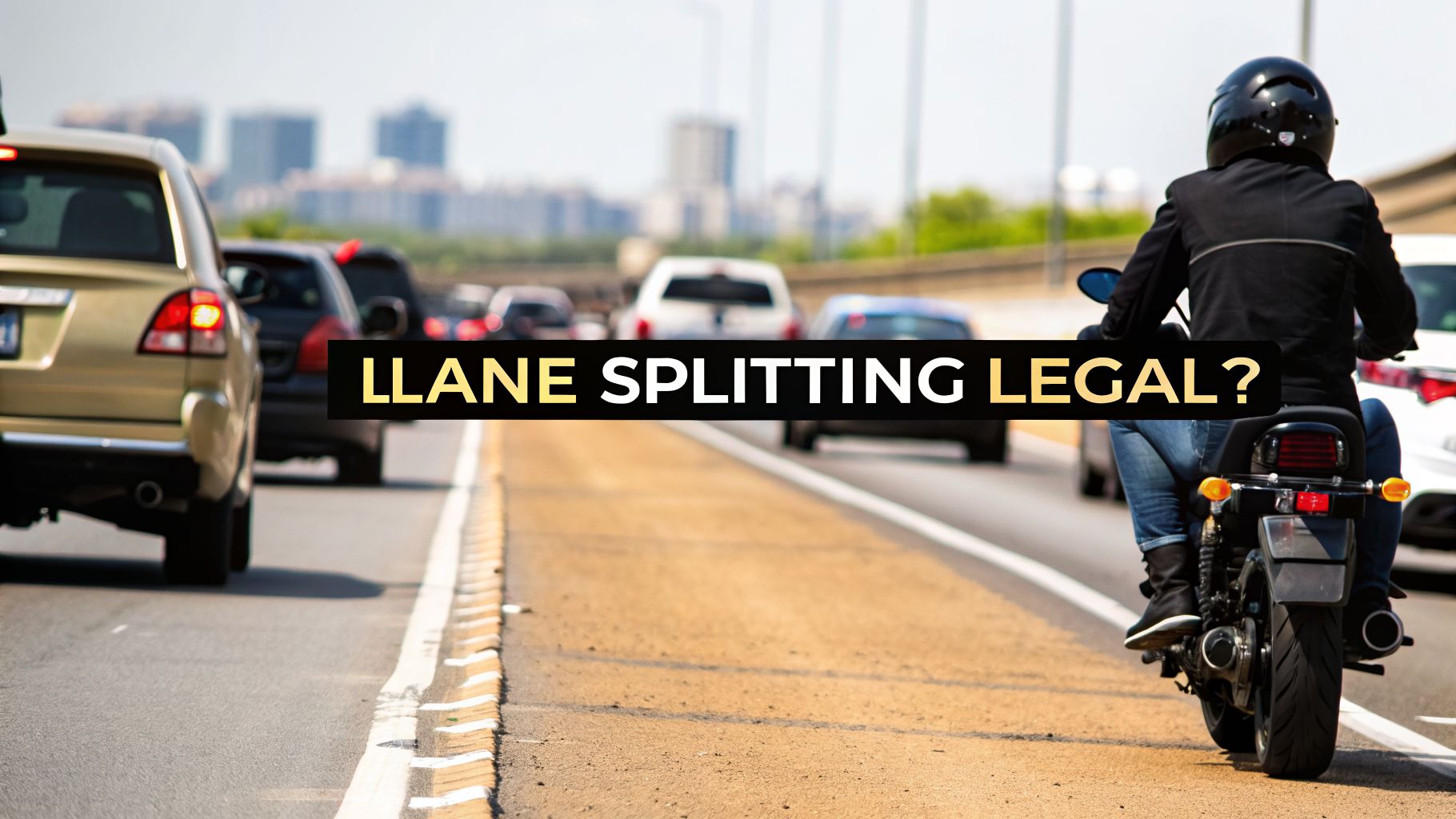
For any rider stuck in gridlock, that gap between cars can look mighty tempting. But using it is a practice known as lane splitting, and its legality is all over the map. This creates a confusing and often risky situation for motorcyclists who cross state lines.
Disclaimer: This article is for informational purposes only and is not to be construed as legal advice. No attorney-client relationship exists based on the review of this article, and none of the information provided constitutes legal advice.
Before we get into the nuances of lane splitting, it is worth having your basics covered. Every rider needs to meet their home state’s licensing laws, no exceptions.
The landscape of American motorcycle law changed in 2016 when California enacted Assembly Bill 51. The law, effective January 1, 2017, added Vehicle Code Section 21658.1, which defines lane splitting and authorizes the California Highway Patrol (CHP) to develop educational guidelines.
A UC Berkeley study (Rice, Troszak and Erhardt, SafeTREC, 2015) looked at 5,969 motorcyclists involved in collisions in California, 997 of whom were lane splitting. Among motorcyclists in collisions, those who were lane splitting were less likely to be rear-ended or to suffer some injuries than those who were not. The study was observational and does not show that lane splitting causes these differences.
A few other states have since adopted lane filtering, a more restricted version of lane splitting.
To help you keep track, the table below gives a quick overview of where things stand in a few key states.
US Lane Splitting & Filtering Laws At A Glance
This table provides a snapshot of the laws for lane splitting and lane filtering in several key states as of 2026. Remember, laws can and do change, so always check the most current regulations for the state you’re riding in.
Disclaimer: This article is for informational purposes only and is not to be construed as legal advice. No attorney-client relationship exists based on the review of this article, and none of the information provided constitutes legal advice.
| State | Lane Splitting Status | Lane Filtering Status |
|---|---|---|
| California | Legal | Legal |
| Arizona | Illegal | Legal (only between stopped vehicles, posted speed limit of 45 mph or less) |
| Utah | Illegal | Legal (only between stopped vehicles, posted speed limit of 45 mph or less) |
| Montana | Illegal | Legal (20 mph or less, passing vehicles that are stopped or moving 10 mph or less) |
| Oregon | Illegal | Illegal (Legislation has been proposed) |
| Texas | Illegal | Illegal |
As you can see, the rules vary quite a bit. What’s perfectly legal in California could get you a ticket—or worse—in a neighboring state. It’s on every rider to know and follow the local laws to the letter.
Lane Splitting vs. Lane Filtering: What’s the Difference?
Disclaimer: This article is for informational purposes only and is not to be construed as legal advice. No attorney-client relationship exists based on the review of this article, and none of the information provided constitutes legal advice.
Riders and drivers throw the terms “lane splitting” and “lane filtering” around all the time, often using them interchangeably. But in the eyes of the law—and from a practical safety standpoint—they are worlds apart. Getting this distinction right is the first step for any motorcyclist trying to ride safely and legally.
A simple way to picture the difference is to think about the traffic around you. Is it moving, or is it stopped?
Lane splitting is when a motorcycle rides between lanes of moving traffic. Think of it like a nimble speedboat navigating between two larger, slower-moving ships on the open water. This is what you see on freeways or highways where traffic is flowing, even if it’s crawling along. It demands a high level of skill because everything around you is in motion.
On the other hand, lane filtering is when a motorcycle moves between lanes of stopped or nearly stopped traffic. This is more like a kayaker paddling between anchored boats in a quiet harbor to get to the front of the pack. You’ll typically see this at red lights or in total gridlock.
Why The Legal Distinction Is So Important
The difference between these two actions is precisely why some states have outlawed lane splitting but have given the green light to lane filtering. From a lawmaker’s perspective, filtering is seen as a much lower-risk move. When traffic is at a standstill, the speed difference between the bike and the cars is tiny, dramatically cutting down the risk of a serious crash.
At its heart, the legal difference comes down to one thing: vehicle speed. Lane splitting happens alongside moving traffic. Lane filtering is strictly for stopped or barely-moving vehicles, which makes it a much easier pill for cautious states to swallow.
Take states like Arizona and Utah, for example. They now allow riders to filter up to the front of an intersection when cars are stopped. But that’s it. They do not permit splitting between cars cruising at 40 or 50 mph on the highway.
This legal detail is everything. Knowing the specific rules where you ride doesn’t just keep you out of trouble with a traffic ticket—it helps other drivers understand what you’re doing, which can reduce confusion and those frustrating road rage moments. Before you head out, always double-check the local laws, paying close attention to any posted speed limits or road-type restrictions that apply.
A State By State Breakdown of US Lane Splitting Laws
Disclaimer: This article is for informational purposes only and is not to be construed as legal advice. No attorney-client relationship exists based on the review of this article, and none of the information provided constitutes legal advice.
Trying to make sense of US motorcycle laws can feel like navigating an obstacle course. While things are slowly changing, for now, only a handful of states have officially given the green light to the practice in one form or another.
This jumbled legal landscape means riders have to be extra careful. Before we jump into the state-by-state rules, it helps to understand the bigger picture. You can learn more about the broader legal context of lane splitting in our detailed guide, which answers a lot of common questions riders have.
The Pioneers of Legalization
California is the only state whose vehicle code defines lane splitting. Assembly Bill 51 added Section 21658.1 to the Vehicle Code, effective January 1, 2017, and authorized the California Highway Patrol (CHP) to develop educational guidelines. The CHP’s current safety tips include:
- Danger increases at higher speed differentials between your motorcycle and surrounding traffic.
- Danger also increases at higher overall traffic speeds.
- It is typically safer to split between the two leftmost lanes.
A few other states have adopted more limited rules.
States Adopting Lane Filtering
While California gives a thumbs-up to full lane splitting, other states have chosen to legalize only lane filtering. This is a really important difference. Filtering is usually restricted to specific situations, like when traffic is stopped, and at much lower speeds.
The main thing to remember is that lane splitting happens in moving traffic, while lane filtering is for getting through stopped or very slow-moving cars. Because it’s a lower-risk move, it’s been easier for lawmakers to get behind.
Here’s a quick look at how other states have set up their own rules:
- Arizona: Allows lane filtering on roads where the speed limit is 45 MPH or less. Bikers can go up to 15 MPH while filtering between stopped cars.
- Utah: Also allows filtering on roads with a speed limit of 45 MPH or less. Riders here also have to keep it at or below 15 MPH while doing it.
- Montana: Lets riders make a “reasonable and prudent” pass of stopped or slow-moving traffic, but not at speeds over 20 MPH.
The Gray Area and Explicit Bans
In most states, lane splitting and filtering are either flat-out illegal or stuck in a legal gray area. States that don’t have a specific law one way or the other usually fall back on general traffic laws that say you have to stay in your lane, which effectively bans the practice.
This kind of ambiguity can be a real headache, leading to spotty enforcement. One cop might not give it a second look, while another could write you a ticket. Because of this, unless a state has passed a law that explicitly allows it, you should always assume lane splitting is illegal. It’s just not worth the risk.
Lane Splitting Laws Around The World
Disclaimer: This article is for informational purposes only and is not to be construed as legal advice. No attorney-client relationship exists based on the review of this article, and none of the information provided constitutes legal advice.
While lane splitting might feel like a hot-button issue here in the States, it’s a totally normal, everyday part of the commute in many places around the globe. Looking at the global perspective really helps put the American debate in context.
When you see how other nations handle lane splitting, you get a glimpse into different driving cultures and traffic management priorities. In many crowded cities, motorcycles and scooters aren’t just for fun; they’re essential transportation. In those places, splitting and filtering are simply woven into the fabric of how people get around.
A Different Approach in Europe
The European Union, for instance, has a much different take on this than the U.S. Most EU countries either have laws that explicitly allow lane splitting or simply tolerate it as common practice. The Netherlands is a great example—filtering through slow or stopped traffic is not only accepted but backed by laws that often put the responsibility on car drivers to watch out for bikes in a collision.
This legal mindset makes sense when you consider how many motorcycles are on the road in these countries. Instead of seeing it as a reckless stunt, they view lane splitting as a logical way to keep traffic flowing and make things a little less congested for everyone. You can dig deeper into these differences by reading about lane splitting practices worldwide.
Think of it this way: by letting motorcycles filter through traffic, cities can essentially boost the capacity of their roads without pouring a single drop of new concrete. It’s a traffic management strategy that uses the small size of a motorcycle to everyone’s advantage.
Common Practice in Asia and South America
It’s a similar story in the massive urban centers of Asia and South America. In cities like São Paulo, Brazil, or Bangkok, Thailand, lane splitting is the absolute norm. It’s just an unspoken rule of the road that helps millions of commuters survive some of the most intense traffic jams on the planet. For these riders, it’s all about efficiency.
Rules and attitudes vary by country, and some places have integrated lane splitting or filtering into everyday traffic.
A quick look at various countries shows just how common this practice is.
International Lane Splitting Legality
| Country/Region | Legal Status | Common Practice Notes |
|---|---|---|
| Most of Europe | Widely legal or tolerated (e.g., UK, France, Spain) | Filtering is very common, especially in urban areas. Some countries have specific rules for speed. |
| Australia | Legal in some states (e.g., NSW, Queensland) | Called “lane filtering” and is typically permitted at low speeds (under 30 km/h or about 18 mph). |
| Brazil | Legal | Known as the corredor, it’s an essential part of navigating heavy traffic in major cities. |
| Taiwan | Legal | Allowed for motorcycles to navigate between cars, reflecting the high density of scooter usage. |
| Canada | Illegal | Lane splitting is prohibited nationwide, similar to the majority of U.S. states. |
Rules and practices vary widely from country to country.
What The Data Says About Lane Splitting Safety
Disclaimer: This article is for informational purposes only and is not to be construed as legal advice. No attorney-client relationship exists based on the review of this article, and none of the information provided constitutes legal advice.
When you strip away the emotions and arguments about lane splitting, the big question always comes down to a single word: safety. Is it a dangerous stunt or a smart way to navigate traffic? For riders and drivers alike, we need to look past gut feelings and see what the real-world data tells us.
A 2015 UC Berkeley study (SafeTREC) looked at motorcyclists involved in collisions in California. Among motorcyclists in collisions, those who were lane splitting were less likely to be rear-ended than those who were not. The study was observational and does not show that lane splitting causes fewer injuries.
The study reported that lane splitting appeared relatively safe in traffic moving at 50 MPH or less, when the motorcyclist was no more than 15 MPH faster than other vehicles.
Balancing The Risks And Rewards
Now, this doesn’t mean lane splitting is a risk-free activity. Of course not. It introduces its own set of dangers that every rider needs to anticipate and manage. The most frequent hazards are drivers making sudden lane changes without looking or opening their doors into the path of a filtering motorcycle.
One finding from the research is that speed matters. Injury risk rose as the speed difference between the motorcycle and surrounding traffic grew.
A Global Perspective On Safety
The debate here in the U.S. looks a lot different when you zoom out to a global view. Across the world, lane splitting is widely accepted as a normal and practical part of managing traffic.
Some countries in Europe, Asia and South America permit some form of lane splitting or filtering, but rules vary.
What To Do After A Lane Splitting Accident
Disclaimer: This article is for informational purposes only and is not to be construed as legal advice. No attorney-client relationship exists based on the review of this article, and none of the information provided constitutes legal advice.
If you’re involved in a collision while lane splitting, the immediate aftermath is often chaotic and confusing. What you do in those first few moments is crucial for both your health and your legal rights. Your absolute first priority is safety.
If you can, move yourself and your motorcycle out of the flow of traffic to avoid a secondary crash. Next, call 911 right away. Get police and paramedics on the way, even if you think you feel fine. Adrenaline is a powerful pain-masker and can hide serious injuries that might not show up for hours or even days.
Documenting The Scene And Protecting Your Rights
While waiting for help to arrive, switch into evidence-gathering mode. If you’re physically able to, start taking photos and videos of everything. You’ll want to capture the scene from multiple angles, showing the final positions of the vehicles, the damage to your bike and the other car, any skid marks on the road, and the general road conditions. Don’t forget to get shots of any relevant traffic signs or signals.
This next part is critical: do not admit fault. Don’t apologize or say anything that could be interpreted as taking the blame. This applies to the other driver, any witnesses, and even the police. Just stick to the simple, objective facts of what happened from your point of view.
Insurers may argue that because you were lane splitting, you hold a certain percentage of the fault. That is not always the case, especially if the other driver was negligent.
Once you’ve spoken with the police and gathered your evidence, get a complete medical evaluation as soon as possible. Many of the same steps apply to both car and motorcycle accidents, so for a more detailed checklist, see our guide on what to do after a car accident.
Why You Need An Attorney
Trying to navigate the claims process after a lane splitting accident is loaded with unique challenges. The practice is still widely misunderstood by the public, insurance adjusters, and even potential jurors.
An attorney may be able to help you understand the claims process:
- Investigate the Crash: Depending on the case, this may include gathering police reports, locating witness statements, and involving accident reconstruction experts if needed.
Frequently Asked Questions About Lane Splitting
Disclaimer: This article is for informational purposes only and is not to be construed as legal advice. No attorney-client relationship exists based on the review of this article, and none of the information provided constitutes legal advice.
Riding a motorcycle comes with its own set of rules and nuances, and lane splitting is one of the most talked-about topics. When you’re out on the road, questions inevitably pop up. Here are some straightforward answers to the common questions we hear from riders.
Is It Legal To Lane Split Past A Police Car?
Technically, yes—but you need to be extremely careful. In a state where lane splitting is legal, the law doesn’t make a special exception for law enforcement vehicles. You can legally and safely filter past a police car just like any other vehicle.
However, the reality on the ground can be different. An officer might not expect you to split past them, and any move they consider unsafe could get you pulled over. Your best bet is to use extreme caution and good judgment. If you have any doubt, it’s safer to just hang back.
What Is A Safe Speed For Lane Splitting?
While the exact rules vary, the California Highway Patrol (CHP) has published educational safety tips. They do not set numeric limits. The tips note that danger increases at higher speed differentials and higher overall speeds. A UC Berkeley study found lane splitting appeared relatively safe when traffic was moving at 50 MPH or less and the motorcyclist was no more than 15 MPH faster than other vehicles.
A small difference in speed gives both the rider and other drivers more time to react.
Always let the current road conditions be your guide. If traffic is jerky or drivers seem distracted, slow down or merge back into a lane.
Will My Insurance Cover A Lane Splitting Accident?
If you get into an accident while legally lane splitting in a state that permits it, your insurance should treat it like any other crash. Fault will be determined, and coverage will apply based on your policy.
But there’s a catch. If the insurance company can argue you were riding recklessly—say, by going way too fast or splitting in an unsafe situation—they might claim you were partially at fault. This can seriously complicate your claim and reduce your payout.
Disclaimer: This article is for informational purposes only and is not to be construed as legal advice. No attorney-client relationship exists based on the review of this article, and none of the information provided constitutes legal advice.
If you’ve been injured in a motorcycle accident, trying to navigate the legal aftermath on your own is a tough road. Contact us today for a consultation at https://www.bizlawpro.com.
Attorney Advertising. This article is general information, not legal advice, and does not create an attorney-client relationship. Prior results do not guarantee a similar outcome.